Eighteen months ago, the Inter-American Institute for Cooperation on Agriculture (IICA) and the European Union (EU) signed a two million Euro contract for a project called “Productivity Enhancement of Banana Farms through integrated soil fertility management in the Banana Belt Area of Belize.” Implementation started a year and a half ago with the goal to teach banana farmers about integrated soil fertility management; increase the soil fertility in banana sector to improve productivity; and to enhance the capacity of UB’s micro-propagation lab to improve production of banana plantlets. The Inter-American Institute for Cooperation on Agriculture and the Banana Growers Association led the implementation on the ground through capacity building; infrastructure development; field demonstrations; soil conditioning and other activities. It is expected that the new practices introduced will have far reaching effects on the banana industry, primarily increasing the production of bananas. Although some farms are already seeing the benefits of some of the project.
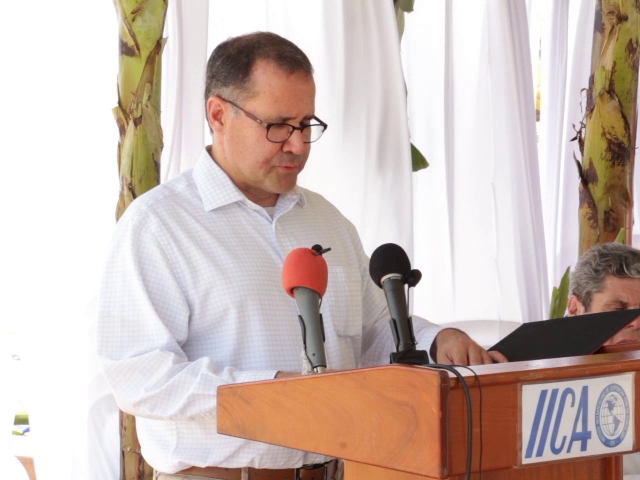
IICA’s Deputy Director General, in his speech said “This is exactly the kind of project that I have been pushing for at IICA. I think it is important for ourselves, important for international donors and the governments to bring innovation directly to the farm. It includes the participation of the government, the academia and the private sectors working together to improve a specific sector. This is what we should be doing to have a tangible impact on productivity and economic development.”
While Mr. Nicolaus Hansmann, Team Leader at the EU Technical Office in Belize said “This project has been executed in eighteen months. All the activities have been delivered, effectively delivered. I think this new set up of project management has proven to be very successful.”
One of the project components included the upgrading of UB’s Micro-propagation Lab with equipment, water and security systems; as well as training for lab techs. And for the first time in the history of the banana industry, three thousand five hundred meristems were produced in Belize inside the lab. Two plots were planted with the local meristems and they were successfully harvested a few weeks ago. The partners say the plants produced bananas that are comparable to imported plantlets. Now, UB hopes to produce up to one hundred thousand plantings for the next banana crop.
The President of UB, Dr. Clement Sankat during his speech said “What this project has done is to build a capacity in Belize; a Belizean capacity to produce banana plants for the industry. And that is, to my mind, the biggest plus and gain. The University of Belize commits itself to selling those plants to the farmers at a competitive but fair price and we are prepared to work with you to ensure that happens. We are prepared to move over time from about one hundred thousand – seventy-five thousand plants to about five hundred thousand plants in five or six years but let us begin next year. Let us produce a hundred thousand and the next year another hundred thousand.”
More information: