The summit will bring together different experts and industry leaders to discuss and analyze key issues related to sustainable fuels. The academic agenda will include, among other things, a conference on the evolution of SAF prices compared to those of fossil fuels and trends in raw materials.
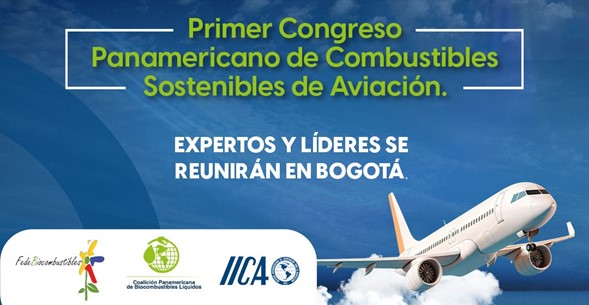
Bogotá/ San José, 22 July 2024 (FEDEBIOCOMBUSTIBLES/IICA) – On 31 July, Bogotá will host the First Pan-American Summit on Sustainable Aviation Fuels, an event organized by the Colombian Federation of Producers of Renewable Energy for Mobility (Fedebiocombustibles), the Pan-American Liquid Biofuels Coalition (CPBIO) and the Delegation of the Inter-American Institute for Cooperation on Agriculture (IICA) in Colombia.
The summit will be held at a key moment for the country. According to the Federation, Colombia is expected to have its first sustainable aviation fuel (SAF) plant this year, which will produce 50 million gallons of SAF and allow for reducing CO2 by 60 million tons. By producing the next generation of biofuels, Colombia would become a leader in sustainable mobility.
“The First Pan-American Summit on Sustainable Aviation Fuels represents a milestone for our industry and will serve as a catalyst for the development of sustainable solutions in the aviation sector. Considering the goal of decarbonizing the sector by 2050—to achieve zero emissions—this event will provide authorities, experts and industry leaders throughout the region with an opportunity to engage in collaboration and exchange knowledge”, remarked Carolina Rojas, President of Fedebiocombustibles.
The summit will bring together different experts and industry leaders to discuss and analyze key issues related to sustainable fuels. The academic agenda will include, among other things, a conference on the evolution of SAF prices compared to those of fossil fuels and trends in raw materials.
The event will also include a conference on technological pathways, with special emphasis on production costs and performance associated with the development of new biofuel technologies. The companies participating in this segment will be TOPSOE, Honeywell, Lanzajet and Axens.
There will also be a presentation on the Carbon Offsetting and Reduction Scheme for International Aviation (CORSIA), which will explain how this scheme promotes the use of SAF and its sustainability criteria.
“SAF production and consumption will be key to reducing greenhouse gas emissions in aviation, a sector that is very difficult to decarbonize and in which hydrogen or electric propulsion will be marginal. The summit will seek to link aviation to the terrestrial biofuels sector and its value chain, given that, in the future, they will need to be integrated”, explained Agustín Torroba, IICA Biofuels Specialist and Technical Secretary of the CPBIO.
One of the highlights of the summit will be a panel discussion on the terrestrial biofuels value chain and its outlook as it relates to SAF. It will be moderated by Agustín Torroba and will include the participation of distinguished experts: Victor Castro, Executive Director of CARBIO (Argentina); Carolina Rojas, President of Fedebiocombustibles; Alvaro Lorenzo, General Manager of ALUR (Uruguay); Flavio Castellari, Executive Director of APLA (Brazil); and Juan Diaz, Regional Consultant at the U.S. Grains Council.
Fedebiocombustibles is celebrating its twentieth anniversary. Over the course of two decades, the sector has worked tirelessly to develop and consolidate biofuels in Colombia. During this time, the organization has been a driving force for rural development, fostering the generation of employment and opportunities in the country’s agricultural areas. It has also actively contributed to diversifying the national energy matrix, reducing its dependence on fossil fuels and strengthening Colombia’s energy security.
The Inter-American Institute for Cooperation on Agriculture (IICA) is the specialized agency for agriculture of the Inter-American System that supports the efforts of Member States to achieve agricultural development and rural well-being. The Institute provides cooperation services through close and permanent work with its 34 Member States and has broad experience in areas such as technology and innovation for agriculture, agricultural health, food safety and quality, international agricultural trade, family farming, rural development, natural resource management and the bioeconomy.
Additional information:
comunicaciones@fedebiocombustibles.com
comunicacion.institucional@iica.int