The document compiles the technical perspectives of 13 experts on the positive impact this production activity has not only on food and nutritional security, but also on the socioeconomic and environmental development of the Americas.
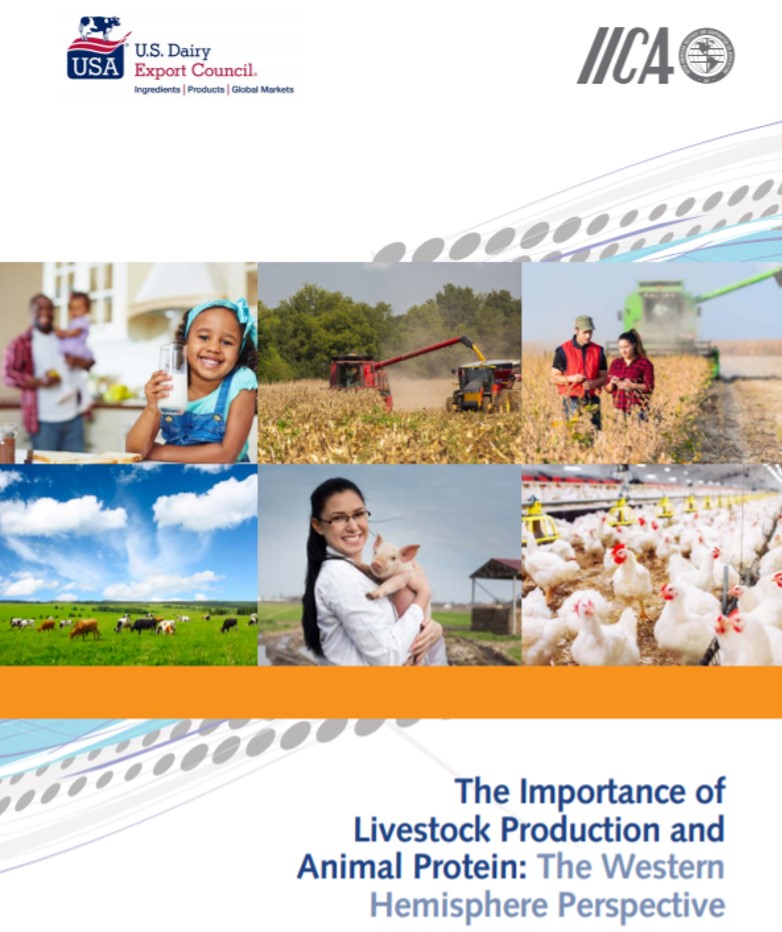
San Jose, 16 June 2021 (IICA). The Inter-American Institute for Cooperation on Agriculture, in collaboration with the US Dairy Export Council (USDEC), published a technical document on the important role livestock production and animal food products play in the future of the global food system.
The 59-page document, entitled The Importance of Livestock Production and Animal Protein: The Western Hemisphere Perspective, includes the perspectives of international experts on some of the most relevant problems facing livestock production with the aim to illustrate the crucial role this production activity and animal protein plays in the agrifood systems. The document can be downloaded here.
Published in association with USDEC, this document is just one piece of a solid body of technical information that demonstrates the progress and contributions made by livestock producers as regards to all dimensions of sustainability, offering the unique perspective of the hemisphere.
The publication is also a useful resource for the public and private sectors ahead of the United Nations Food Systems Summit 2021 to be held in New York in late September, to set the foundation for the positive transformation of global food production and consumption.
The specialists shared their perspectives in a two-day virtual event organized by IICA in October of 2020 and attended by 600 participants from across the hemisphere.
The event highlighted the fact that the livestock industry makes vital contributions to nutrition, the economy, and livelihoods, while reducing its environmental impact. The specialists presented on initiatives of the dairy, poultry, and beef sectors and expressed their perspectives on animal protein in dietary guidelines, science-based guidelines for animal care, the importance of innovation, the important role of trade, and the participation of consumers in debates on livestock production.
Both the event and the publication underscored the strong alignment in the hemisphere in terms of livestock production and animal protein, which must be included in agrifood systems both now and in the future, as well as the progress livestock producers are making in reducing their environmental impact and their commitment to addressing pending challenges.
Another conclusion was that these products provide high-quality proteins and under-consumed nutrients, while contributing to the livelihoods of millions of people in the region. Additionally, global agrifood system solutions must find ways to recognize and compensate progress, while including livestock production and animal protein as an important part of a fair, equitable, and sustainable global agrifood system.
The Importance of Livestock Production and Animal Protein: The Western Hemisphere Perspective is available in Spanish and English and can be downloaded from IICA’s document archive.
More information:
Ana Marisa Cordero, Interim Manager of IICA’s Agricultural Health, Safety and Food Quality Program (SAIA).
ana.cordero@iica.int
Horrys Friaca, International Specialist with IICA’s Agricultural Health, Safety and Food Quality Program (SAIA).
horrys.friaca@iica.int