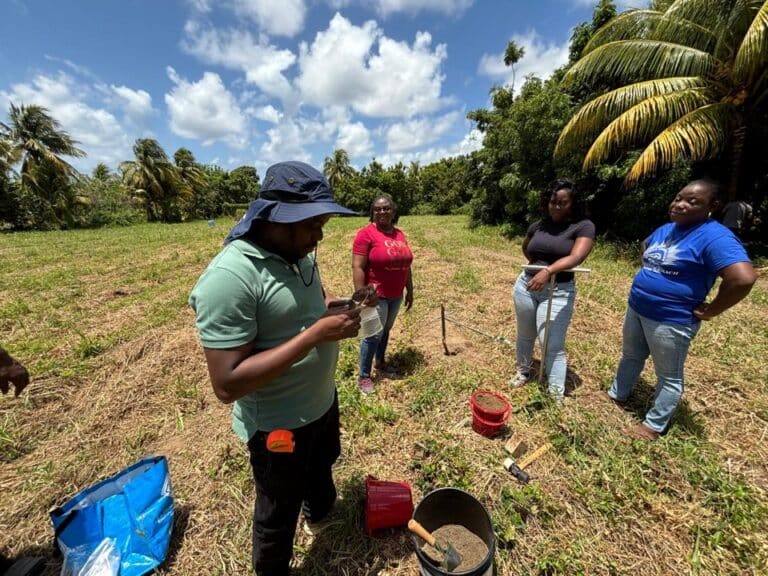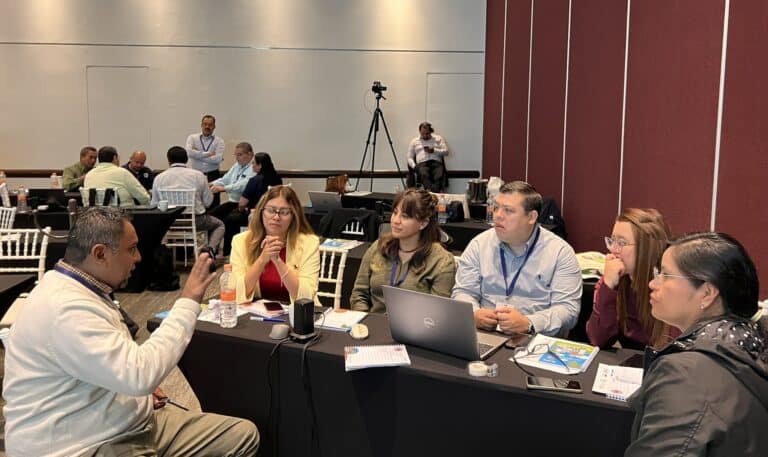
The purpose of the course was to provide state-of-the-art information on good practices for the management of coffee cultivation within the new scenarios faced by families involved in this activity.
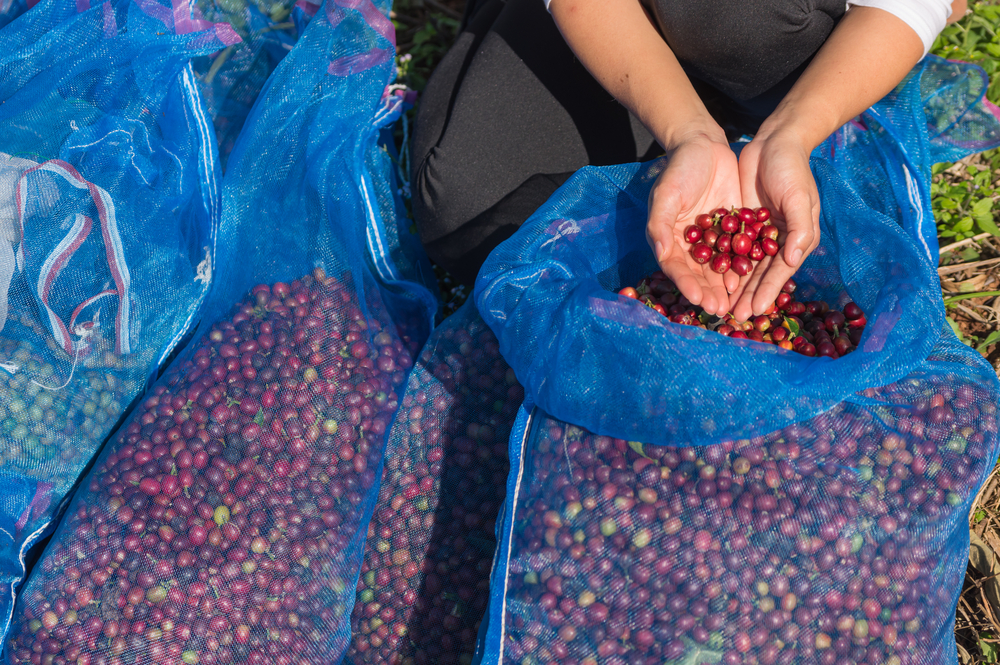
San José, 22 March 2021 (IICA) – Surmounting the obstacles presented by the current pandemic, 125 students from 16 Latin American countries recently completed the International Diploma in Innovative Coffee Growing course, which was held virtually and was coordinated by various institutions in the sector.
The purpose of the course was to provide state-of-the-art information on good practices for the management of coffee cultivation within the new scenarios faced by families involved in this activity.
The course, which was conducted in 2020 and 2021, was coordinated by the Inter-American Institute for Cooperation on Agriculture (IICA) and the European Union, through its Central American Program for Comprehensive Management of Coffee Leaf Rust (PROCAGICA); the Costa Rican Coffee Institute; the Tropical Agricultural Research and Higher Education Center (CATIE); and the Regional Cooperative Program for the Technological Development and Modernization of Coffee Production (PROMECAFÉ).
These organizations created an Advisory Committee to guide the development of the course and determine the topics and content to be covered, as well as to identify the most suitable specialized trainers, explained Angela Díaz, coordinator of CATIE’s training unit and member of the Committee.
“Covid-19 has forced us to take an exponential leap and rethink ways to continue offering courses and certifications on the subject of innovative coffee growing”, she pointed out.
Díaz also said that PROCAGICA played a crucial role in the design and definition of the technical aspects of the course, by helping to identify the most adequate experts and topics.
René León-Gómez, Executive Secretary of PROMECAFÉ –which sponsored the training–, mentioned that the course received the support of 32 regional institutions that combined their efforts to further broaden the vision and capacities of professionals who provide technical support to families that produce coffee, and who often specialize in only one area of the production chain.
“Technicians may be highly specialized in the area of soil fertility, but know little about market efforts or technology promotion; the goal of the course was to expand their range of knowledge so that they could achieve a broader vision of coffee growing”, said León-Gómez.
The course took place from November 2020 to February 2021, but not continuously during this 4-month period, he explained.
“In total, it took 15 days to cover a total of 120 hours of training, with a fully virtual yet synchronous format –we were all connected at the same time. This methodology was our response to the challenges posed by the pandemic. We had 69 specialists as instructors and lecturers, and the students were mainly professionals from Mesoamerica, plus one from Korea and another from Germany, both of whom reside in the region ”explained the Executive Secretary of PROMECAFÉ.
Topics of the course
The course addressed a number of topics, including the challenges faced by the sector as a result of declining international coffee prices and how to make coffee growing more profitable in order to allow families to reach their full potential. It also discussed how to promote the resilience of producers and the use of low-cost, highly effective technologies to facilitate coffee-related research and extension.
“The training of extension specialists has always been a challenge, because Mesoamerican coffee growers are mainly smallholder farmers, who are scattered, numerous and possess low levels of education, which makes training them more complex” explained León-Gómez.
In order to overcome these difficulties, the use of technology was promoted to support coffee growing and particularly extension services, so as to offer research results to producers.
This training program began in the late 1970s as an initiative of PROMECAFÉ to train, strengthen, and provide updated information to coffee experts in the region. Although formerly called “Modern Coffee Growing Course”, for the last two editions its name has been changed to “International Diploma in Innovative Coffee Growing”.
“Before the pandemic, there were very few capacity-building initiatives that offered virtual courses of this magnitude, and with this degree of technical and practical specificity; however, given the current needs, PROMECAFÉ and its strategic partners paved the way and were able to successfully develop and redesign this international training course, which in my view is a relevant example of regional efforts and integration favoring the coffee sector”, stated Harold Gamboa, Coordinator of PROCAGICA’s Regional Executing Unit.
“Through these joint efforts and the optimization of resources, a new training system was created; this will continue to be part of the tools offered by PROMECAFÉ for the benefit of its member countries,” said Gamboa.
More information
Institutional Communication Division of IICA
comunicacion.institucional@iica.int