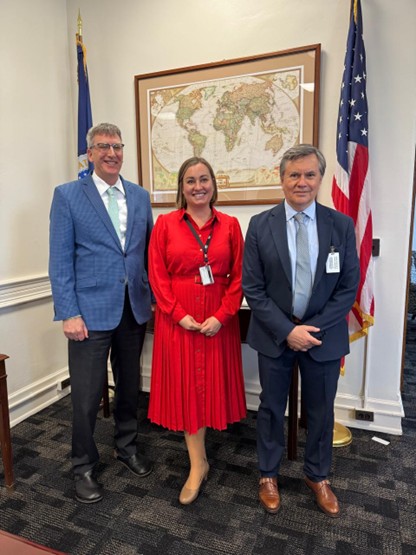
Jason Hafemeister, Acting Deputy Assistant Secretary of the USDA; Manuel Otero, Director General of IICA; and Courtney Knupp, Senior Advisor to the USDA Under Secretary.
Washington D.C., 13 March 2025 (IICA) – During a work visit to Washington D.C. by the Director General of the Inter-American Institute for Cooperation on Agriculture (IICA), the hemispheric agency and the United States government ratified their strategic partnership to undertake coordinated work aimed at spurring the modernization of the agriculture sector in the Americas.
Otero was welcomed at the United States Department of Agriculture (USDA), where the parties agreed that their joint work will continue to focus on promoting science and innovation applied to new technologies for agriculture as well as strengthening research and prevention and control systems related to health and food safety.
They also confirmed their shared conviction that efforts must continue to be undertaken to ensure that, in all political forums, farmers play an increasingly prominent role in global discussions on the transformation and future of food production.
Participating in the meeting with the IICA Director General at USDA headquarters were Jason Hafemeister, Acting Deputy Under Secretary; Courtney Knupp, Senior Advisor to the Deputy Secretary; and Donald Willar, International Trade Specialist for the Foreign Agricultural Service.
“We reviewed the status of the main diseases that are putting animal production at risk throughout the continent, namely the New World screwworm and African swine fever”, explained Otero.
New World screwworm is a disease that primarily affects cattle, but may affect other domestic and wild species, including human beings. Although it had been eradicated from Central America, cases were reported in Panama and Costa Rica in 2023, and in Nicaragua and Honduras in 2024.
African swine fever (ASF) is a highly infectious hemorrhagic disease that affects both domestic and wild pigs and is harmless to humans. The disease had also been eradicated but reemerged on Caribbean islands in recent years.
The United States and IICA are engaged in coordinated work to prevent and control these diseases, which threaten food security and the livelihoods of producers and therefore require joint action.
During the meeting at USDA, Otero described the initiatives of the “IICA of Open Doors” program, which have enabled the specialized international agency to foster greater interest in agriculture among the younger generations, through various projects that increase awareness of the future, science, innovation and agricultural transformation in the Americas.
The IICA Director General also shared an update on the complete remodeling of the United States Meeting Room at the Institute’s headquarters in San José, Costa Rica, which will become one of the premier venues for high-level conferences and meetings of the agriculture sector in the Americas.
Otero also extended an invitation to the new Secretary of Agriculture of the Americas, Brooke Rollins, to visit IICA Headquarters.
Otero, who was accompanied by Deputy Director General Lloyd Day, Special Advisor Jorge Werthein, and the IICA Representative in the United States, Margaret Zeigler, was also welcomed at the U.S. Department of State, where he met with McCoy Pitt, Senior Official at the Bureau of International Organization Affairs.
In Washington, D.C., the Director General also attended the Fifty-sixth Special Session of the General Assembly of the Organization of American States (OAS) and met with Albert Ramdin, Suriname’s Foreign Minister and the newly elected Secretary General for the term 2025-2030, with whom he discussed opportunities for joint work.
More information:
Institutional Communication Division.
comunicacion.institucional@iica.int