“The region has the productive resources to tackle the challenge of balancing these apparently contradictory goals; that is, increasing production in light of its role at global level, while properly addressing priorities in climate action, inclusion and the reduction of poverty”, said the Director General of IICA, Manuel Otero.
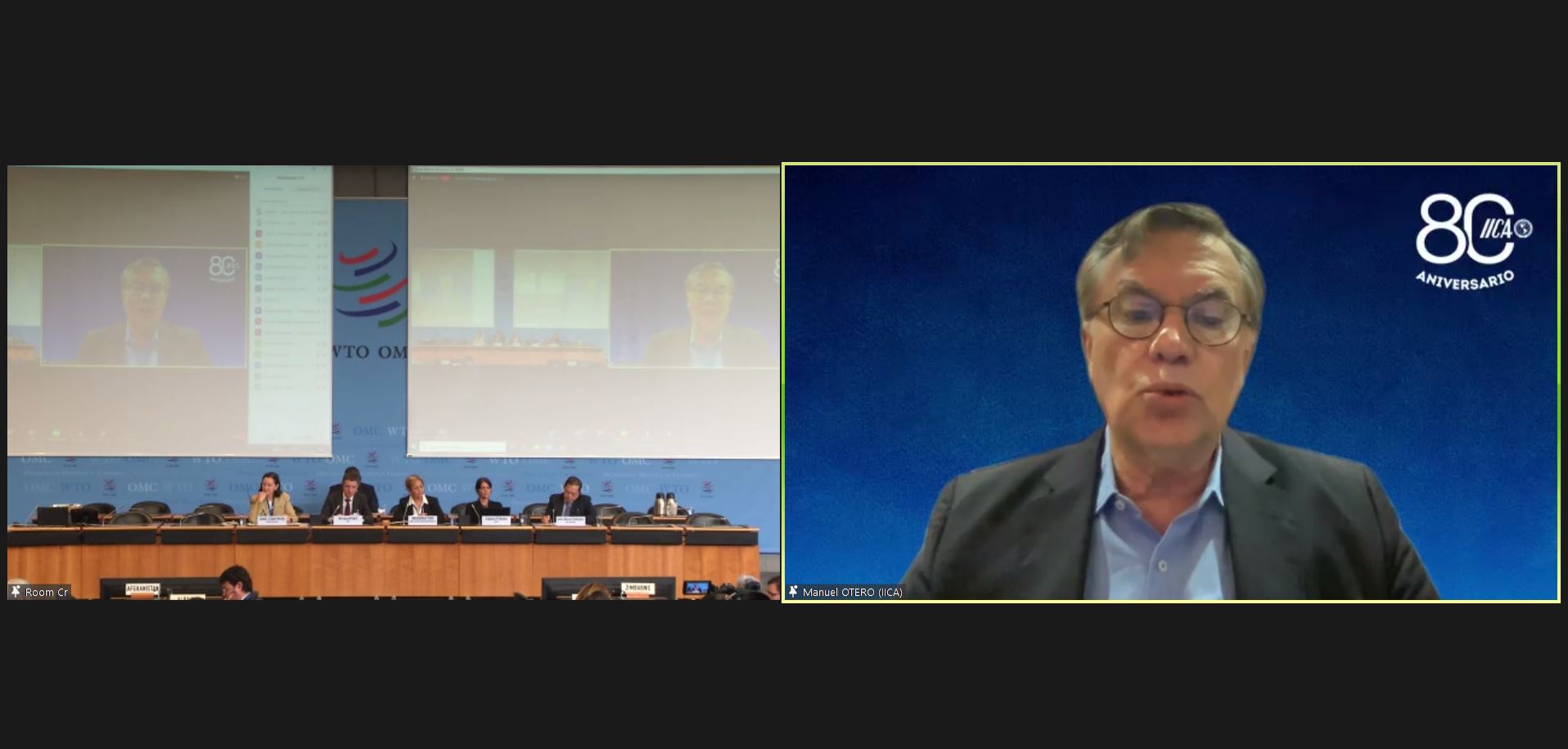
San Jose, 28 April 2022 (IICA) – The American continent has the productive resources to increase agricultural production and tackle global food insecurity, while adequately addressing priorities on climate action, social inclusion and poverty reduction, stated IICA Director General Manuel Otero in a speech to the World Trade Organization (WTO).
Otero, in his capacity as Director General of the Inter-American Institute for Cooperation on Agriculture (IICA), participated in the WTO Seminar on Food Security: Technical Perspectives, in which officials, experts of international organizations and policymakers dialogued on trade and food security, in a discouraging context caused by the effects of two years of the Covid-19 pandemic and armed conflict in Ukraine, which has caused food and energy prices to rocket.
The seminar—where it was highlighted that about one billion people are suffering from hunger in the world despite significant increases in agricultural production in recent years as a result of technological advances, and that guaranteeing food security is a challenge for global public policy—included the participation of the WTO Director-General, Ngozi Okonjo-Iweala; WTO Deputy Director-General Jean-Marie Paugam; FAO chief economist Máximo Torero; high-ranking officials with responsibilities in the areas of agriculture and trade; and ambassadors from countries of the five continents accredited with the Geneva-based organization.
Otero said, “We have a group of net exporters, which can be considered pantries of the world and are countries in a continent that is the main net exporter of food on the planet. This situation coexists with a reversal of improvements in the reduction of poverty and other realities of the region, including that of net importers, which have been significantly affected by the international crisis”.
IICA’s Director General added that the Latin American and Caribbean population suffering from food insecurity has increased 10% as a result of the war in Ukraine.
“This image underscores the fact that there is no ‘one-size-fits-all’ set of tools, but rather the need for a careful balance of instruments so that each situation is addressed correctly. What would work for the global contribution of the region would not necessarily work for other countries”, Otero added, at a roundtable moderated by the Costa Rican Ambassador to the WTO, Gloria Abraham Peralta.
He concluded, “The good news is that, in general, the region has the productive resources to tackle the challenge of balancing these apparently contradictory goals; that is, increasing production in light of its role at global level, while properly addressing priorities in climate action, inclusion and the reduction of poverty”. To achieve this, he called on those present to fine-tune science and technology strategies, promote inclusion in family farming, and foster a favorable and transparent trade environment that will harness the productive potential of the natural resources of the region and their productive efficiency.
More information:
Institutional Communication Division
comunicacion.institucional@iica.int