The contest sought to recognize tourism activities and products in the Americas that are adopting bioeconomy practices.
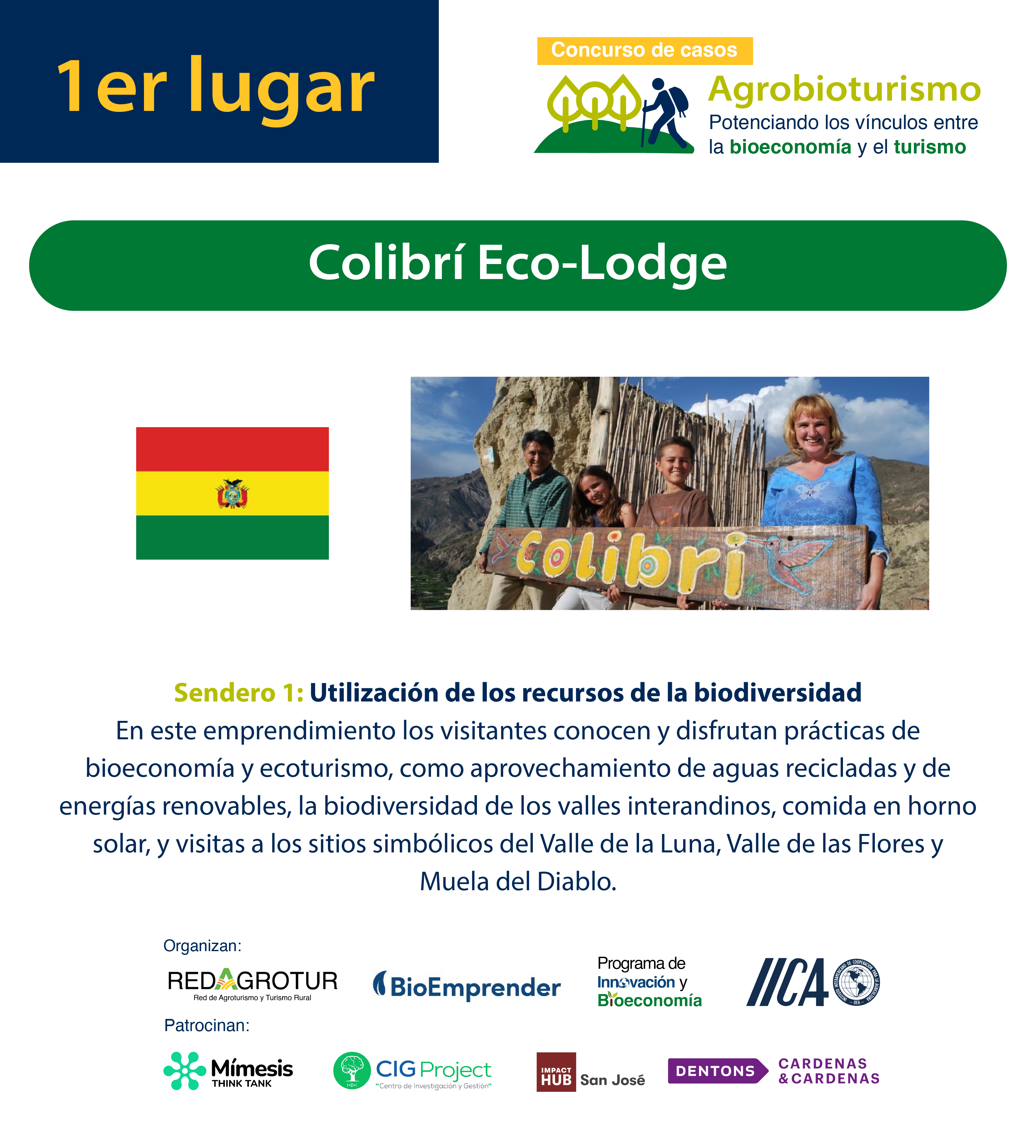
San Jose, 30 January 2024 (IICA). Colibrí Camping and Eco Lodge in Bolivia was declared winner of the Agrobiotourism: Strengthening Linkages between the Bioeconomy and Tourism competition promoted by the Inter-American Institute for Cooperation on Agriculture (IICA), out of a total of 110 entries from 14 countries in the region.
The contest sought to recognize tourism activities and products in the Americas that are adopting bioeconomy practices. It received promotional support from the Inter-American Agrotourism Network (REDAGROTUR) and external sponsorship from the Impact Hub of Costa Rica, the CIG Project in Peru, as well as from Mímesis Think Tank and Dentons Cárdenas, of Colombia.
Colibrí Camping and Eco Lodge is a venture that introduces bioeconomy practices and ecotourism to visitors, such as the use of recycled water, renewable energy and the preparation of food using solar ovens. It also conducts visits to symbolic sites in the Andean valleys of Bolivia.
Coming in in second place was the Uva Dulce project in Chile, which is based on sustainable agricultural practices and also allows visitors to enjoy the country’s cultural and archaeological heritage. The third-place award was given to Argentina’s Chacra Agroecológica PosVill, which offers a tour of an agroecological citrus plantation, introducing visitors to pruning and irrigation practices and the production of biofertilizers.
Hugo Chavarría, Manager of IICA’s Innovation and Bioeconomy Program, explained that tourism is a sector that has close linkages with the bioeconomy and that can benefit immensely from its adoption thanks to the latter’s ability to increase and diversify offerings and income.
Chavarría pointed out that, “The connections between tourism and the bioeconomy generate further linkages with other economic activities in rural areas; promote greater appreciation of local customs and foster environmental sustainability”.
Luci Mamani, advisor to the winning project, said that, “We are honoured to receive this award and proud to be part of the Colibrí project – a venture that not only draws on the natural beauty of our valleys, but can create a three-fold impact on our community – economically, environmentally and socially. Colibrí is a source of pride not only for those of us within the organization, but also for the community”.
Mamani explained that, “Our motto is construction without destruction. We do not need to level our terrain or to destroy nature in order to create a beautiful experience for visitors from other countries”.
The winning businesses received cash awards, as well as scholarships to pursue specialization courses in biobusiness-related issues; technical assistance and mentorship from IICA and the other competition sponsors.
Moreover, all of the entries will be included in a technical publication on linkages between the bioeconomy and tourism.
More information:
Institutional Communication Division.
comunicacion.institucional@iica.int