Belém do Pará, Brazil, 13 November 2025 (IICA) – Agriculture in the Americas is fulfilling its role to ensure the planet’s food security; and the sustainability practices it applies throughout the hemisphere demonstrate that the sector is offering long-term solutions to the climate, environmental, economic and social challenges facing humanity.
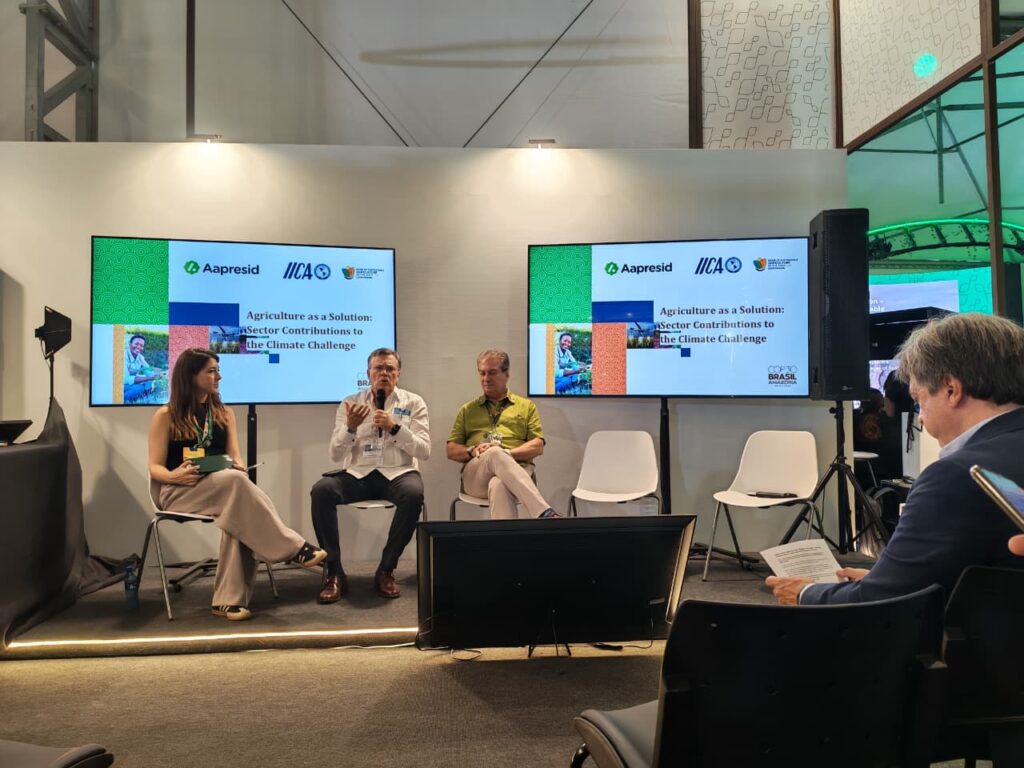
This was the view of experts gathered in the Home of Sustainable Agriculture of the Americas pavilion, at COP30, which is underway in Brazil.
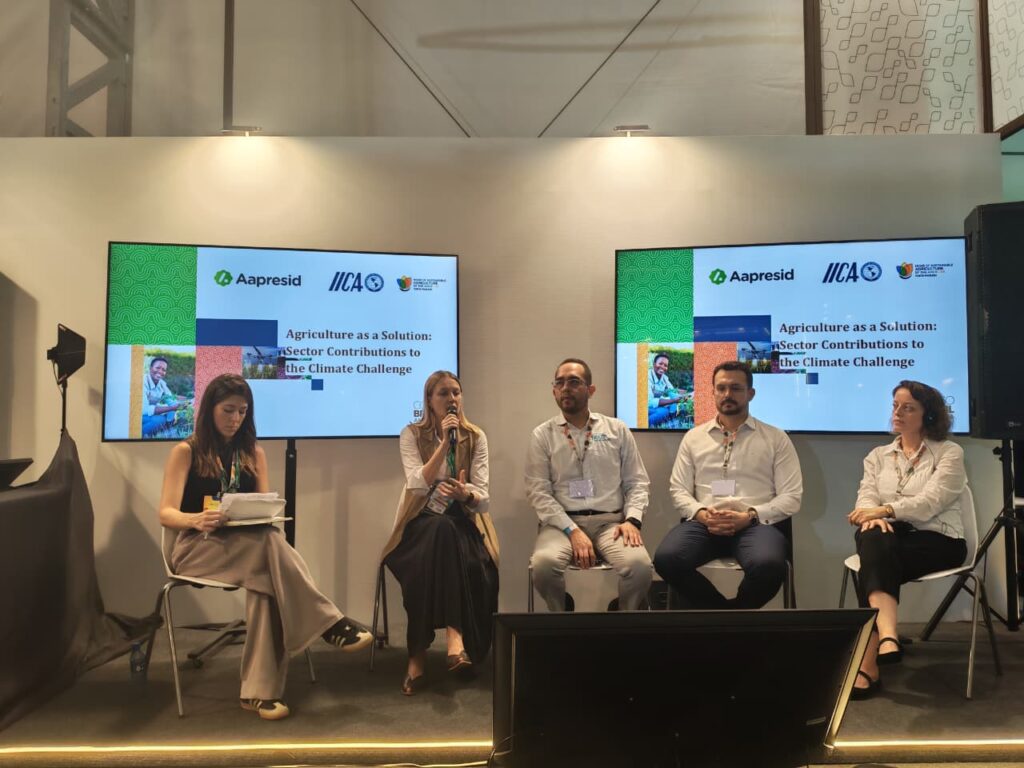
The pavilion, sponsored by the Inter-American Institute for Cooperation on Agriculture (IICA), is located in the meeting’s Agrizone in Belém do Pará, and was the venue of a panel discussion, involving Franciele Trentini, Senior Manager of Innovation at OCP Brasil; Luis Bustamante, Sustainability Marketing Lead at U.S. Soybean Export Council (USSEC); Daniel Barcelos Vargas, Public Policy Researcher at the School of Economics of the Getulio Vargas Foundation in São Paulo; and Tamar Toria, Executive Director of the Georgian Farmers’ Association.
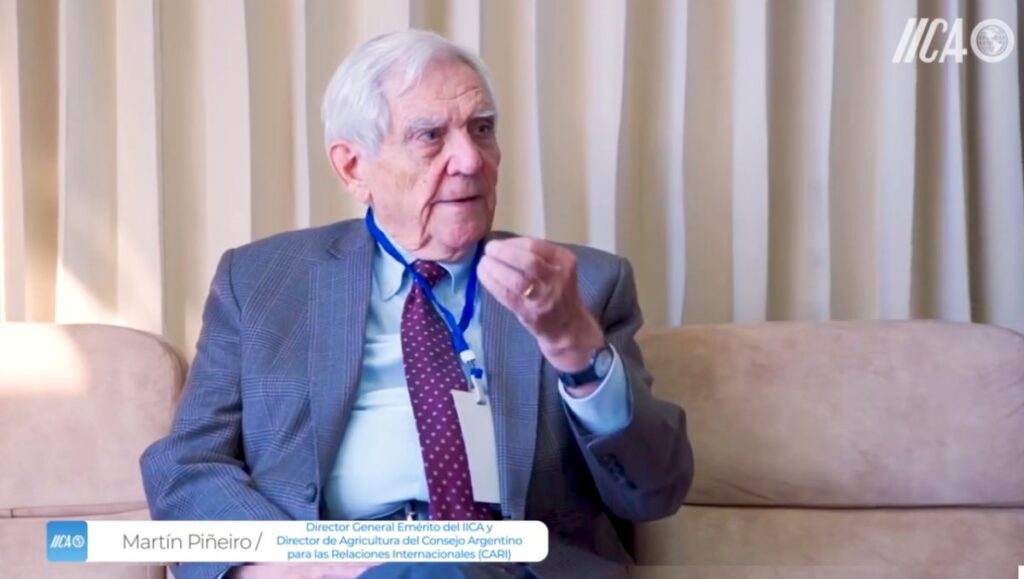
The event began with a discussion between Executive Secretary of the Legal Amazon Consortium and COP30 Special Envoy for Subnational States of the Amazon, Marcello Brito; and Manuel Otero, Director General del IICA.
Brito noted that “IICA’s presence in the COP30 Agrizone, the area devoted to the agriculture sector and conceived by the Brazilian Agricultural Research Corporation (EMBRAPA), is a success. Here, in this space that provides an immense showcase of Brazilian agribusiness, we can demonstrate that agriculture is part of the solution to address the challenge of producing the food, energy and biomass that the world needs”.
Manuel Otero noted that, “Agriculture in the Americas is illuminating the path to sustainability. It is the only sector capable of sequestering carbon and can harness the extensive biomass resources of the tropical region. For example, Brazil, is already doing this, through the production of biofuels and biocosmetics.
From producers to research
In the panel discussion, co-organized by the Argentine Association of Director Seeding Producers (AAPRESID) and IICA, Franciele Trentini explained that OCP Brasil and the Brazilian Agribusiness Association (ABAG, of which OCP is a member) are spearheading the establishment of a collaborative innovation chain, as a means of finding out the needs of producers. “In this way”, he said, “we can learn and cooperate, as innovation must be an open process and working together as a chain should be mandatory”.
Luis Bustamante of USSEC argued that the sustainability practices of agricultural producers must transcend rural areas and be a tool that allows them to improve their market position. “As such, competitiveness and sustainability will go hand in hand and should be evident to all interest groups. International trade is what allows producers to gage their competitiveness, and sustainability can be seen as a comparative advantage”.
Researcher Daniel Barcelos Vargas pointed out that Brazil had achieved a 70% increase in productivity in just half a century, with minimal expansion of its agricultural frontier. Even today, it has managed to preserve 66% of its forests.
This was thanks to the technologies adopted by producers. Today, almost all production is done through direct seeding, and the country is a global leader in the use of bioinputs”, said Vargas.
The academic, from the Getulio Vargas Foundation School of Economics in São Paulo, called attention to international parameters on environmental issues, which he believes are oblivious to the realities of the countries of the Americas.
“Their measurement is inadequate and thus the real world is portrayed as a caricature or something from the past. Thus, our task is to increase knowledge and promote dialogue that will accommodate diversity”, he added.
The AAPRESID-IICA panel discussion shared the perspective of the agriculture sector in Georgia, a country whose farmers—particularly small- and medium-scale farmers—are faced with the urgent need to institute better practices to tackle climate vulnerability.
“Other than simply providing funding, we are seeking to forge partnerships that will allow us to demonstrate successful sustainability experiences to our farmers”, said the Executive Director of the Georgian Farmers’ Association, Tamar Toria.
More information:
Institutional Communication Division.
comunicacion.institucional@iica.int