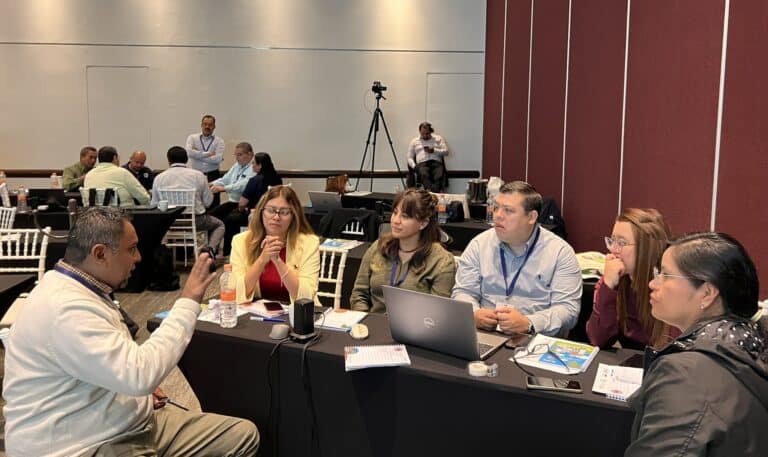
Participants in the event, attended by the President of Costa Rica, analyzed the challenges facing the family agriculture sector and young people in rural areas.
San Jose, Costa Rica, October 31, 2014 (IICA) The President of Costa Rica, Luis Guillermo Solis, the Minister of Agriculture of Costa Rica, Luis Felipe Arauz, a researcher from Mexico, Cassio Luiselli, and the Director General of the Inter-American Institute for Cooperation on Agriculture (IICA), Victor M. Villalobos, agreed that family agriculture should play a more important role in local economies, development and food security.
All were attending the forum entitled Family Agriculture and Rural Youth, held at IICA Headquarters in San Jose, Costa Rica.
Addressing high-level public officials, private-sector leaders, members of the diplomatic corps, representatives of the public agricultural sector and IICA personnel, President Solis renewed his commitment to agriculture, stating “Despite the importance of agriculture throughout history, it continues to be overlooked and excluded, ignoring the fact that it is a key player in the economies of many countries today.”

Minister Arauz added “We believe the future of our agricultural sector lies in its young people. We want them to maintain ties with the countryside, encouraging them to do so by applying technological innovations and providing new opportunities for their personal and professional growth.”
In Latin America, some 23 million rural youths are hindered by the limited availability of educational opportunities and the quality of the training they receive. Only 18% of them have a college education and the migration of rural youths to urban area continues.
For Cassio Luiselli, the keynote speaker, steps must be taken to encourage young people not to migrate to cities, by creating good-paying jobs, breathing new life into the economic activities of their communities and making it easier to access resources.
“The idea is not to keep them artificially in the countryside. We need to support rural families, providing older adults with decent pensions and young people with incentives and jobs,” he underscored.
It is estimated that there are some 15 million family farms in Latin America. Nine million are small-scale and depend less and less on agriculture; four million depend mostly on agriculture and hire few outside workers; and one million are classified as transitional, and are well on their way to becoming commercial-scale agricultural operations.
IICA, Villalobos stated, contributes to the development and application of instruments intended to strengthen the public institutional framework, with a view to making it easier for small- and medium-scale farmers and rural entrepreneurs to form part of value chains.
In his opinion, if these families are to be strengthened, it is necessary to innovate and to develop a new paradigm for agriculture, one that will make it more efficient, competitive, sustainable and inclusive.
He noted “The Institute has made this a key aspect of the technical cooperation we provide. We have attached priority to work with rural youths and with professional groups, while at the same time focusing our work on developing the human resources that will be required for a new type of agriculture. We must teach young people to love life in the country, rather than to try to tie them to it.”
For further information:
evangelina.beltrán@iica.int
Photo gallery