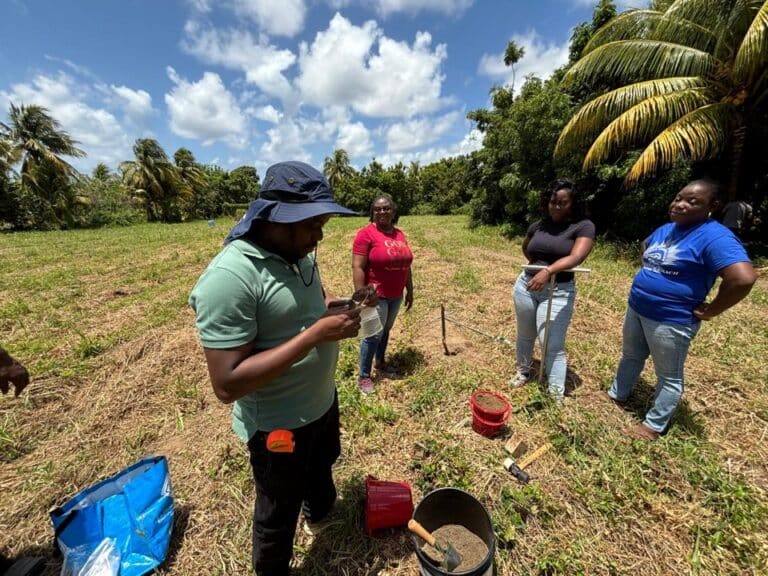

Georgetown, Guyana, 30 May 2025 (IICA). Guyana has launched a national surveillance plan and diagnostic sampling scheme for the early detection of African swine fever (ASF), a disease that affects wild and domestic pigs, and threatens both food security and producers’ livelihoods.
The initiative is part of the project “Surveillance and Response for the Prevention ofAfrican Swine Fever (ASF) in the Americas”, spearheaded by the United States Department of Agriculture (USDA) and the Inter-American Institute for Cooperation on Agriculture (IICA).
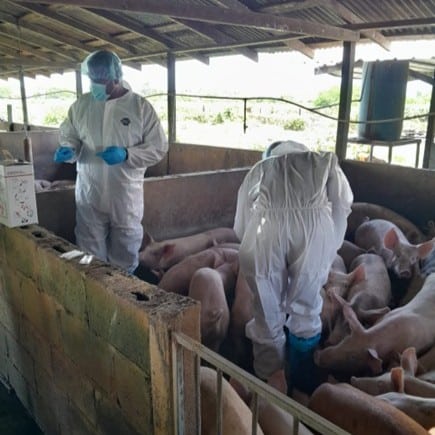
The launch took place during a three-day pilot program, which included farm visits, group work sessions, training activities, veterinary laboratory visits, and demonstrations of sample packaging procedures.
In addition to USDA and IICA, USDA’s Foreign Agricultural Service (FAS), the Guyana Livestock Development Authority (GLDA), local producers, and the Caribbean Agricultural Health and Food Safety Agency (CAHFSA) were actively involved in the development of the pilot program.
The surveillance plan developed in Guyana includes a comprehensive strategy focused on five key areas: improved biosecurity, nationwide surveillance, stakeholder engagement, outbreak preparedness, and financial support for affected producers.
Although ASF does not pose a risk to human health, it is devastating to domestic and wild pig populations. Outbreaks can severely impact national economies and food security. The urgency increased with the reappearance of the disease in the Caribbean in 2021, after a 40-year absence, with cases reported in the Dominican Republic and Haiti.
Evidence-based approach
Muhammad Ibrahim, IICA Director of Technical Cooperation, explained that the inter-American organization has adopted a comprehensive, evidence-based approach to national animal health capacity building, prioritizing epidemiological surveillance, biosecurity, and early response to transboundary diseases.
“Effective ASF prevention calls for robust institutional architecture and health governance aligned with international standards. At IICA, we promote the implementation of sustainable strategies tailored to each context to ensure that countries have the tools to protect their food security”, he added.
GLDA Executive Director Dwight Walrond pointed out that the initiative will serve as a model for animal disease management in Guyana and the rest of the Caribbean.
“The surveillance plan includes measures such as the strengthening of biosecurity on farms, improvements to control points, enhanced surveillance at ports of entry, increased laboratory diagnostic capacity, and the implementation of education and training campaigns for industry stakeholders”, he added.
Eric Coleman, USDA’s Director of Emergency Programs, observed that preventing ASF requires constant surveillance, technical collaboration, and a rapid response, so this pilot program in Guyana is a decisive step toward a more prepared and resilient Caribbean.
“At USDA, we recognize that animal health is key to food security and economic development. Therefore, we strongly support this initiative, led by USDA and IICA, designed to boost local and regional capacities for addressing health threats like ASF”, Coleman said.
US Ambassador to Guyana Nicole Theriot emphasized that: “Preventing ASF is critical to the survival and growth of the pork industry. This initiative, funded by USDA and implemented by IICA, goes beyond Guyana and seeks to improve surveillance, diagnosis, biosecurity, and emergency preparedness in the Caribbean, Central America, and the Andean region, under a comprehensive One Health approach”.
Regional response
As part of the program in Guyana, the joint IICA-USDA delegation met with Guyana’s Minister of Agriculture, Zulfikar Mustapha to discuss the results of the technical work sessions on ASF surveillance and response efforts that took place in the country.
The minister reaffirmed the government’s commitment to strengthening veterinary and surveillance systems, and highlighted the progress made with the construction of a modular pig slaughter and processing plant, as part of efforts to modernize the national pork industry.
Mustapha emphasized that implementation of the pilot plan is a firm step toward modernizing the country’s animal health system.
“This program not only strengthens our technical capabilities, but also positions Guyana as a regional leader in swine health surveillance. We are committed to protecting our industry, guaranteeing food safety, and ensuring the continuity of agricultural trade in the Caribbean”, the minister said.

More information:
Institutional Communication Division.
comunicacion.institucional@iica.int