Inter-American Institute for Cooperation on Agriculture

Rural youth

IICA, CFL, SLAFY and MOA Support Phase 5 Helping Out Our Primary and Secondary Schools (HOOPSS)

Tiempo de lectura: 3 mins.

The HOOPSS Project was recognized by the Minister of Agriculture and contributing partners as an important contributor to improved food and nutrition security.
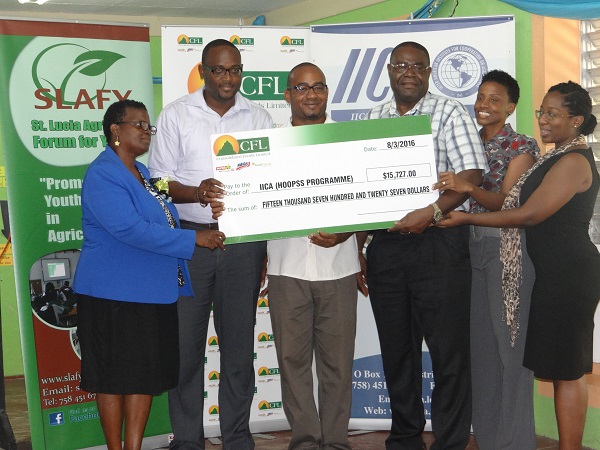
Representatives of CFL and partners presenting Cheque for
Phase 5 to SLAFY

The IICA Delegation in Saint Lucia, in collaboration with Consolidated Foods Limited (CFL), the Saint Lucia Agricultural Forum for Youth (SLAFY) and the Ministry of Agriculture,  Food Production, Fisheries,  Cooperatives and Rural Development (MAFPFCRD) agreed to implement a fifth phase of the Helping Out Our Primary and Secondary Schools (HOOPSS) Project in 2015 with financial support from CFL.  The HOOPSS Project was initiated in 2009.

HOOPSS Phase 5 is supporting 19 primary and secondary schools in developing self-sustaining farms, engaging students on the merits of agriculture as a viable career, enhancing their local school feeding programmes and agricultural science curriculum, as well as strengthening market linkages between schools and CFL.

These targets have been achieved by improving on existing school farms while expanding the scope of school farm programmes to new areas t such as rearing poultry, rabbits and fresh-water fish (aquaculture); as well as greenhouse technology. Doing so has been beneficial to broadening the knowledge base of students and teachers, alike.  Under Phase 5, HOOPSS benefited from the support of the Tele-Gathering Group through Jameson Alphonse (SLAFY Vice President) and LIME Saint Lucia to give support to the urban, pallet garden of the Marchand Primary School, as well as support to the greenhouse of the Marigot Secondary School.  

At the launch of Phase 5, The HOOPSS Project  was been recognized by the Minister of Agriculture and contributing partners as an important contributor to improved food and nutrition security by strengthening school feeding systems and agricultural development by adding value to the engagement of youth on agriculture.

For more information contact: Brent Theophile (brent.theopile@iica.int)
 

Share

Related news​

San José, Costa Rica

May 29, 2026

IICA Director General receives overwhelming support in presenting the key pillars of the Institute’s work for the next four years, with a focus on strengthening the agriculture sector of the Americas

Member countries of the Inter-American Institute for Cooperation on Agriculture (IICA) expressed support for a presentation by Director General Muhammad Ibrahim during a meeting of the Special Advisory Commission on Management Issues (SACMI), where he outlined the key areas of focus of the organization’s work from now until 2030.

Tiempo de lectura: 3mins

San José, Costa Rica

May 28, 2026

Latin America and the Caribbean develop shared agenda for sustainable dairy farming with support from IICA, CAF, and regional partners

Producers, technical specialists, and institutions in different areas of Latin America and the Caribbean are taking part in a coordinated effort to develop a regional agenda for sustainable dairy farming. The initiative is spearheaded by the Inter-American Institute for Cooperation on Agriculture (IICA), CAF-Development Bank of Latin America and the Caribbean, the Pan-American Dairy Farming Federation (FEPALE) and Chile’s Dairy Consortium.

Tiempo de lectura: 3mins

San José

May 27, 2026

IICA and CIRAD renew strategic partnership to promote agroecological innovation and more sustainable agrifood systems in Latin America and the Caribbean

The work will prioritize initiatives that form part of a comprehensive approach to agroecological transition and agricultural health in areas such as agroforestry and forest management, resilient and competitive tropical agriculture, science, technology and innovation, bioinputs that reduce dependence on agrochemicals, integrated crop management and regenerative agriculture, precision agriculture, animal and plant health, soils and ecosystems, public policies for sustainable agrifood systems, governance, and institutional coordination.

Tiempo de lectura: 3mins