Winners will receive cash prizes for the purchase of inputs and services, scholarships to participate in specialization courses in the area of bioeconomy and the opportunity to be part of a bio-entrepreneurship support network.
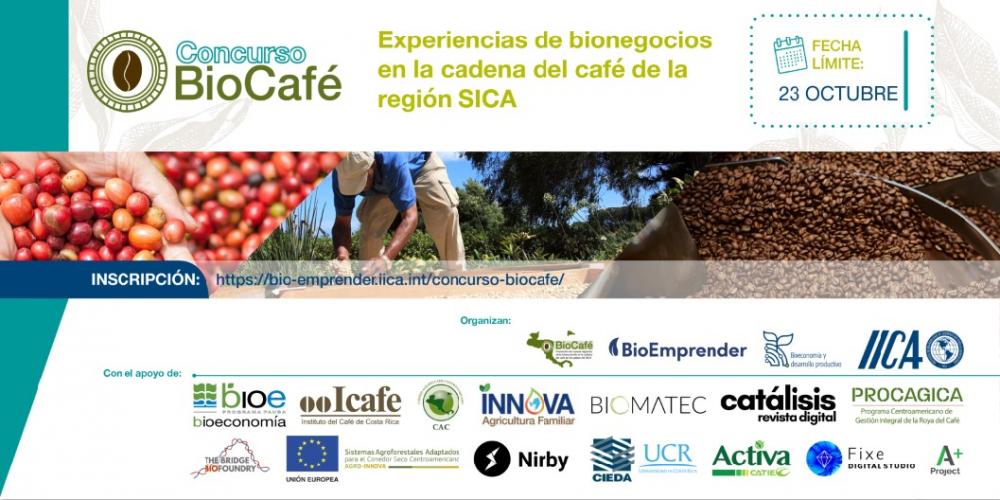
San José, 17 September 2021 (IICA) — The Inter-American Institute for Cooperation on Agriculture (IICA) will launch, through its Bioeconomy and Production Develpment Program, the competition Bio-coffee: experiences with bio-businesses in the coffee chain, to recognize entrepreneurs, businesses and organizations developing value proposals, experiences and ventures in bioeconomy in this productive chain.
Winners will receive cash prizes for the purchase of inputs and services, scholarships for participating in specialization courses in the area of bioeconomy and the opportunity to be part of a bio-entrepreneurship support network through mentorship programs and the strengthening of skills.
Registration is open until 23 October 2021. The awards ceremony will take place online on 5 November and will be broadcast over IICA social media. In this first edition, five winners will receive prizes.
The competition is aimed at producers, entrepreneurs, associations, cooperatives and micro, small and medium-sized enterprises related to the coffee chain in Guatemala, Belize, Honduras, El Salvador, Nicaragua, Costa Rica, Panama and the Dominican Republic.
The initiative is sponsored by the Instituto del Café de Costa Rica (ICAFE), the Central American Agricultural Council (CAC), the INNOVA AF-IICA project, the consultants BIOMATEC, The Bridge Biofoundry, Fixe Studio Digital, the Bioeconomy Program of the Universidad de Buenos Aires, Argentina (Bio-FAUBA), the AGROINNOVA-IICA project, the Central American Program for Integrated Coffee Rust Management (PROCAGICA) and Catálisis Revista Digital.
It also has the support of ACTIVA-CATIE, the Centre of Research in Agricultural Economics and Agribusiness Development (CIEDA – Universidad de Costa Rica) and the consultants ProjectA+.
Among the experiences that are presented before October 11, a participation in the XXV Latin American Coffee Growing Symposium will be raffled, which will take place in San Salvador, from October 20 to 23, 2021; restrictions apply.
Registration:
https://bio-emprender.iica.int/concurso-biocafe/
More information:
Institutional Communication Division
comunicacion.institucional@iica.int