Belém do Pará, Brazil, 11 November 2025 (IICA). In this city in northern Brazil, with approximately one hundred guests from various spheres of the hemispheric agriculture sector in attendance, the Inter-American Institute for Cooperation on Agriculture (IICA) officially opened the Home of Sustainable Agriculture of the Americas pavilion at COP30, where it will highlight several actions that are contributing to the sustainable transformation of this production sector and discuss new policies to accelerate the process.
The pavilion is housed in the AgriZone, an area established by the Brazilian Agricultural Research Corporation (EMBRAPA) to showcase innovation in agriculture. From now until 21 November, IICA and its partners in diverse sectors will host events, featuring the participation of specialists in family farming, innovation, digital technologies and the bioeconomy, among other very topical issues.
Speakers at the opening of the Home of Sustainable Agriculture of the Americas included Manuel Otero, Director General of IICA; Daniel Carrara, Director General of Brazil’s National Rural Learning Service (CNA/SENAR); and Muni Lourenço, who is President of the National Environmental Commission of the National Confederation of Agriculture (CNA) and President of the Federation of Agriculture and Livestock of the State of Amazonas (FAEA).
The inauguration was followed by an event in which IICA reported on progress made in the Hemispheric Partnership for Food Security in the Americas, a hemispheric integration initiative launched in 2021.
Otero pointed out that, “Nothing can happen without farmers, and thus IICA maintains that they must play a leading role in climate negotiations, given that agriculture is key to global food and environmental security and is an instrument of peace”.
The Director General revealed that the Institute recently celebrated its 83rd anniversary and had streamlined its cooperation strategies to become a more responsive organization with closer ties with the private sector. Consequently, the ministers of Agriculture of the Americas, to whom IICA is accountable, see the Institute’s operations as an investment.
“For the fourth consecutive year, we have installed our pavilion at COP—this time in the AgriZone. This area has a most appropriate name, considering that agriculture has now been prioritized in climate negotiations at a time that calls for a new generation of sectoral policies and a new narrative to describe what a sector that is critical for food production and biodiversity protection is achieving, with the support of innovation, science and technology”.
Daniel Carrara, from CNA/SENAR, noted the tremendous importance of IICA’s Pavilion in demonstrating the positive transformation of agriculture in the hemisphere. Discussions on this issue are essential”, he insisted, “as sustainability is not limited to Brazil”.
“We are eager to further strengthen our relationship with IICA, given its international recognition”, said Muni Lourenço, representing CNA and FAEA.
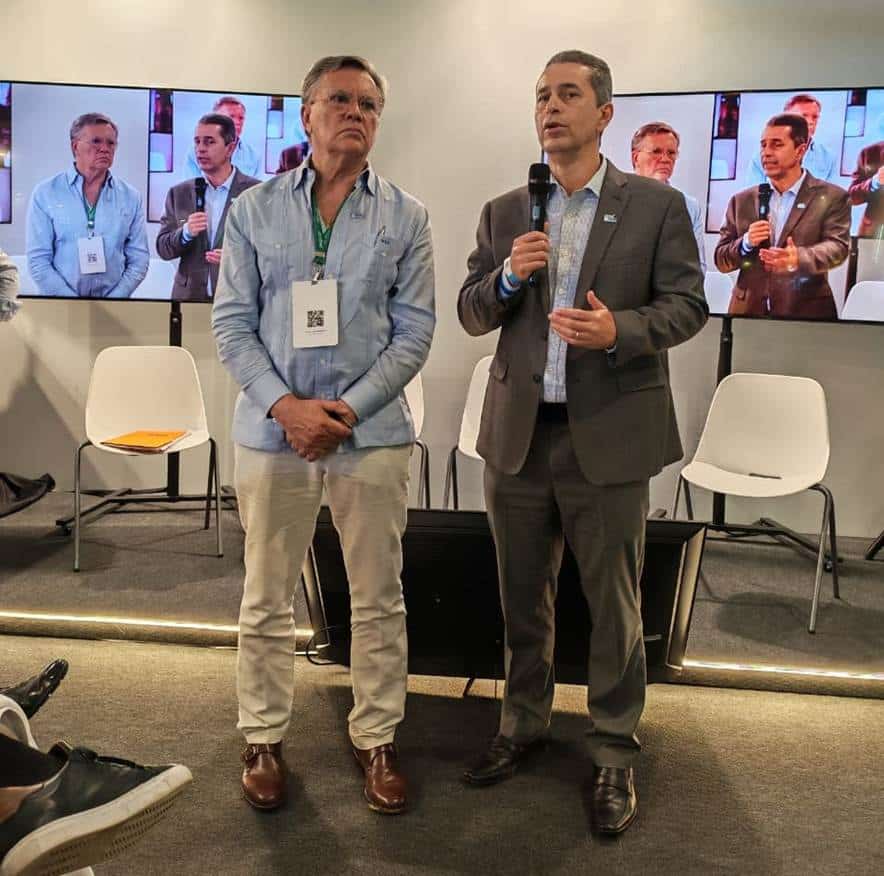
Manuel Otero, Director General of IICA; and Muni Lourenço, President of the National Environmental Commission of the National Confederation of Agriculture (CNA) and President of the Federation of Agriculture and Livestock of the State of Amazonas (FAEA).
Hemispheric partnership
The presentation of the results of the Hemispheric Partnership for Food Security in the Americas featured the participation of Suelma Rosa, Vice President of Corporate Affairs for Mexico and Latin America at PepsiCo; Arnoud Hameleers, Director of IFAD in Brazil; Marcelo Torres, President of AAPRESID; and Manuel Otero, Director General of IICA.
Since it was launched in 2021, the Partnership has compiled almost 90 high-impact initiatives in its IICA Footprint tool, which have been undertaken through cooperation between the Institute and approximately 200 partners, in areas such as food security, regenerative agriculture, agricultural digitalization and agribusiness, among others.
Suelma Rosa, of PepsiCo, noted that, “IICA’s recognition and technical capacity have encouraged us to partner with it. We are guided by a positive image of agriculture, and the Institute is infusing science into what our farmers are doing”.
The Vice President explained that technical cooperation, in the way that IICA provides it, is the third pillar that enables farmers to incorporate more sustainability tools. The others are private sector investment and public policies.
“Attracting greater investment in agriculture calls for simple work, replicable proposals that reduce risks and are backed by long-term policies”, noted the Director of IFAD Brazil.
“IICA is like a family, and it is extremely influential in Latin America and the Caribbean, particularly because it promotes strategic policies and has an immense capacity to improve institutions”, added Hameleers.
Marcelo Torres, President of AAPRESID, issued an appeal for the promotion of interactive innovation models for agriculture in the Americas, through coordination among companies, cooperating countries and the public sector.
“The Hemispheric Partnership, spearheaded by IICA, has outlined the path that we must take in areas that require our attention, such as soils, digital agriculture or the bioeconomy”, he noted.
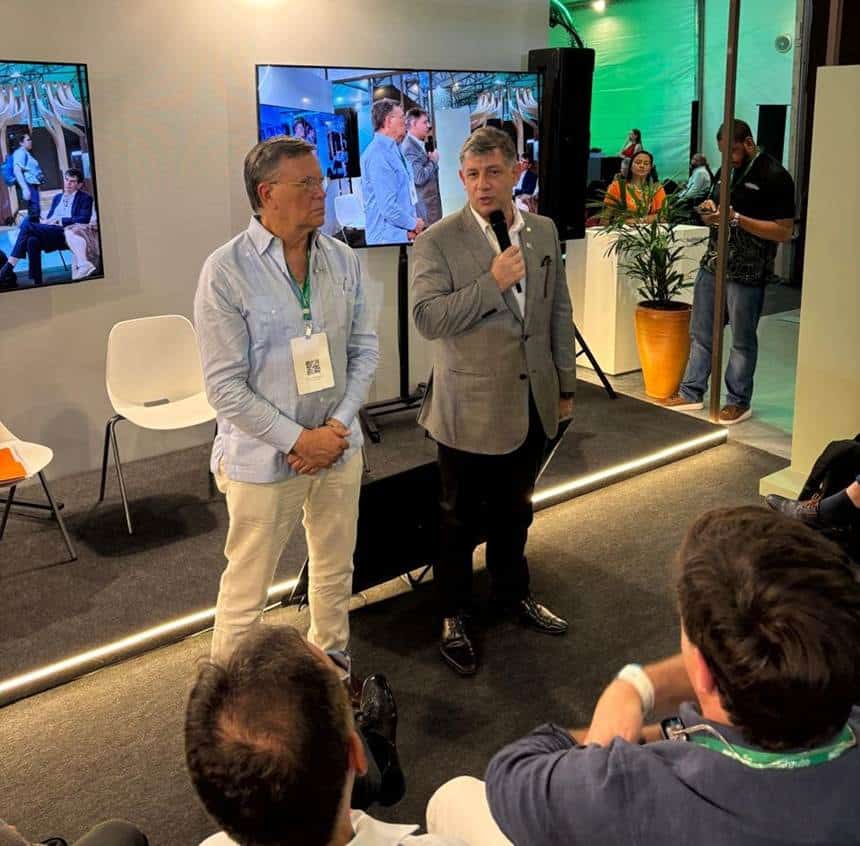
Manuel Otero, Director General of IICA; and Daniel Carrara, Director General of Brazil’s National Rural Learning Service (CNA/SENAR).
More information:
Institutional Communication Division.
comunicacion.institucional@iica.int