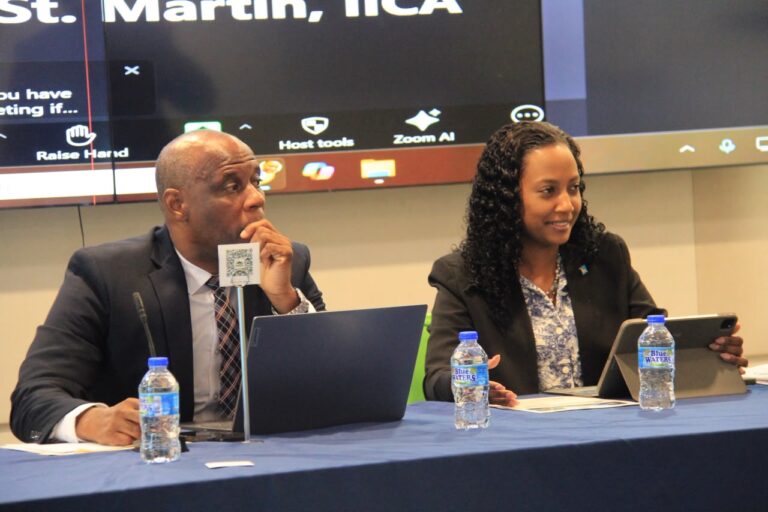
A combined team from the IICA Offices in the Caribbean and Headquarters participated in and supported the organization and hosting of the “Caribbean Regional Symposium on Agricultural Insurance – Disaster Risk Management” held in Jolly Beach, Antigua from June 15-19, 2010. The symposium boasted the participation of some 100 participants from across the region, with presenters from the Caribbean, Latin America, the United States and Europe.

Jolly Beach, Antigua and Barbuda, June 28, 2010 (IICA). Against the background of inadequate agricultural risk mitigation measures in the Caribbean and the limited capacity of trained personnel within the sector to develop and implement disaster risk mitigation programmes and measures, the symposium sought to build the knowledge and technical capacity of producers, public and private personnel and policy technicians in the planning, development and management of disasters including the development and management of agricultural insurance schemes for the Caribbean region.
Given the increased risks facing the agriculture sector, due to a number of internal and external factors, disaster risk management has re-emerged high on the agenda of governments and policy makers, insurance companies, development finance institutions and producer organizations in the region. The symposium therefore proved timely and resulted successful in bringing together the key stakeholders to present, discuss and evaluate the challenges and opportunities related to addressing risk management in agriculture.
At the end of the symposium, participants resolved to undertake the critical next steps towards achieving the overall objective of the establishment of a regional programme for disaster risk management for the agricultural sector in the Caribbean. This will include the design and implementation of a regional catastrophic risk facility for agricultural insurance in the region and the call for increased government support for existing private sector insurance and reinsurance entities in the Caribbean. Given these resolutions, the technical work will now commence to complete action plans for the short and medium terms. The Institute will continue to play a technical role in the way forward.
Mr. David C. Hatch, Associate Deputy Director General of IICA and Representative in the United States, made a made a key presentation on the interaction between the public and private sector partnerships in addressing disaster risk management. Also participating on behalf of the Institute were Mr. Victor Del Angel, Director of Management and Regional Integration, IICA Headquarters; Mr. Trevor Murray, Director of Operations for the Caribbean Region, IICA; Ms. Una May Gordon, IICA Representative in the ECS, Mr. Ignatius Jean, IICA Representative in Guyana, Dr. Vincent Little, Technical Specialist, IICA/CARICOM, Mr. Kervin Stephenson, Regional Specialist in Projects and Mr. Kent Coipel, Technical Specialist IICA Office in Dominica.
Regional coordination of the event on IICA’s behalf was spearheaded by Mr. Kervin Stephenson, while the IICA Office in Antigua and Barbuda, under the guidance of Ms. Julie-Ann Laudat, Technical Specialist, formed part of the local organizing committee for the symposium in that country. Other professional and support members of staff from the IICA offices in the Caribbean provided key support during the conference in the management of the secretariat, IT and media and communications.
The Institute was joined by other regional and international organizations in supporting the event, including the Ministry of Agriculture, Land, Housing and the Environment of Antigua and Barbuda, the CARICOM Secretariat, the Caribbean Agricultural Research and Development Institute (CARDI), the Caribbean Development Bank (CDB), the Food and Agriculture Organization (FAO), the Caribbean Disaster Emergency Management Agency (CDEMA), the World Bank and the EU-ACP and the Australian Government.
For more information contact:
Find more details in the Website:
http://www.iica.int/ENG/REGIONES/CARIBE/ANTIGUA/Pages/RegionalAgriculturalInsuranceSymposium.aspx