Virtual platform will enable discussion with specialists and preparation of an academic document on agriculture and food security, which will also serve as a basis for decision-making within the hemisphere.
San Jose, Costa Rica, April 9, 2012 (IICA). Starting this week, professionals, students, researchers and business persons in Latin America and the Caribbean who are linked to the agricultural sector will the able to participate in a network for analysis and discussion of the role of agriculture leading up to the next G20 summit (to be held in June of this year). The network will be supported by IICA and SAGARPA.
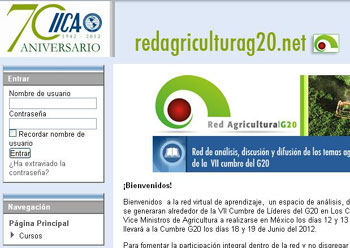
G20 Agricultural Network (www.redagriculturag20.net) will make available forums involving specialists, technical documents and multimedia tools that will promote the exchange of ideas and opinions among participants. The result of the network will be a report which the Inter-American Institute for Cooperation on Agriculture (IICA) and the Secretary of Agriculture, Rural Development, Fisheries and Food of Mexico (SAGARPA) will circulate among decision-makers within the hemisphere.
The VI Summit of Leaders of the G20 (made up of the strongest economies in the world) will be held in Los Cabos in the Mexican state of Baja California Sur, on June 18-19, 2012.
Mexico holds the interim presidency of the G20 this year and has proposed that priority be given to agriculture as a means of improving food security. IICA (which has five G20 countries among its membership) has supported the presidency of Mexico by bringing together the experience available within the hemisphere in agricultural innovation, family agriculture and access to markets, agricultural health and food safety as well as institutional strengthening and agricultural development policies.
The digital network being promoted by IICA and SAGARPA will also serve to disseminate the main arguments that the Vice-Ministers of Agriculture of the G20 will propose when they meet on April 12-13 and on May 17-18, prior to the meeting of Presidents and Heads of State.
To participate in the Agricultural Network G20, simply access the internet and follow the guidelines for veracity of the information posted, as well as respect and tolerance during the forums.
For more information, contact:
info@redagriculturag20.net