Tapachula, Mexico, 29 April 2026 (IICA). The Inter-American Institute for Cooperation on Agriculture (IICA) is preparing, together with other international organizations, a program of concrete actions, strategic commitments and research that will underscore the importance of tropical agriculture and make it possible to mobilize funds and implement projects with an impact in the territories.
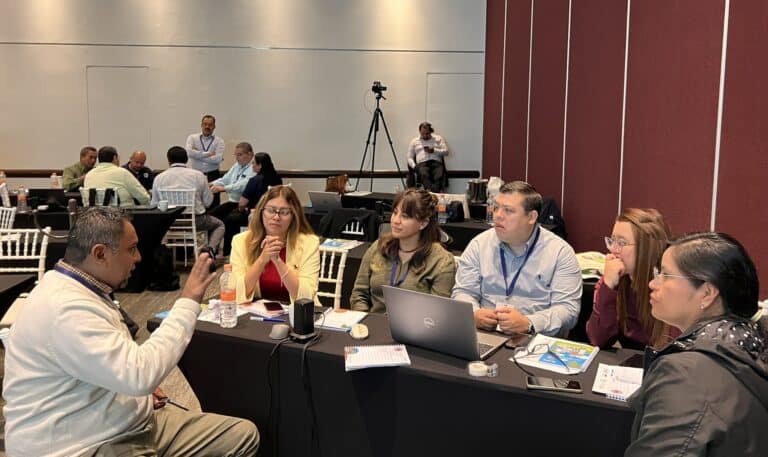
The portfolio of initiatives is being designed during a three-day working meeting in Chiapas, a state in southern Mexico with enormous natural and cultural wealth that demonstrates the extraordinary value of tropical agriculture for food security across the hemisphere and around the world.
Farmers are taking part in the meeting along with representatives of state agencies, agricultural institutions, academia, and international organizations.
“Inclusive and Competitive Sustainable Tropical Agriculture: Critical Path for Mexico and the Americas” is the title of the high-level international event taking place in the city of Tapachula, close to the border with Guatemala.
It was organized jointly by the Government of the State of Chiapas and its Secretariat for the Countryside, IICA and the Tropical Agricultural Research and Higher Education Center (CATIE).
The participants include the Director General of IICA, Muhammad Ibrahim, who explained that the collective efforts should contribute to the transition from traditional models to increased sustainable production that integrates science and ancestral knowledge to promote inclusion and competitiveness. “Chiapas, the heart of Mexico’s biodiversity, has all the resources to be a model laboratory that can be replicated across the region,” he said.
One of the sessions focused on the integration of sustainable productivity, climate resilience, technological innovation and financing mechanisms, underpinned by hemispheric cooperation.Experts from IICA, CATIE, the Alliance of Bioversity International and CIAT, the International Maize and Wheat Improvement Center (CIMMYT) and Mexico’s National Institute of Forestry, Agricultural and Livestock Research (INIFAP) discussed ways to promote concrete actions with impact on the territories.

Muhammad Ibrahim, Director General of IICA; and Diego Montenegro, IICA Representative in Mexico.
Hemispheric Platform
“Research and new technologies often fail to translate into concrete projects that benefit rural communities, which are the ones that will strengthen tropical agriculture in Mexico and the Americas,” pointed out Diego Montenegro, IICA Representative in Mexico and Coordinator of Special Affairs for the Northern Region, who moderated the discussion.
Last year, in collaboration with other leading agricultural innovation institutions in Latin America and the Caribbean —such as the Brazilian Agricultural Research Corporation (EMBRAPA), the Caribbean Agricultural Research and Development Institute (CARDI), CIMMYT, and the Alliance of Bioversity International and CIAT—, IICA and CATIE launched the Hemispheric Platform for Tropical Agriculture. This initiative aims to benefit farmers and indigenous communities through the implementation of innovative technologies and sustainable production systems.
“It is a space that brings together institutions with extensive experience, lessons learned, and cutting-edge scientific advances that need to be tested and placed in the hands of farmers. Proven technologies for greater sustainability and competitiveness in tropical agriculture already exist, but often they do not reach farmers,” explained IICA Specialist Karen Montiel.
“With the Hemispheric Platform for Tropical Agriculture, leading institutions are leveraging their comparative advantages to advance a research agenda tailored to tropical territories, which will facilitate the mobilization of funds and enable us to have a greater impact on public policies,” she added.
Laura Benegas, Director of Research and Inclusive Green Development at CATIE, emphasized the importance of integration. “We need to be thinking in terms of production chains that involve a combination of technologies,” she suggested. “And all the projects should include a component related to financing mechanisms. It’s the only way to promote generational renewal in agriculture.”
Alejandro Cano González, from INIFAP, gave a specific example of cooperation by describing the experience of 150 Mexican technicians who went to be trained at EMBRAPA, the state enterprise that has played a decisive role in the transformation of tropical agriculture in Brazil, a country that in a matter of decades went from being a net food importer to an agricultural powerhouse in terms of production and exports.
Jelle Van Loon, Associate Director of CIMMYT, referred to the need to “tropicalize” available agricultural technologies: “We have to adapt them to the needs of tropical agriculture, and to do that we must work together. CIMMYT is committed to demonstration plots: we have many throughout the region. We also prioritize trade;we target schemes that integrate small and medium-scale producers into markets with fair prices for coffee or cacao.”
Jeimar Tapasco, principal scientist at the Alliance of Bioversity International and CIAT, spoke about the portfolio of technologies available to farmers for dealing with issues such as the reduction of greenhouse gas emissions and water management. “The challenge lies in forging connections so that this gains momentum and has an impact on the land; for this, the role of public institutions is fundamental,” he commented.

Muhammad Ibrahim, Director General of IICA; and Karen Montiel, Technical Cooperation Specialist at IICA.
More information:
Institutional Communication Division.
comunicacion.institucional@iica.int