This was announced by the company’s CEO for Latin America, Paula Santilli, during a roundtable that she participated in with Latin American and Caribbean Ministers of Agriculture, and other senior executives of global companies involved in the production and marketing of food.
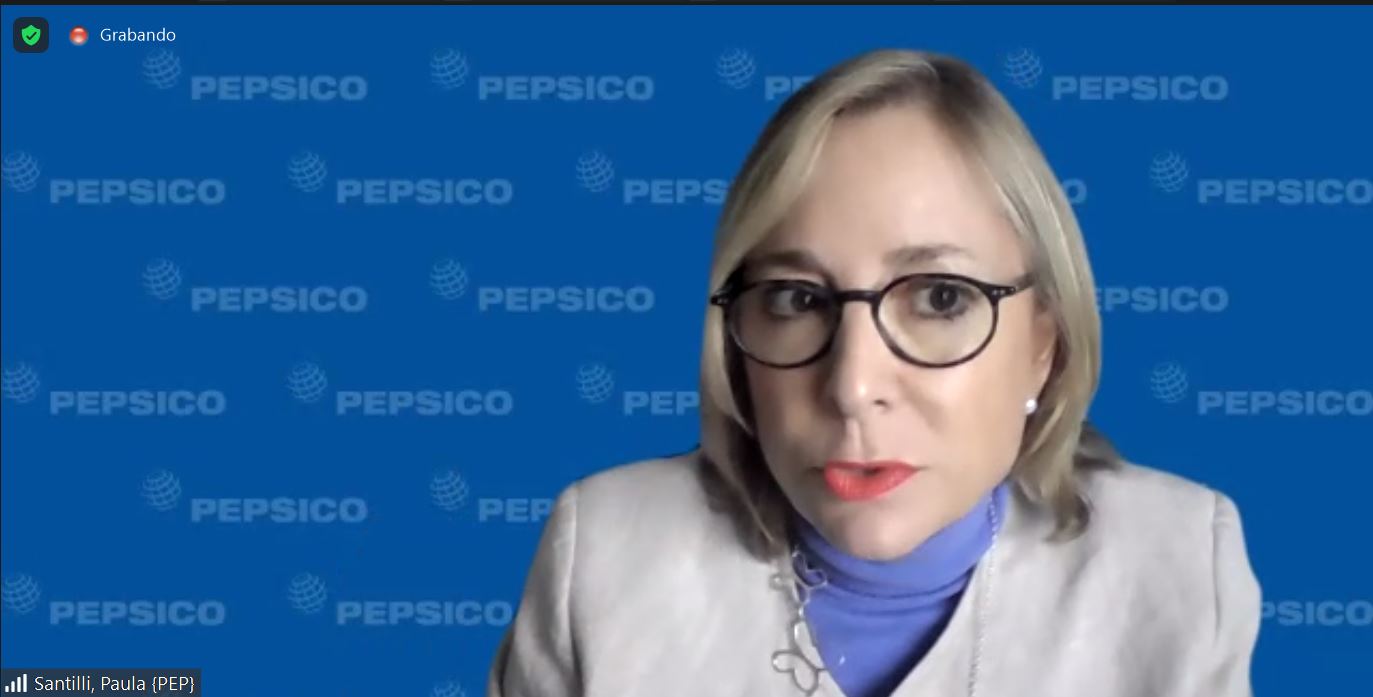
Washington, 10 August 2021 (IICA). The multinational food company Pepsico has set a goal to ensure that all the raw materials it uses are 100% sustainable by 2030.
This was announced by the company’s CEO for Latin America, Paula Santilli, during a roundtable that she participated in with Latin American and Caribbean Ministers of Agriculture, and other senior executives of global companies involved in the production and marketing of food.
The debate between actors from the public and private sectors was organized by the Council of the Americas and the Inter-American Institute for Cooperation on Agriculture (IICA) to discuss the future of the way food is produced and consumed and the situation of the communities of rural areas in the Americas in preparation for the 2021 Food Systems Summit, convened by the UN.
“Pepsico is a huge agroindustrial company that needs agriculture. We know that without farmers there is no business. That is why we are very close to producers, large or small, and we work to ensure that all our crops -corn, sugar, potatoes- are 100% sustainable. That is our main focus” Santilli said.
“We have set an ambitious goal for the company”, she added, “and we are committed to ensuring that everything we buy is 100% sustainable by 2030. This is not easy for a company of this magnitude, because 2030 is just around the corner. We need help if we are to achieve this goal”.
The round table began with the opening words of renowned scientist Rattan Lal, considered the world’s greatest expert on soil science, and featured the participation of the Minister of Agriculture, Livestock and Fisheries of Argentina, Luis Basterra; the Minister of Agriculture of Guyana, Zulfikar Mustapha; the Global Manager of Sustainability and Business Administration of Bayer, Klaus Kunz; and Walmart’s Director of Global Government Affairs, Christian Gómez.
The introduction and closing remarks were given by Eric Farnsworth, Vice President of The Americas Society / Council of the Americas (AS/COA), and Manuel Otero, Director General of IICA. Steve Liston, Senior Director of the Council of the Americas, acted as moderator.
Santilli explained that Pepsico has become an active promoter of regenerative agriculture, a concept that reconciles the challenge of producing adequate and nutritious food, on the one hand, with that of restoring ecosystems degraded by human activity.
“Regenerative agriculture means, among other things, adding biological components to production and using technology to care for the soil. We seek to reduce the amount of fertilizers and pesticides used and the consumption of water. This is a worldwide objective, and obviously also applies to Latin America. In addition, our goal is to lower greenhouse gas emissions and improve the livelihood of the people involved in our supply chain” said Santilli.
The executive also expressed support for a joint effort by the public and private sectors and the civil society to move towards a more sustainable agriculture: “We must work in harmony to change the current practices. This will not happen overnight, but we must unite with farmers so that ineffective practices are put aside and new ones can be incorporated”.
According to Mrs. Santilli, governments and companies should work to foster inclusive growth so that rural inhabitants can lift themselves out of poverty, and called for greater efforts to be made to empower rural women.
To illustrate her point, she said: “Think of a woman farmer entering a bank to ask for a loan to buy a tractor, in order to help her community to be more efficient. It is an impossible mission. For a man, on the other hand, it is easier. This is why industries and governments must work together so that the smallest, most vulnerable communities, which have the smartest approach to regenerative agriculture, are economically empowered and can sustainably establish themselves in rural areas”.
“Otherwise” she concluded, “we already know what happens: emigration to the cities, education failure, overwhelmed urban infrastructure… At Pepsico we have embraced regenerative agriculture because our business needs healthy and sustainable farming. We want to work as a team to achieve the changes that are needed”.
More information:
Institutional Communication Division.
comunicacion.institucional@iica.int