The Economic Commission for Latin America and the Caribbean (ECLAC), the Food and Agriculture Organization of the United Nations (FAO) and the Inter-American Institute for Cooperation on Agriculture (IICA) presented the report entitled “The Outlook for Agriculture and Rural Development in the Americas: A Perspective on Latin America and the Caribbean”.
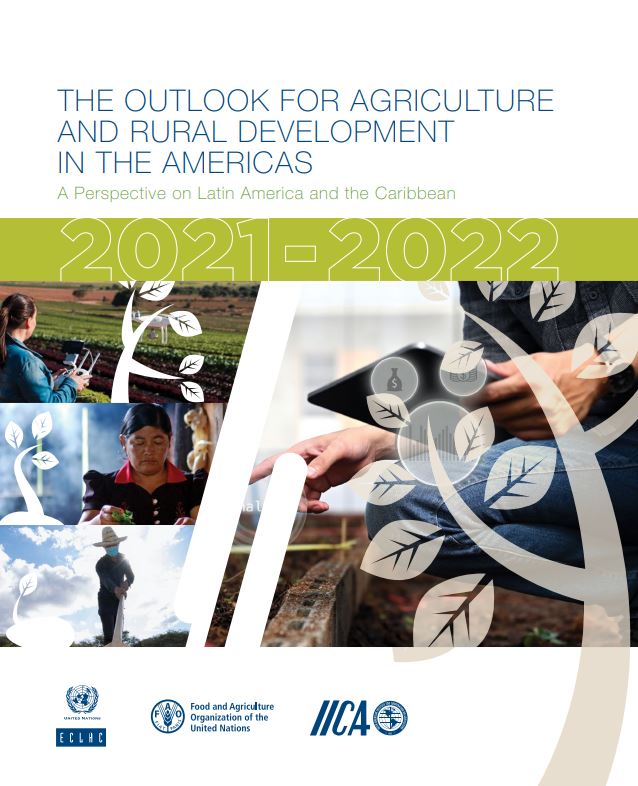
San José / Santiago, 3 September 2021 (IICA, FAO, ECLAC). Overcoming the health, economic and social crisis caused by the Covid-19 pandemic provides an opportunity to transform the development model of Latin America and the Caribbean and build agrifood systems that are resilient to future risks.
That is the conclusion of the ninth edition of the report entitled “The Outlook for Agriculture and Rural Development in the Americas: A Perspective on Latin America and the Caribbean”, prepared in an interdisciplinary manner by more than 30 technical specialists from the Economic Commission for Latin America and the Caribbean (ECLAC), the Food and Agriculture Organization of the United Nations (FAO) and the Inter-American Institute for Cooperation on Agriculture (IICA).
The pandemic caused the regional GDP to contract by 7% in 2020 – the largest downturn in economic activity in 120 years – and extreme poverty rose to levels that had not been observed in the region for the last 20 years.
The ECLAC, FAO and IICA document calls for “rebuilding better”, and stresses that long-term transformative actions must be carried out in tandem with the immediate recovery process,
while also tackling the health, economic and climate crisis.
To this end, it is essential to recognize the role of agriculture as a source of income, employment and food for the region and the world. The document states that, given that it is an essential sector, food production, along with health, should head the list of priorities for financing and investment during the recovery and transformation phases in the aftermath of the pandemic.
“The pandemic has demonstrated that agrifood systems play a crucial role in maintaining global, regional and national food flows from our fields to populations limited by quarantine measures and mobility restrictions. It has also made our vulnerabilities more evident”, stated Alicia Bárcena, Executive Secretary of ECLAC.
The agrifood sector proved to be more resilient than other economic sectors to the health, logistical and financial challenges posed by the pandemic: agrifood exports from the region increased by 2.7% in 2020 compared to 2019, while total exports fell by 9.1%.
According to the publication, the future of agrifood systems will depend on establishing a more harmonious relationship between human beings and correcting the multiple social, economic and territorial inequalities in the region.
Accelerating the digitization of agriculture
The document argues that accelerating the digitization of agriculture will be a priority issue in the aftermath of the pandemic.
“Digital agriculture can make a substantial contribution to the transformation and strengthening of agrifood systems as they evolve towards sustainability and social inclusion. Digital technologies can generate greater, more sustainable and resilient production; more efficient and accessible markets; safer, more nutritious and traceable food; and, of course, more inclusion and a better quality of life for all rural stakeholders”, explained Manuel Otero, Director General of IICA.
According to the report, the digitization of agriculture in Latin America and the Caribbean is in its early stages, but it is beginning to accelerate and will become inevitable. The use of digital tools is still low and unequal due to various obstacles: while 71% of the urban population has access to connectivity services, in rural populations this percentage decreases to 36.8 %.
“This is and will continue to be a process in which the winners will be those with the greatest capacity for innovation, for anticipating events, as well as for discovering and amplifying new solutions and new ways of producing, processing, trading, buying, selling and consuming food”, remarked Julio Berdegué, FAO Regional Representative.
To transform agrifood systems, “The Outlook for Agriculture and Rural Development in the Americas” report recommends investing in good sustainable management practices, fostering cooperative undertakings and capitalizing on the region’s opportunities to add value to biological resources and generate new socioeconomic opportunities in rural areas.
The publication also describes how to carry out development programs in a situation of scarce economic resources, such as what could occur in the coming years. It argues that agriculture- and food-related economic activities must ideally be based on endogenous, low-cost solutions that enable farmers, their families and communities to use their own resources. It also describes the current crisis as an opportunity to rethink the financial agenda for development, as well as an occasion to launch a sustainable and equitable rebuilding process.
The report “The Outlook for Agriculture and Rural Development in the Americas: A Perspective on Latin America and the Caribbean” can be downloaded at: https://www.agrirural.org/en.
More information:
Institutional Communication Division.
comunicacion.institucional@iica.int