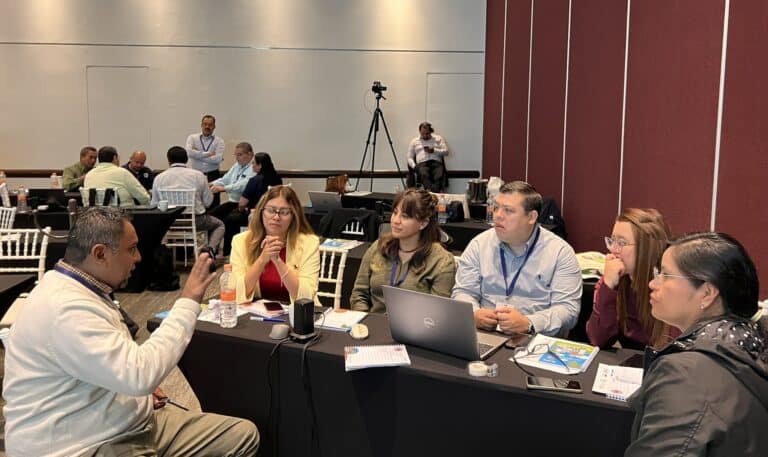

Mexico City, 19 May 2025 (IICA). In a joint effort to address the threat posed to the region by New World screwworm (NWS), representatives from the ministries of agriculture and veterinary services of Belize, Costa Rica, El Salvador, Guatemala, Honduras, Mexico, and Panama met in Mexico City to take part in a regional course entitled “Artificial intelligence to strengthen training and communication strategies for dealing with New World screwworm.”
The initiative was organized—as part of a joint work plan—by the Animal and Plant Health Inspection Service (APHIS) of the United States Department of Agriculture (USDA) with the Inter-American Institute for Cooperation on Agriculture (IICA), and with support from the Panama-United States Commission for the Eradication and Prevention of Screwworm (COPEG), the International Regional Organization for Plant and Animal Health (OIRSA), and the United Nations Food and Agriculture Organization (FAO).
The disease caused by NWS is primarily found among cattle, but it can also affect other domestic and wild species, and even humans, impacting public health and leading to losses in productivity and competitiveness.
Eradicated in the region in the early 2000s, new cases of the disease were reported in Panama and Costa Rica in 2023, and in Nicaragua and Honduras in 2024, leading countries to implement actions aimed at strengthening their prevention, control, and eradication measures.
Making the measures implemented more effective
The main purpose of the regional course was to strengthen the technical skills of the teams responsible for disseminating information and providing training in the participating countries, with a view to making the measures implemented in response to this health emergency more effective.
This activity was also part of the communication and training activities called for in the APHIS/USDA-IICA Plan.
At IICA, the Hemispheric Program on Agricultural Health and Agrifood Safety and Quality was responsible for the activity.
The delegates spent three days exploring innovative digital tools designed to strengthen knowledge transfer and improve educational processes in the field. The technological solutions included systems for analyzing audiences, personalizing messages, evaluating the impact of campaigns, and speeding up the creation of content for digital media.
Also presented were emerging technologies such as augmented reality simulations, computer-generated images, drones, and sensors for early detection of NWS, making it possible to take more effective health management decisions.
This training initiative was part of the coordinated efforts of APHIS/USDA and IICA to prevent and eradicate NWS in the region.
More information:
Institutional Communication Division.
comunicacion.institucional@iica.int