The first climate station prototype will be introduced in the field, for use in the Central American Program for Integrated Coffee Rust Management (PROCAGICA), under the direction of IICA and financed by the European Union.
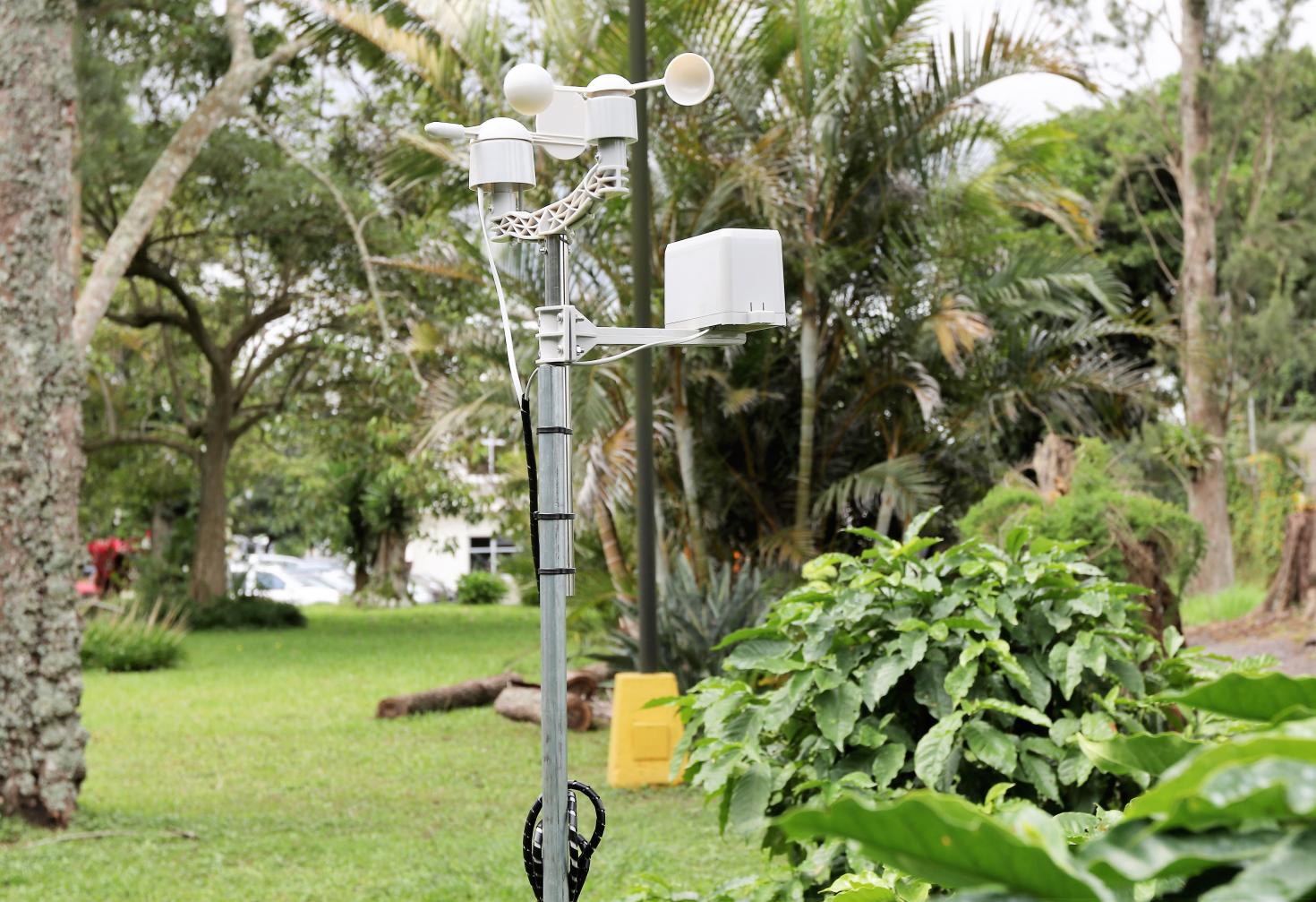
San José, 21 August 2019 (IICA). Microsoft, Lantern Technologies and the Inter-American Institute for Cooperation on Agriculture (IICA) have developed an Internet of Things device that will enable producers to monitor agro-climatic variables to inform decision-making in the management of their farms and to improve their yields.
It is the first climate station prototype designed with the latest Internet of Things (IoT) technologies and is equipped with sensors that capture real time data on variables such as soil and environmental humidity, temperature, precipitation, luminosity, dew, and wind speed and direction, to name a few.
Emmanuel Picardo, IICA’s Manager of Information and Communication Technologies and Digital Agriculture, explained that Microsoft will facilitate cloud storage of the information captured by the sensors. Producers will be able to access the data and to set up alerts and notifications on specific variables, so that they can be sent to them via their mobile devices or email.
According to Picardo, “This is a comprehensive solution for small- and medium-scale farmers that can be scaled up. The sensors use conventional batteries and can function independently in the field for up to two years. They are connected to the cloud via a radio frequency network that uses a low bandwidth at a moderate cost”.
Initially, the climate station will be introduced in the field, for use in the Central American Program for Integrated Coffee Rust Management (PROCAGICA), under the direction of IICA and financed by the European Union.
The Program will provide technical assistance to coffee growers in Guatemala, El Salvador, Honduras, Nicaragua, Costa Rica, Panama and the Dominican Republic, to address problems stemming from the coffee leaf rust, with an emphasis on production, and social and trade-related matters.
PROCAGICA’s Coordinator, Harold Gamboa, stressed that, “There is an increasingly pressing need for climate information, given the complexity of production scenarios and greater climate vulnerability, which impacts yields and the price of commodities”.
He went on to add that, “This technological tool aims to facilitate decision-making in the management of production units and to improve planning of field activities, in keeping with the characteristics of each region.
The Institute will be instrumental in providing training, advisory services and support to producers in using the device, as well as in interpreting the data and information that is collected, enabling them to apply good agricultural practices, prevent crop losses and to improve productivity.
“The climate station prototype is part of IICA’s efforts to transform and digitalize agriculture”, said Picado, “as we seek to reduce the digital divide, facilitating producers’ access to technological tools and giving them a sense of security and confidence in using this type of solution.
More information:
Emmanuel Picado, Manager of IICA’s Information and Communication Technologies and Digital Agriculture Division.
Harold Gamboa, Coordinator of PROCAGICA.