Tomorrow, the meeting participants will visit the Jamaican agricultural sector and return to their countries committed to implementing strategies that will ensure that the hemisphere’s population has food on the table.
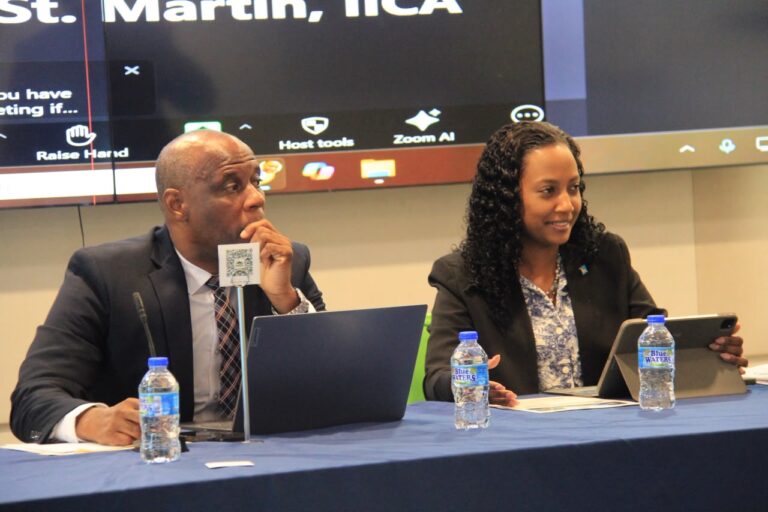
Montego Bay, Jamaica, October 30, 2009. The Week of Agriculture and Rural Life of the Americas – Jamaica 2009, which brought together representatives of 33 countries concluded today in Montego Bay with the approval of a number of strategic actions aimed at promoting food security in the hemisphere.
The week’s activities will be complemented with a field trip to the southern and northern coasts of Jamaica to visit successful agricultural operations.
The week comprised a number of important meetings, including the Fifth Ministerial Meeting Agriculture and Rural Life of the Americas and the Fifteenth Regular Meeting of the Inter-American Board of Agriculture (IABA), the governing body of the Inter-American Institute for Cooperation on Agriculture (IICA).
On this occasion, the ministers and secretaries of agriculture or heads of delegation adopted the Hemispheric Ministerial Agreement Jamaica 2009, and meeting as the IABA, elected Victor Villalobos from Mexico as Director General for 2010-2014.
The new ministerial agreement follows up on the Guatemala 2007 Agreement and implements the mandates related to agriculture, food security and rural life issued at the Fifth Summit of the Americas, held in July 2009 in Port of Spain, Trinidad and Tobago.
The principal commitments assumed by the countries are set out in strategies aimed at:
- Building national capacity for enhancing food security and rural life;
- Strengthening the positioning of the issues and priorities of agriculture and rural development in the public conscience and national strategies; and,
- Investing more in agriculture and rural development, to promote with the stakeholders of agriculture, a broader way of thinking and acting in agriculture and the rural milieu, and fostering with them the “working together” approach to improving agriculture and rural life in the Americas.
Some of these actions are related to promoting competitive rural enterprises, integrating and strengthening commercial-scale agricultural production chains, promoting a favorable environment, greater environmental accountability in the countryside and the creation of capacities and opportunities in rural communities (see full Ministerial Agreement – Jamaica 2009).
On this occasion, the participants in the Week of Agriculture included high-level political and agricultural leaders from Jamaica and the rest of the hemisphere. The activities were inaugurated officially by the Prime Minister of Jamaica, Bruce Golding, and by his Minister of Agriculture and Fisheries, Christopher Tufton, who served as Chair.
The Permanent Secretary at the Ministry of Agriculture of Jamaica, Donovan Stanberry, also played a key role serving as the Chairman of the Group for the Implementation and Coordination of the Agreements on Agriculture and Rural Life of the Summit Process (GRICA), which was responsible for laying the groundwork for the agreement signed in Jamaica.
Also in attendance at the meeting were experts and high-level international officials, such as the Secretary General of the Organization of American States (OAS), Jose Miguel Insulza, the Secretary General of the Economic Commission for Latin America and the Caribbean (ECLAC), Alicia Barcena, the FAO Regional Representative for Latin America and the Caribbean, Jose Graziano Da Silva, and the Director General of IICA, Chelston Brathwaite.
The participants highlighted the critical role played role by the private sector in achieving food security in the nations of the hemisphere. This emerged from the Private Sector Dialogue, which involved outstanding entrepreneurs from the Americas, including the General Manager of the Jamaica National Building Society (JNBS), Earl Jarrett.
The next Week of Agriculture will take place in 2011.
For more information, contact