
Belém do Pará, Brazil, 14 November 2025 (IICA) – The only sector capable of sequestering carbon in an economical way is agriculture, said Marcelo Regúnaga, General Coordinator of the Group of Producing Countries of the Southern Cone (GPS) in a statement released at COP30.
The GPS network, whose membership consists of the main private agroindustrial organizations in Argentina, Brazil and Uruguay, has a close partnership with the Inter-American Institute for Cooperation on Agriculture (IICA).
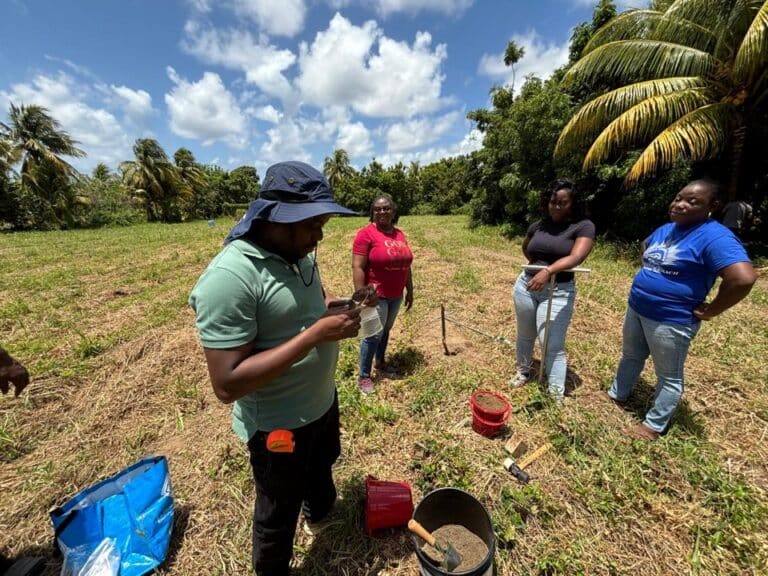
On an ongoing basis, the GPS network generates scientific knowledge, thereby making a significant contribution to efforts to demonstrate that agriculture can play an important role in resolving environmental challenges, through different production options, such as the recovery of degraded soils, forestation, silvopastoral production systems and no-till farming.
In a statement that was released at the Home of Sustainable Agriculture of the Americas,the pavilion that IICA and its strategic partners have established in the COP30 Agrizone, Regúnaga noted that, “The Southern Cone countries of the Americas have great potential to attract investments and implement solutions aimed at sequestering carbon in agroindustrial activities, given the region’s enormous wealth of natural resources and the technological developments that are already evident in its agribusinesses”.
Funding
Regúnaga pointed out that the further development of solutions that will have a significant impact at the global level, will hinge on identifying private and public funding mechanisms to undertake investments that will unleash the full potential of the agriculture sector.
“The global warming that affects the planet is the product of greenhouse gas emissions that have accumulated in the atmosphere over almost two centuries, due to industrialization processes, particularly in developed countries”, he explained.
Regúnaga, an agricultural engineer and agricultural economist with extensive experience working as a consultant to international organizations, said that scientific studies and simulation models that illustrate the evolution of emissions in different economic sectors show that the only sector that can sequester carbon in an economical way is agriculture or other nature-based solutions.
“In other words, agriculture isn’t a problem, as has been suggested in previous editions of COP, but rather is part of the solution to the global challenges of food security; the reduction of carbon in the atmosphere; the energy transition, through the use of biofuels, as well as other bioeconomy and circular economy initiatives; and social and economic development in relatively less developed countries”, he said in closing.
More information:
Institutional Communication Division.
comunicacion.institucional@iica.int