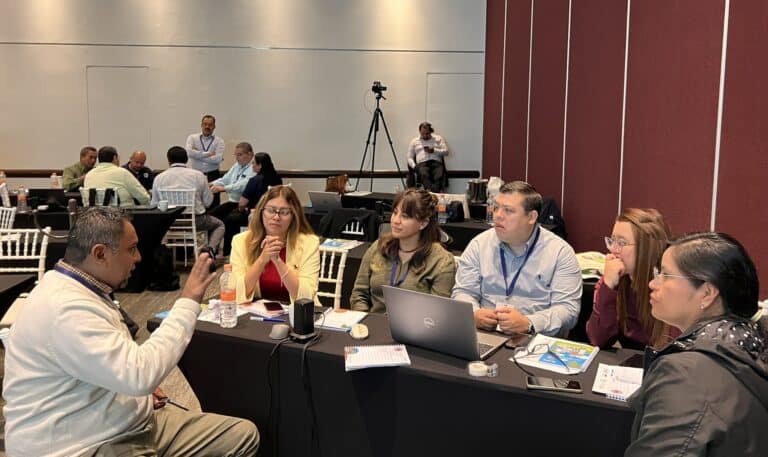
During a presentation at IICA Headquarters, the Director of the USDA’s Global Policy Analysis Division explained this region’s potential to provide food for the world’s growing population.

San José, Costa Rica, May 2, 2013 (IICA). The fact that there are nearly 123 million hectares of unused farmland in Latin America could make the region a key player in the enormous efforts to feed the world’s burgeoning population. This part of the world is better placed to do so than others, which, although they have huge amounts of land available, also have major logistical or developmental difficulties to overcome.
With Brazil leading the way in terms of the amount of land available for farming, Latin America and the Caribbean have better infrastructure and farms that are closer to markets than other regions that still have unused farmland, such as Africa (which has some 202 million hectares that could be used for crops) and Russia and Ukraine (with some 52 million), according to a presentation given at the Inter-American Institute for Cooperation on Agriculture (IICA) by Michael Dwyer, of the United States Department of Agriculture (USDA).
Dwyer, Director of the Global Policy Analysis Division of the USDA’s Foreign Agricultural Service, explained that the use of new land for agricultural activities is one of the factors to which the USA pays closest attention in projecting the evolution of national and international agriculture, an annual exercise known as the “Agricultural Outlook,” the details of which IICA passes on to its member countries (read IICA’s most recent Technical Note on the subject).
The USDA representative explained that, in South America, the growth in the production of soybeans and other oilseeds since 1990 had been due mainly to increased acreage rather than bigger yields. In other parts of the world, higher production had been achieved by improving yields, especially with regard to crops such as grains and cotton.
“The agricultural sector of Latin America and the Caribbean needs to think about how to seize this opportunity, but first it must address issues such as land ownership and land titling,” noted the USDA official, whose presentation in Costa Rica was organized by the Ministry of Agriculture and Livestock (MAG) and the local IICA Office.
Tania López, Deputy Minister of the MAG, also took part in the activity held at IICA Headquarters in San Jose, during which the U.S. expert expressed concern about the rising value of land, largely due to the effect of high commodity prices—which are expected to remain high over the next decade¬—and growing competition for the use of the resource.
In general, terms, three trends have been detected in the structure of land ownership in Latin America and the Caribbean, namely: fragmentation in Mexico, Central America, and the Andean nations; concentration in the Southern Cone; and a high percentage of land owned by the State in the Caribbean countries. That is the conclusion of the report, The Outlook for Agriculture and Rural Development in the Americas: A Perspective on Latin America and the Caribbean 2013, prepared by IICA, the Regional Office for Latin America of the United Nations Food and Agriculture Organization (FAO) and the Economic Commission for Latin America and the Caribbean (ECLAC).
Based on data for 2011 from the World Bank, the USDA official explained that 76% of the 123 million unused hectares of farmland in Latin America and the Caribbean could be used to produce food that could reach markets in less than six hours. The percentage in Russia, Ukraine and other parts of Eastern Europe is 83%, but in Africa it is 47%.
In total, there are 446 million hectares of farmland available worldwide. This is land in areas that are not protected and without forest cover, and with a population density of less than 25 persons per square kilometer.
In addition to tapping the agricultural potential of such land, on which more food could be produced and clean energy sources developed, Dwyer suggested that biotechnology could be used to achieve higher agricultural yields, which had fallen in recent months in the USA and the European Union, mainly due to severe weather, and had experienced very little growth since last year in South America, Central America, and East Asia.
“Given the expected growth in the demand for food and energy, due largely to the burgeoning middle class in developing countries, we should harness biotechnology and all the tools available for raising productivity,” Dwyer remarked. He also mentioned techniques such as conservation tillage, drip irrigation, and multi-cropping practices.
He added that by 2022 there are expected to be 978 million middle-class households worldwide, 853 million of which will be in developing countries. In Latin America, the countries with the largest number of such households will be Brazil (13 million), Mexico (six million), and Colombia (two million).
For more information, contact:
miguel.arvelo@iica.int