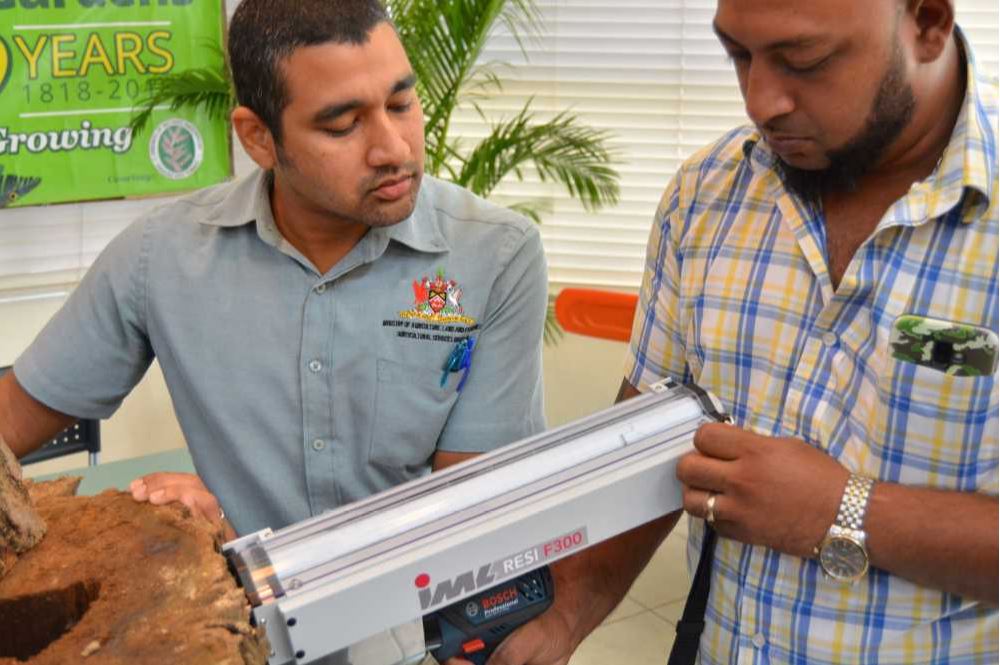
The Institute handed over to the Ministry of Agriculture, Land and Fisheries in Trinidad and Tobago their first resistograph to evaluate trees health and prevent risks under heavy rains, winds and floodings.
 Port of Spain, December 19, 2019 (IICA). The Inter-American Institute for Cooperation on Agriculture (IICA) supports the work of the Ministry of Agriculture, Land and Fisheries in Trinidad and Tobago (MALF) on the development of an Agricultural Disaster Risk Management (ADRM) Plan, handing equipment to assess the level of risk of trees after natural disasters.
This equipment was procured by IICA, under a special Caribbean Fund from the IICA Director General, Manual Otero. It included a Resistograph, which, according to Yohann Govia of the MALF-HSD, is the first owned by the MALF.
In demonstrating the use of the machine to HSD officers and the media, Govia was quick to confirm that they “do not cut down healthy trees and having the resistograph will help us to detect and monitor cavities in trees, assess if trees pose a risk and determine the health of trees that we want to preserve”.
In addition to the Resistograph, IICA also provided a harness and spikes for tree climbing, two chainsaws and 400 feet of two sizes of heavy duty, expandable rope used for enhanced safety.
IICA Technical Specialist, Richard Rampersaud, indicated that “IICA was invited by the Minister of Agriculture, Land and Fisheries, Senator Clarence Rambharat, to be part of a Ministerial Committee tasked to develop an Agricultural Disaster Risk Management (ADRM) Plan”.
As a member of the Committee and the Data Management Working Group, IICA worked alongside MALF technicians to assess specific communities for flood vulnerability and develop farm flood vulnerability maps. IICA also data entry of outstanding flood claims over the 2015-2018 period, and supported the sensitisation and training of MALF senior staff and extension offices in first responder and incident command centre operations.
“Having a disaster management plan is one thing; but being prepared and able to actually respond to incidents is more important, including the capacity to be able to reach your response team at any time”, said the Ministry of Agriculture, Senator Clarence Rambharat.
The rains and flooding in parts of south Trinidad during the week of December 9th, provided the perfect backdrop to the handover of specialised equipment to the Horticultural Services Division (HSD) of the MALF.
More information:
Richard Rampersaud, Agribusiness and Value Chain specialist at IICA