Amina J. Mohammed, UN Deputy Secretary-General made these remarks at the Conference of Ministers of Agriculture of the Americas, which is taking place in conjunction with the meeting of the Inter-American Board of Agriculture (IABA), IICA’s highest governing body, under this year’s theme: “Sustainable Agri-food Systems, the Engine of Development of the Americas”.
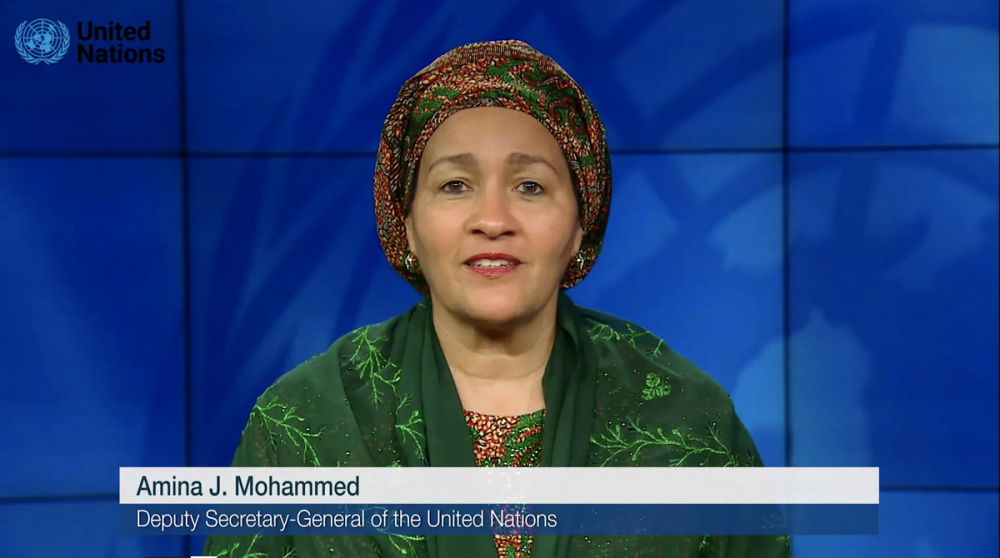
San Jose, 1 September 2021 (IICA). UN Deputy Secretary-General, Amina J. Mohammed, in a message to the ministers of Agriculture of the Americas, maintained that investments aimed at transforming global agrifood systems could drive post Covid-19 economic and social recovery and get the world back on track to achieving the 2030 Agenda and the Sustainable Development Goals (SDGs) within the next nine years.
Mohammed made this assertion at the Conference of Ministers of Agriculture of the Americas, which is taking place in conjunction with the meeting of the Inter-American Board of Agriculture (IABA), the highest governing body of the Inter-American Institute for Cooperation on Agriculture (IICA), under this year’s theme: “Sustainable Agri-food Systems, the Engine of Development of the Americas”.
“There is no one-size-fits-all solution for all the challenges faced by food systems, but in every context, there are opportunities to innovate and to accelerate action together towards the 2030 agenda”, said Mohammed.
The diplomat spoke about preparations for the United Nations Food Systems Summit, which will take place in New York on 23 September. The American hemisphere will be the only region that will come to the Summit with a joint position, defined by a document containing 16 messages that were agreed on among the 34 Member States of IICA, under the coordination of the Institute.
“We are now in the final stages of preparation for the Food Systems Summit. These have taken place under the unprecedented pressure of the Covid-19 pandemic, which has stolen lives and livelihoods, reversing progress on the 2030 Agenda and the SDGs”, stated Mohammed.
“However, the Pre-Summit that was held in July in Rome demonstrated that governments and other stakeholders are ready to come together around this issue. More than 500 leaders met in person with more than 2,000 delegates from 191 countries. Together, we discussed how we can accelerate action on food systems to benefit people, the planet and prosperity”, she added.
Mohammed defined the upcoming Summit as an exercise characterized by “effective multilateralism in action” and considered it “a reason for shared hope during this Covid-19 crisis”.
“Transformative investments in our food systems”, she explained, “can drive our recovery from the pandemic and get us back on track to achieve the SDGs in the next nine years”.
During her message to the Ministers of the Americas, she also revealed that more than 1,000 pre-summit dialogues across 145 countries have demonstrated that transformative solutions and actions must be tailored to local realities.
“The Summit itself will be an opportunity to consolidate the enormous progress that has been made and set the right tone for the decade ahead. As countries and regions define their pathways, it will be essential to create and maintain multi-sectoral and collaborative dialogue”, she remarked.
Lastly, Mohammed noted that “small-scale producers and indigenous peoples, in particular, must be valued and heard. Inclusive approaches will complement and broaden scientific evidence-based policies and processes. This conference, which will include representatives from civil society, the academic sector and beyond, is therefore an important contribution to our common effort”.
More information:
Institutional Communication Division.
comunicacion.institucional@iica.int