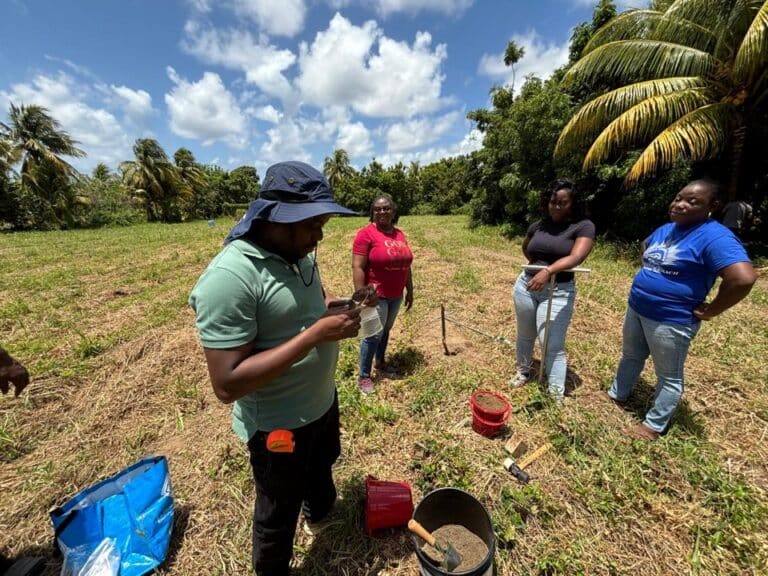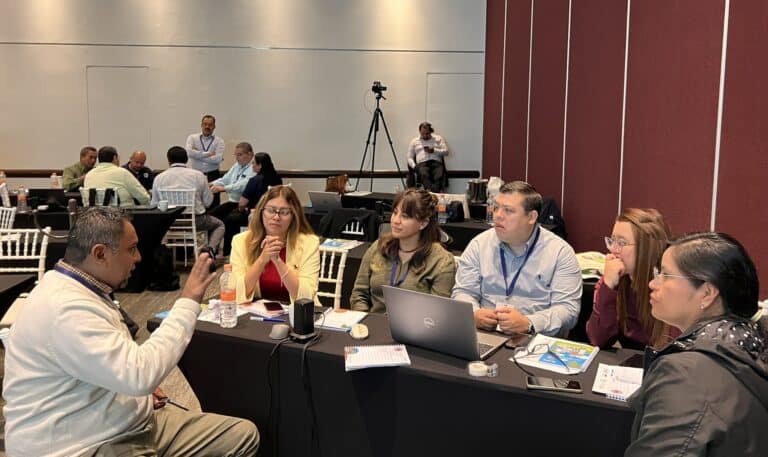
The competition, which involved more than 40 young participants, was organized by ESRI Panama, GeoTecnologías, Netafim, Indigo Drones and IICA.

San José, XX September 2025 (IICA). – With the goal of fostering innovative solutions for the sustainable management of water in agriculture, more than 40 young people from Guatemala, Nicaragua, Costa Rica, Panama, and Ecuador took part in the GeoRiego Hackathon: Innovative Water Use in Central American Agriculture, organized by the Inter-American Institute for Cooperation on Agriculture (IICA) and regional partners.
The event, held at IICA’s headquarters in San José, Costa Rica, brought together 19 teams that used geospatial technologies and multi-scale data to tackle the challenge of efficient water use in the region.
The competition was organized by ESRI Panama, GeoTecnologías, Netafim, Indigo Drones, and IICA. It was aimed at students and university professors in agricultural engineering, biosystems, agronomy, water resources management, geography, environmental sciences, and other related disciplines.
Participants, aged between 24 and 36, worked for a month on the development and design of technological solutions, with access to specialized mentors in geographic information systems, remote sensing, climate modeling, programming, agronomy, and water management.
They also received training in ArcGIS (geographic information system application), data analysis, efficient irrigation, watershed modeling, app configuration and the use of drones in agriculture.
“During the hackathon, we developed workshops focused on analytics, automation and data visualization, and encouraged the participation of Central American universities, the generation of new knowledge, and the empowerment of geospatial science as a powerful tool to analyze and propose solutions to the most challenging water-related problems”, said Emilce Mejía of ESRI Panama.
Isaac Arauz, Head of Education and Business Development at Indigo Drones, highlighted the importance of inter-institutional partnerships. “Each actor in this network can contribute their knowledge and tools to serve the common cause, which is to develop this event and generate a positive impact on participants”, he noted.
Joselyn Leiva Berrocal, Business Developer in Agriculture at GeoTecnologías, stated that “the hackathon experience awakened creativity; now the challenge is to go deeper into methodologies and best practices so that students and professionals can turn their ideas into sustainable solutions”.
The competition concluded with the presentation of innovative solutions to a jury composed of specialists from the organizing entities, as well as professors and university students from Costa Rica.
José Francisco Aguilar, professor at the School of Biosystems Engineering of the University of Costa Rica, said that “these kinds of spaces aim to generate synergies and integrate development, production, government and academic sectors. Through this IICA call, students can see a broader horizon of opportunities and challenges regarding current technological options”.
Innovative proposals for more efficient water management
First place in the hackathon was awarded to Elvis Danilo Pérez Bendaña, from Nicaragua, for his project addressing water balance in crops. It compares the amount of water needed by plants to grow with the amount available in the soil, guiding sustainable irrigation with a focus on natural water recovery.
Second place went to Sebastián Vargas Castro, Obeth Cambronero Fernández, Rodrigo Michael Murillo Cruz, Byron Vargas Montero and Kevin Corrales Castillo, from Costa Rica, with an innovative proposal for melon irrigation management in Puntarenas province. Their solution consists of a digital platform with artificial intelligence, integrating data on water resources and agricultural production to support producers, public institutions and research centers.
Finally, third place went to Christopher Mora Jiménez, María Auxiliadora Zúñiga Amador, Arnoldo Arias, Roldán José Aguirre Murillo and Priscilla Blanco Castillo, from Costa Rica, who presented a plan for water harvesting and irrigation in coffee crops in the Naranjo area, Alajuela province. The proposal sought solutions to meet the needs during the coffee flowering period, with the goal of reducing water consumption by 30% during this stage.
Emmanuel Picado, Manager of the Information/Communication Technologies and Digital Agriculture Division at IICA, noted that “the challenge demonstrated how data and technological tools can be turned into innovative and strategic solutions for Central America. The active participation of students and professors from various universities in the region reflects the enormous potential of academic collaboration in favor of regional water security”.
He added that, at IICA, “we are proud to be facilitators of these initiatives, promoting innovation, collaborative learning, and the development of technical capacities that strengthen the sustainable future of our region”.
More information:
Institutional Communication Division.
comunicacion.institucional@iica.int