IICA organized a forum “Commercialization strategies that facilitate market access for cocoa producers” in the Dominican Republic, with the participation of more than 30 actors representing public and private support institutions and producers´ organizations.
IICA´s Flagship Project: “Competitiveness and Sustainability of Agricultural Chains”, identified three commercialization strategies[1] (short supply chains, supply chain linkages and commercialization linkages for differentiated products) to support agricultural producers to enter, remain or increase their participation in local, national and international markets.
IICA´s actions on this topic seek to foster institutional and commercial innovations in order to create better linkages and increase producers’ participation in markets, with commercialization strategies that enable them to identify, understand, and internalize consumers’ demands, so they can develop processes that add value to and earn higher incomes for their products.
The implementation of the commercialization strategies started with two of the Project´s prioritized chains, cocoa and horticulture, by sharing institutional experiences and successful producers´ organizations cases in order to identify determinants and success factors for each strategy. In this edition of the newsletter, the progress of the cocoa value chain will be addressed
IICA organized the forum “Commercialization strategies that facilitate market access for cocoa producers” in the Dominican Republic, with the participation of more than 30 actors representing public and private support institutions and producers´ organizations from Colombia, Costa Rica, Ecuador, Guatemala, Honduras, Panama, Peru and Dominican Republic.
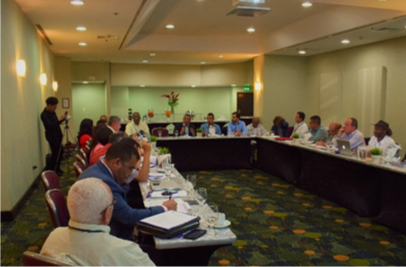 IICA organized the forum “Commercialization strategies that facilitate market access for cocoa producers” in the Dominican Republic, with the participation of more than 30 actors representing public and private support institutions and producers´ organizations from Colombia, Costa Rica, Ecuador, Guatemala, Honduras, Panama, Peru and Dominican Republic.
The event included an in-depth analysis of 8 producers’ organizations and SME´s: Grupo CONOCADO, Asociación de Productores de Cacao del Cibao (APROCACI) and Xocolat from the Dominican Republic; Asociación de Productores de Cacao from Honduras (APROCACAHO); Unión de Organizaciones Campesinas Cacaoteras (UNOCACE), from Ecuador; Federación Nacional de Cacaoteros (FEDECACAO), from Colombia; G&E from Costa Rica and Cooperativa Agraria Cafetalera ORO VERDE from Peru. Experiences from the departments of agriculture of Costa Rica, Peru and Panama, in supporting the competitiveness of the cocoa chain in each country, were also shared.
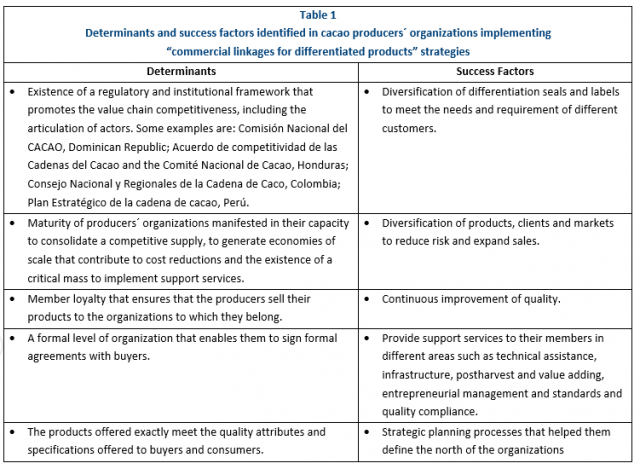
Most producer´s organizations (CONACADO, APROCACI, APROCACAHO, UNOCACE y ORO VERDE) are implementing the “commercialization linkages for differentiated products” strategy as a way to increase their market share and the price received by their members. Among the determinants and factors of their success, the following stand out (Table 1).
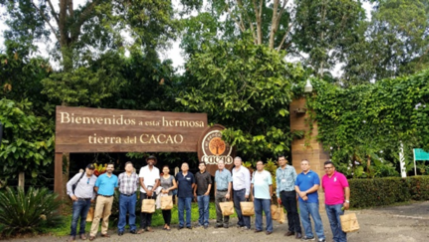
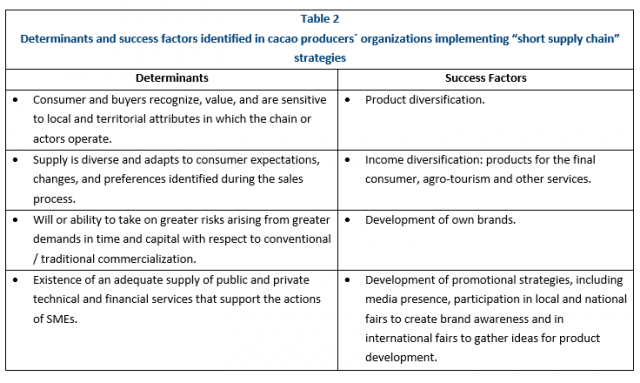
In order to identify determinants and success factors (Table 2) for the “short supply chain” strategy, the cases of two SMEs Xocolat and D&E were analyzed. To complement their information the forum included a visit to El Sendero del Cacao (The Cocoa Path), an agrotourism initiative implemented by Grupo Rizek and the experience of CHOCAL a group of women selling value added products to the local market.
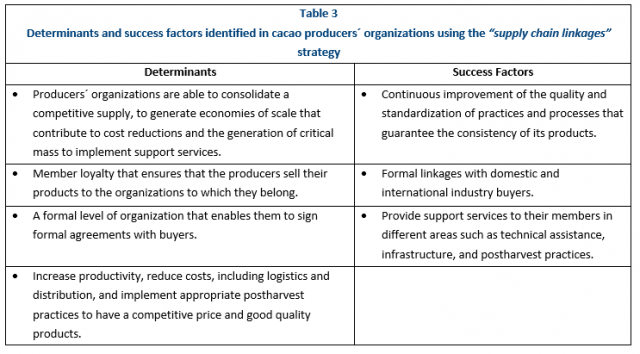
The “supply chain linkages” strategy is being successfully implemented by the Federación Nacional de Cacaoteros of Colombia, their main determinants and success factors are shown in Table 3.
During the last session of the forum, participants identified a set of priorities that can be addressed through horizontal cooperation between institutions and producers’ organizations: the creation of brands for fine aroma cocoa; the implementation and administration of differentiation seals and labels, such as organic or fair-trade; value added; financing schemes; establishment of differentiated prices based on quality, as well as the definition of strategies to preserve the premiums received for quality and product differentiation. Other topics of interest were the strengthening of managerial and associativity capacities, and quality and safety management. IICA is currently working on the systematization of the forum and will share it in the near future.
Progress on the horticultural value chain will be address in the next newsletter.
More information: daniel.rodriguez@iica.int
[1] Short supply chain: “an articulation of individual or informally organized producers of fresh or processed products, differentiated but without certification, with intermediate or final consumers, involving a maximum of one intermediary, in most cases production agreements are not defined prior to sale, and that includes the development of proximity relationships”.
Supply chain linkages: “an articulation of formally or informally organized producers who supply raw materials, fresh products, or products with little value added, that are marketed as generics to meet demand from agroindustrial firms, agroexporters, national or subnational government entities, and distribution chains (public or private), involving two or more intermediaries before reaching the end-consumer, and usually involving prior purchase and sales agreements (formal or informal)”.
Commercial linkages for differentiated products: “an articulation of formally established organizations of producers of raw materials, fresh or processed products, that are differentiated, have third-party certification, have segments and niches sensitive to their attributes, long or short distance between producers and end-consumers, connected in many cases by specialized channels, be they local, regional, national, or international, with close relationships, and with or without prior agreements”.
*The opinions expressed in this newsletter are those of the authors and they do not reflect the position of the Institute on the topics presented.
*This post appears in the IICA Delegation in the USA Newsletter – January – February 2017