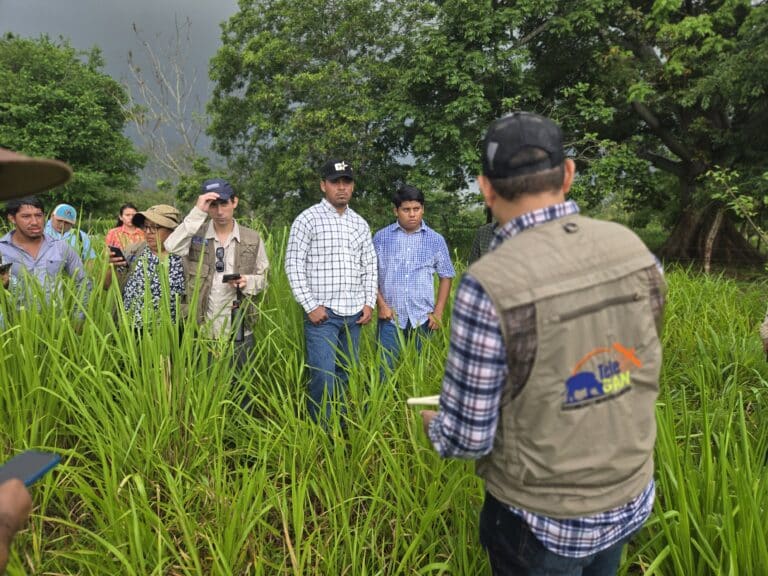
Drones are deployed to map the terrain and gather critical information, enabling producers to improve decision-making and to optimize the exploitation of their farms.
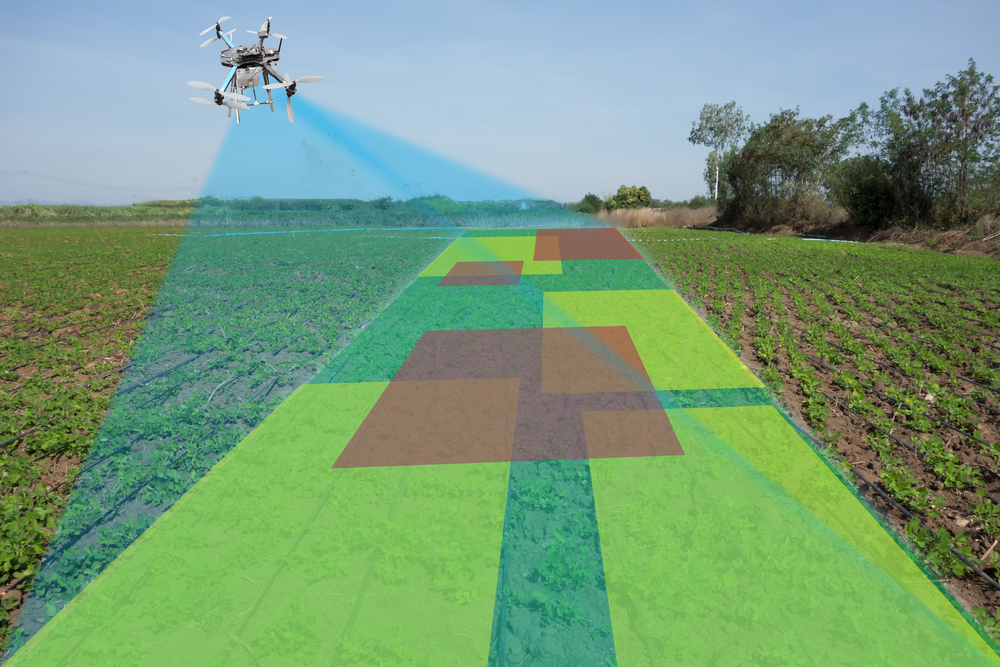
San Jose, 28 July 2020 (IICA). – The Development Banking System (SBD) of Costa Rica and the Inter-American Institute for Cooperation on Agriculture (IICA) have embarked on a project that utilizes drones to collect detailed information on cocoa farms, to inform the preparation of plans to allow producers to be more profitable and to improve their standards of living.
The project will seek to facilitate decision-making by producers, assisting them to make more effective use of their land, for example, by introducing more sustainable agroforestry systems that intercrop cocoa with other crops, and in so doing to provide sufficient income year-round, while protecting and increasing biodiversity.
To date more than 500 hectares have been mapped in the southern Caribbean region of the country and work is slated to begin in the Huetar Norte and Brunca regions in the coming weeks.
Miguel Arvelo, IICA Representative in Costa Rica, stressed that, “Today, more than ever, it is imperative that we progress toward Agriculture 4.0. We are working to support the countries and to equip them with technological tools, such as drones and other equipment, that will transform their rural areas and ensure that their investment will yield the greatest possible impact”.
High resolution maps generated by the drones will facilitate analysis of key aspects, such as topography, shade and the amount of plants and trees on the farms, as well as the protected areas. This information will be used to devise cultivation plans that are adapted to the conditions of the specific farms, in a bid to enhance productivity.
Georeferencing of the terrain will allow the institutions to recommend more efficient processing and logistics models to the producers, which will facilitate their access to various stages in the chain, for example, processing, transportation and storage, all of which are critical to their productivity.
Kenneth Solano, a Specialist in the IICA Costa Rica Delegation pointed out that, “Right now we are concentrating on cocoa. However, this methodology is applicable to practically any crop and any place. I see this as an opportunity to begin to engage producers with technology and to promote science-based decision-making”.
More information:
Institutional Communication Division
comunicación.institucional@iica.int