The entities signed an agreement to encourage the inclusion of youth in the design of policies and initiatives in areas such as resilience, traceability, biotechnology, sanitary and phytosanitary matters and food security.
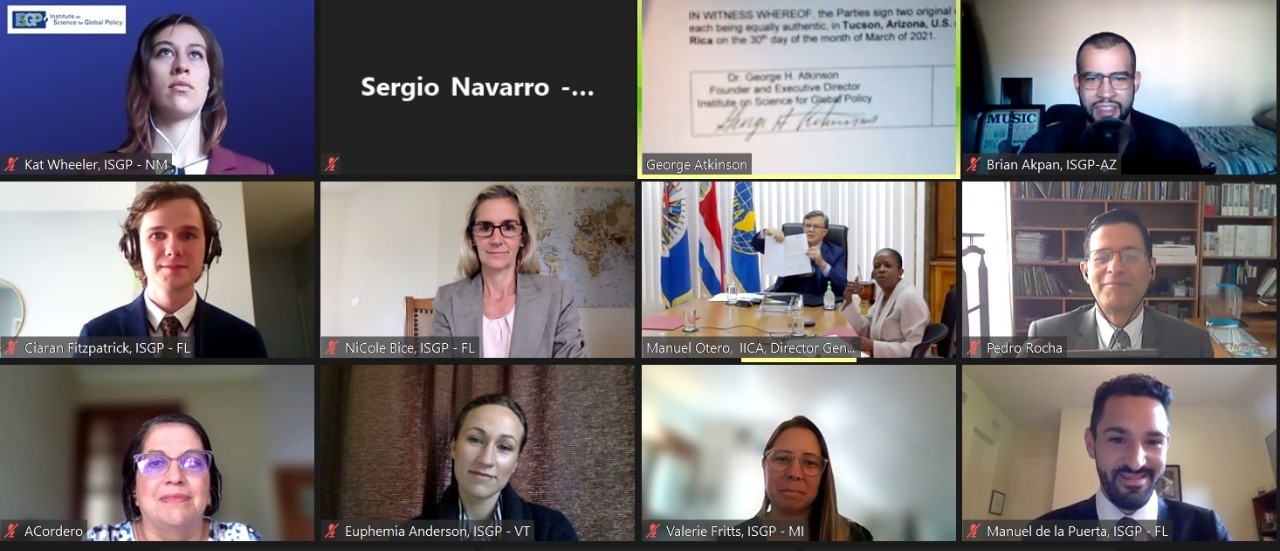
San Jose, 5 April 2021 (IICA). Supporting the development of science-based public policies to inform decision-making and strengthening the agriculture sector to ensure sustainability, productivity and the economic prosperity of producers in the rural Americas were the main objectives of an agreement between the Institute on Science for Global Policy (ISGP) and the Inter-American Institute for Cooperation on Agriculture (IICA).
The agreement was signed between ISGP founder and Executive Director, George Atkinson, and the Director General of IICA, Manuel Otero.
Among the priorities of the agreement are the inclusion of young people in processes to design policies and to promote initiatives focusing on resilience, traceability, biotechnology, sanitary and phytosanitary issues and food security.
Otero stressed that, “A partnership such as this one is essential because we need their input to create science-based, clear guidelines. This is vital for the future of the hemisphere. We have to focus on new agricultural and rural development policies, providing input to ministries for their development. Our farmers and rural areas are counting on us and we cannot fail them”.
The head of the specialized hemispheric agency for agricultural and rural development also remarked that around the world, the sector, particularly in Latin America and the Caribbean, is undergoing a transformation process, moving towards smart agricultural activity. As a result, the situation now requires, “new visions, paradigms and scientific evidence to generate renewed agricultural policies”.
The ISGP Executive Director concurred, indicating that it is imperative that the entities combine efforts to “create the necessary conditions to improve decision-making at the policy level and to achieve sustainability, economic prosperity and the well-being of people in rural territories”.
“We know that IICA is helping to tackle the most urgent issues and we do not want to lose this opportunity to contribute to resolving these challenges. There is a great deal of pressure on decision-making processes in countries. However, they should be science-based. Winning the confidence of the public is one of the greatest challenges we face in devising public policies. Without public support, these policies are meaningless”, said Atkinson.
The founder of the ISGP also underscored the need to focus on rural youth, stating that, “They have an important role to play in the development of today’s programs and in the implementation of future programs. We hope to work with IICA to identify funding sources to make this a reality”.
About ISGP
ISGP is a non-profit organization that for ten years has been organizing, convening, facilitating and moderating conferences and events that promote the dissemination of scientific knowledge and information and technological options to address the major geopolitical and security problems.
It has tackled overarching and general issues such as food security, safety and defense, as well as emerging and persistent infectious diseases. The ISGP conferences reflect global perspectives and seek to provide the government, private sector and community leaders with a clear and accurate vision of the challenges of the global reality and the possible solutions (and predictable risks), which are fundamental to determining sound public policies.
More information:
Institutional Communication Division, IICA.
comunicacion.institucional@iica.int