The Leaders of Rurality of the Americas award pays tribute to those who are playing a unique dual role, both as guarantors of food and nutritional security, as well as custodians of the planet’s biodiversity, by producing under all manner of circumstances.
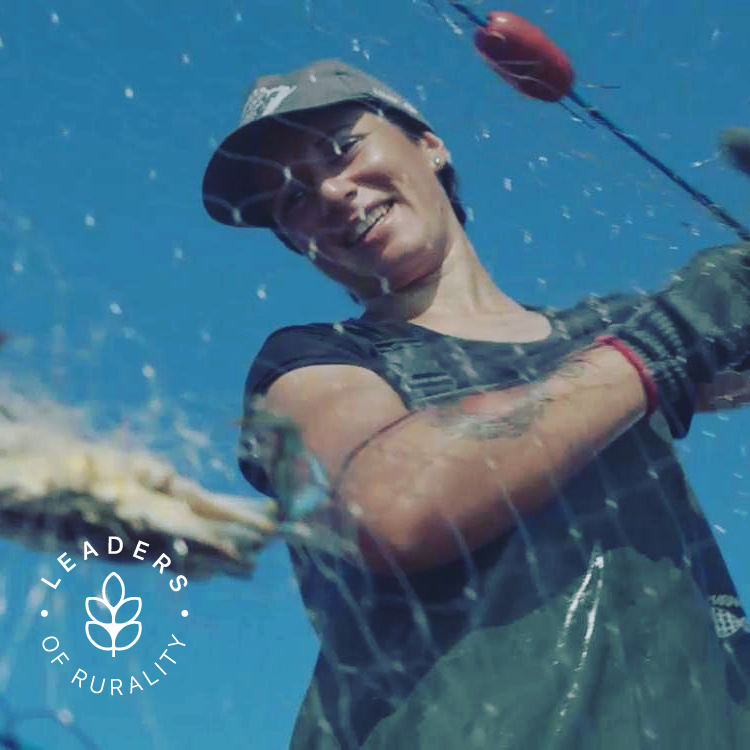
San Jose, 7 November 2023 (IICA) – Andrea Ballestero, a young woman from Laguna de Rocha, Uruguay, who has blazed a trail in the traditionally male occupation of artisanal fishing, has been named by the Inter-American Institute for Cooperation on Agriculture (IICA) as a Leader of Rurality of the Americas.
The 31-year-old Ballestero, who has one daughter, will receive the “Soul of Rurality” award as part of an initiative by the specialized agricultural and rural development agency to give greater visibility to men and women who are leaving their mark and making a difference in the rural Americas – a region that is key to the planet’s food and nutritional security, as well as its environmental sustainability.
Ballestero was born, raised and still lives in a community of only 22 families in the Uruguayan district of Rocha, which lies on the banks of a lagoon of the same name that interconnects at points with the Atlantic Ocean, through a natural system of sand bars that open and close periodically.
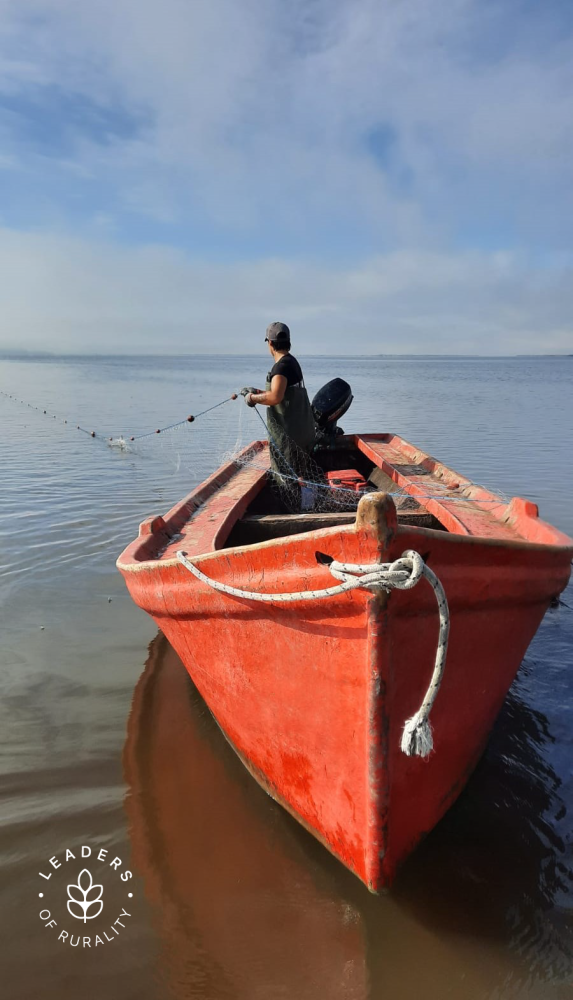
Five generations of the Ballestero family have earned their living from fishing on the lagoon in 6-meter fishing boats. Traditionally, the women in the region concentrated on the land-based aspects of the occupation—pulling the fish from the nets and cutting them up for sale—but did not venture out on the boats to fish. However, Andrea, who learned to pilot a boat and fish, by watching her family members, was not content to remain on shore. Today, she owns her own boat; goes fishing every morning and is involved in all stages of production, including processing.
“My mother and grandmother worked on the land”, she explained. The men would only take them out on the lagoon for short periods, because they had to stay behind to care for the children and household chores. But from I was 16 years old I knew that I wanted to go out and fish and today I have my own boat”.
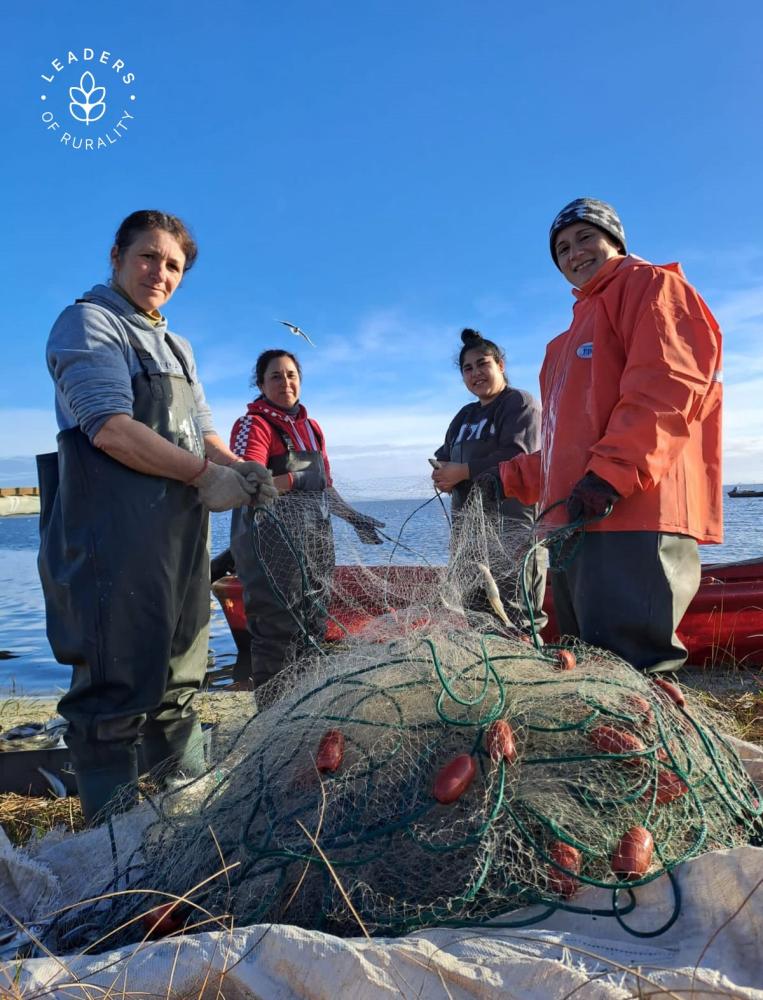
Ballestero also established the “Cocina de Barra” restaurant with eight other women, serving traditional dishes prepared with fresh fish from the lagoon to the tourists who flock to Rocha for its beaches and sunshine. The venture received financial support from the Directorate General for Rural Development (DGDR), which falls under Uruguay’s Ministry of Livestock, Agriculture and Fisheries.
The Leaders of Rurality in the Americas recognition pays tribute to those who are playing a unique dual role, both as guarantors of food and nutritional security, as well as custodians of the planet’s biodiversity, by producing under all kinds of circumstances. The recognition also highlights their capacity to be positive role models in rural areas of the region.
Rural retention and environmental care
“I have held many jobs, but I always return to fishing, as I feel that the lagoon is calling me back. A learned a lot from my parents and grandparents and I chose fishing. It is an activity that demands sacrifice, particularly for women, because we are migrant fisherfolk. During some seasons we go to fish in other lagoons, where we have to sleep in tents or wooden huts for several weeks. But we live well, and I am confident that fishing has a future”, insisted Andrea.
“I learned the job little by little, from a very young age”, she continued. “And at 16 I realized that I could do it. The only thing I needed to go out on the lagoon was a chalana (fishing boat), outboard motor and the material. My father gave me a boat and that encouraged me to go out. I started getting everything I needed together and now it is something that I could never leave because I love it”.
The Laguna de Rocha region where Andrea and her family live is also invaluable from an environmental standpoint and is part of Uruguay’s National System of Protected Areas (SNAP). The designated 22,000-hectare region includes a 7,200-hectare body of water, hills, plains, the coastal strip and part of the oceanic platform. It has also been recognized internationally. In 1977 it was designated as the Lacustre National Park and as a UNESCO global biosphere reserve. Likewise, since 2015 it has been listed as a wetland of international importance by the Ramsar Convention, an intergovernmental treaty that awards this designation for the conservation and rational use of wetlands and their resources.
Andrea points out that, “The lagoon mixes fresh and salt water, because it connects to the sea and to various streams. We have been given permission to fish in Rocha and other lagoons. I got out on the boat at 3 or 4 in the afternoon to lay my nets. I return home and the next day I am up at 4 in the morning to go and pull in the fish. We then remove the fish from the nets and take them inside for cleaning and filleting. The workday often ends as late as 5 or 6 in the afternoon when customers come to buy the catch for the day”.
She is a member of the Association of Coastal Lagoon Fisherfolk (APALCO), following in the footsteps of her parents. APALCO operates as a cooperative focusing on species such as shrimp, sole, sea bass, silverside and blue crab.
Andrea explains that, “Our community protects our resources. We do not plunder the fish recklessly; that is not how we operate. We never fish in the streams, for example, because the fish go there to spawn. We only catch the larger fish from the lagoon. The nets of anyone caught fishing in the streams are immediately seized by the authorities”.
Given their desire to grow and develop, Andrea and eight other women opened the Cocina de la Barra restaurant seven years ago. During the summer the restaurant serves more than 100 customers a day, which for the ladies represents a dream come true.
She recalls that, “It was difficult for us to make up our minds and begin. We always wondered what people would say if it failed. We were very afraid of failure, but we took a chance, and we did it. That is why I encourage all women involved in food production to have courage. Don’t sit and wait for someone to come and help or push you. Be brave and fight for what you want because the world needs us, and I am convinced that this activity has a future”.
More information:
Institutional Communication Division.
comunicacion.institucional@iica.int