The Minister of Livestock, Agriculture and Fisheries of Uruguay, Fernando Mattos, stated that agriculture is recovering the space that it never properly occupied in global climate discussions, and praised the efforts of the Inter-American Institute for Cooperation on Agriculture (IICA), a hemispheric organization specializing in agricultural and rural development, to promote the presence of the agricultural sector in the main global forums for environmental negotiation, such as the COP.
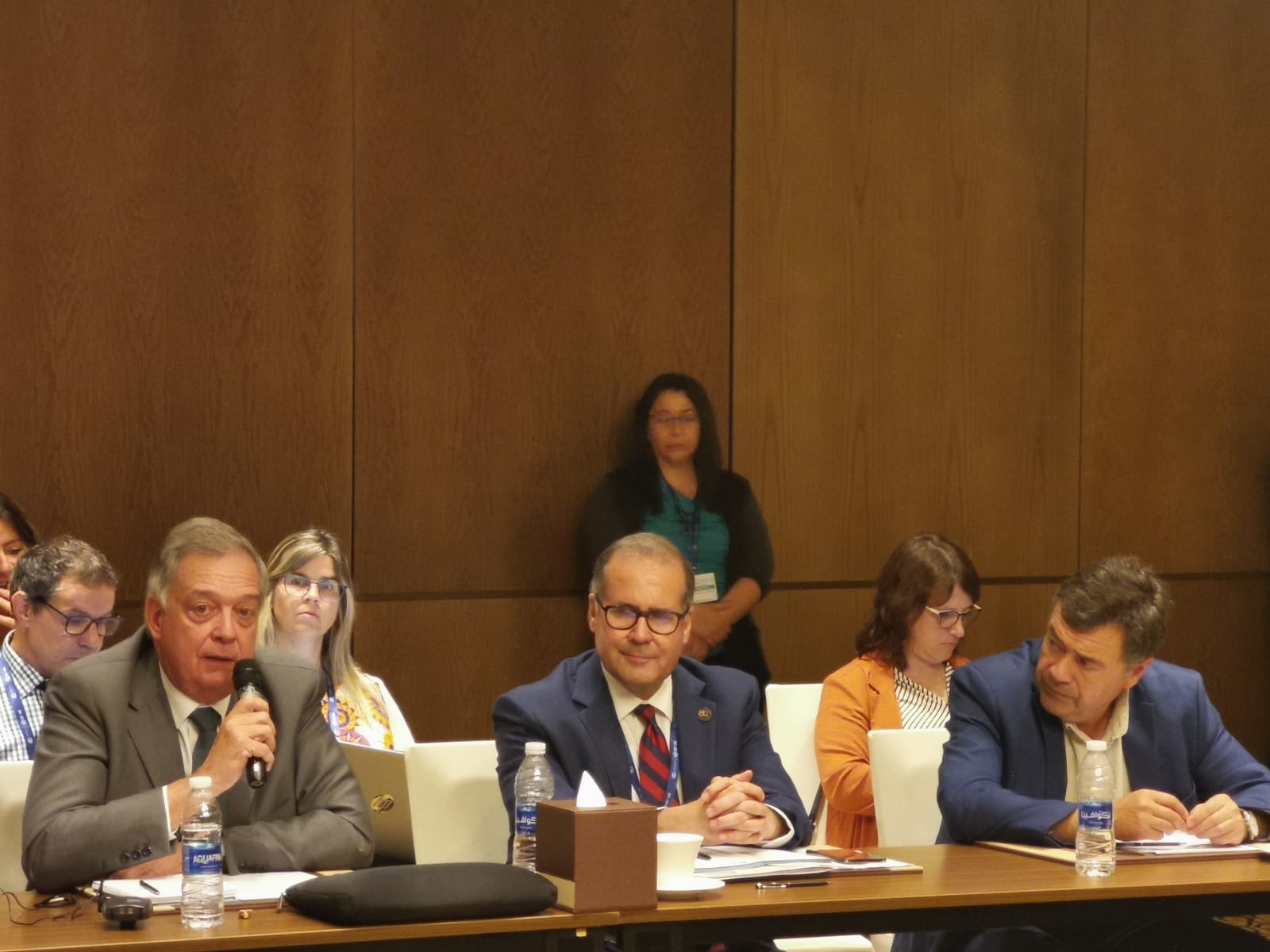
Dubai, United Arab Emirates, 10 December 2023 (IICA) – The Minister of Livestock, Agriculture and Fisheries of Uruguay, Fernando Mattos, stated that agriculture is recovering the space that it never properly occupied in global climate discussions, and praised the efforts of the Inter-American Institute for Cooperation on Agriculture (IICA), a hemispheric organization specializing in agricultural and rural development, to promote the presence of the agricultural sector in the main global forums for environmental negotiation, such as the COP.
At COP28 in Dubai, United Arab Emirates, Mattos actively participated in dozens of meetings, including two ministerial meetings -from Latin America and the Caribbean and from Mercosur, Chile and Bolivia-, in addition to various technical events, in which he discussed issues such as food security and the environment, sustainable livestock farming, biodiversity, knowledge and natural resource management, and access to financing, among others.
The Uruguayan minister pondered over his participation and that of his colleagues from the hemisphere in the climate summit, expressing that “the space that was never properly occupied is being recovered”, and indicated that “we are guarantors of food security. We are essential to tackle supply problems and fight against hunger in the world, and we are also fundamental for social peace because there can be no peace, there can be no tranquility, and there can be no social or political stability if food is insufficient. We also have the environmental responsibility of generating sustainable productive systems. Agriculture is active in this field, as it cannot exist at the expense of natural resources; and therefore, in order to have responsible productive systems, there must be a space, a place to talk about environmental issues.”
Mattos, who chairs the Inter-American Board of Agriculture (IABA), which brings together the Ministers of Agriculture of the Americas, also highlighted the work of IICA, which he defined as “a great catalyst for a much stronger presence of agriculture in these forums,” and said that “this must be increased, since one cannot talk about environmental sustainability without also talking about agriculture.”
In that sense, he defended the role of farmers, stating that agricultural producers have the mandate and legacy of taking care of natural resources.
“There is often a stereotype of food producers as those who destroy nature. This could not be farther from the truth, because we have inherited from our parents and grandparents the responsibility of protecting resources to ensure that we pass them on to our children and grandchildren in better condition than before. This is a kind of mandate for us” he said.
Mattos also referred to the much-needed balance between production and the environment, and praised the growing participation of agriculture, food and agricultural trade issues in the COP: “We promote this type of participation in Uruguay, and we know that there are tensions between production and the environment, but we must find the paths of understanding. It is not reasonable that the COP, having gained such relevance in the past 30 years since 1992, has featured an almost inexistent participation of agriculture, and that only in the past ten years we have started to gradually see a participation, a stronger presence, and I believe this is paramount for mutual understanding.”
In that sense, he called for a system where producers can see economic benefits more quickly with the application of sustainable production methods.
“Thanks to these forums, these climate discussion spaces, we have incorporated a series of practices and raised awareness. We must send a message to those farmers that still fail to see the importance of reducing emissions, and who may need to receive clear signals of greater income for their production when applying these sustainable practices. Normally, farmers only receive income based on the price of their own production; but they should also reap the benefits of applying sustainable production systems, which will make the world much healthier, much fairer and much more productive,” he concluded.
More information:
Institutional Communication Division.
comunicacion.institucional@iica.in