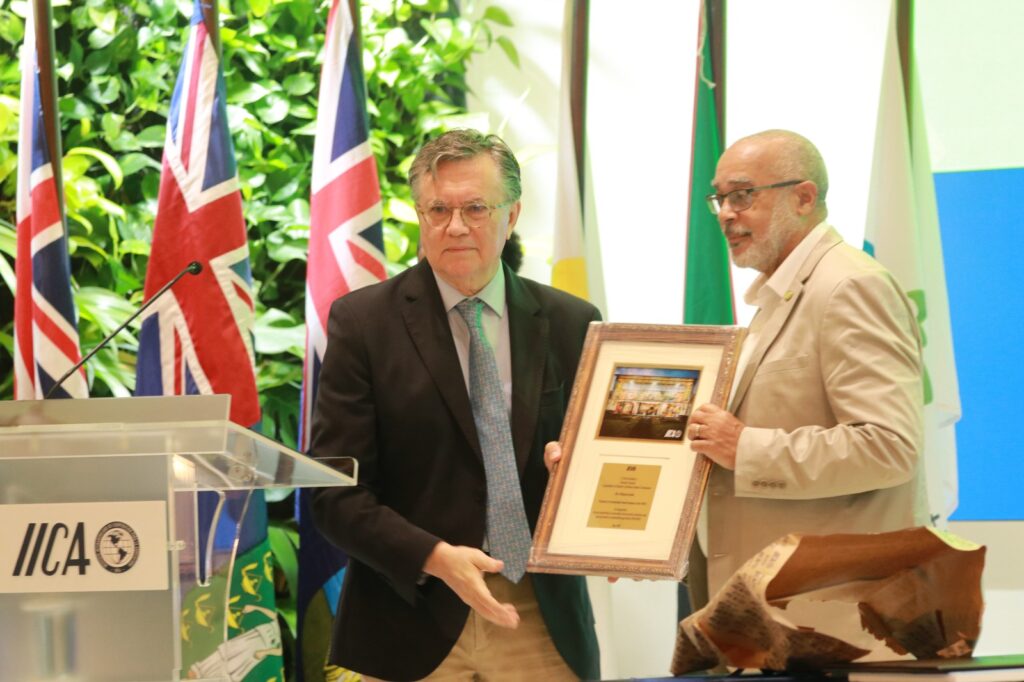
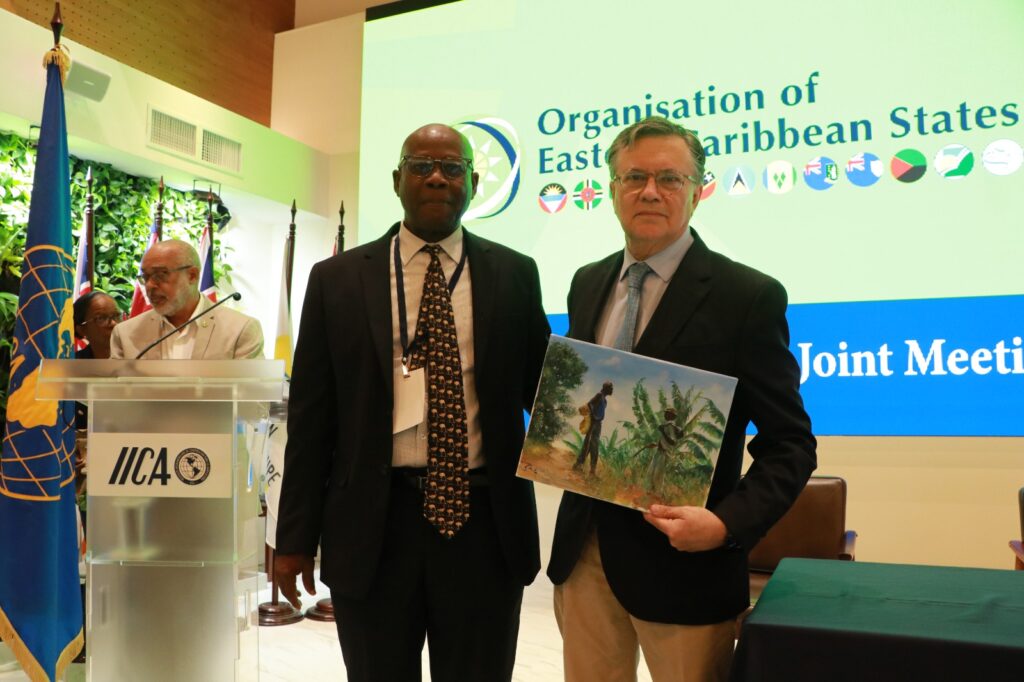
San Jose, 28 May 2025 (IICA) – Countries of the Eastern Caribbean highlighted the work of the Inter-American Institute for Cooperation on Agriculture (IICA) to improve the welfare of rural communities and presented an award of recognition to the organization’s Director General, Manuel Otero, signed by all the region’s ministers of Agriculture and by rural women and youth.
The award was presented during a study and training mission to IICA Headquarters in San Jose, Costa Rica, by rural women and youth of the Caribbean, accompanied by various ministers of Agriculture of the region.
The ministerial, rural women and youth mission was organized by the Organization of Eastern Caribbean States (OECS), to enable the rural population to air their concerns, as well as to promote the sharing of experiences and accelerate collaboration in areas such as agricultural digitalization, entrepreneurship and food security.
OECS Director General, Didacus Jules, highlighted Dr. Otero’s efforts at the helm of IICA to “transform the role of agriculture in the Americas, from a mere economic sector to a pillar of rural development, food security and environmental sustainability. His vision encompasses the empowerment of rural communities, the adoption of climate-smart technologies and biodiversity protection, in keeping with the reality of family farmers”.
On behalf of the Eastern Caribbean countries and as part of this act of recognition, Jules presented a piece by fine artist Jonathan Gladding of Saint Lucia, entitled “Farmers”, which provides a poetic depiction of rural life in the Caribbean islands.
The ministers of Agriculture participating in the visit to IICA Headquarters are Roland Royer, from Dominica; Samal Duggins, from Saint Kitts and Nevis; Alfred Prospere, from Saint Lucia; Lennox Andrews, from Grenada; and Saboto Caesar, from Saint Vincent and the Grenadines.
The OECS consists of twelve Eastern Caribbean islands, six of which are IICA Member States, namely Saint Lucia, Saint Vincent and the Grenadines, Grenada, Dominica, Antigua and Barbuda and Saint Kitts and Nevis. Given the extreme vulnerability of the agriculture sector of these countries to the impact of increasingly frequent natural disasters, in recent years IICA has coordinated actions to provide technical and financial assistance.
“I accept this award of recognition on behalf of the entire IICA family. Our work is grounded in three principles. First, we are an institution of open doors that expects to receive 25,000 visitors this year. Second, we promote dialogue, which we believe is a tool that is pivotal to designing collective action. Finally, while based in the Americas, we have a global outlook, encouraging collaboration with other continents”, noted Otero.
The IICA Director General spoke of the importance of driving rural retention by improving the standard of living of farmers and their families. He also stressed the need to focus on youth, whose involvement is essential to guaranteeing the planet’s food security.
“On taking over the reins of the IICA General Directorate, I realized that we would have to work very closely with vulnerable regions. Thus, the Caribbean has always been a priority and a region to which we have devoted our efforts”, he explained.
On behalf of IICA, Otero also presented a memento to OECS Director General, Didacus Jule, who has held this position since 2014 and has made a significant contribution to building the productivity and sustainability of Caribbean agriculture.
The OECS is an international intergovernmental organization dedicated to Eastern Caribbean regional integration, under the premise that the region consists of countries in close proximity, with shared physical and culture characteristics and common objectives. Its goals include the facilitation of trade within the bloc and the sharing of resources.
More information:
Institutional Communication Division.
comunicacion.institucional@iica.int