
Tapachula, Mexico, 28 April 2026 (IICA) – Tropical agriculture, an irreplaceable driver of food security for the continent and the world, must deepen its path of transformation to become increasingly sustainable, inclusive, and competitive. This was the message delivered by experts and authorities who participated in the opening of an international event in Tapachula, in the state of Chiapas, bringing together a wide range of stakeholders committed to building a critical pathway for the future of tropical agriculture in Mexico and the Americas.
The meeting, taking place in a highly productive region of southern Mexico that, due to its geographic proximity, also serves as a gateway to Central America, is organized by the Government of the State of Chiapas and its Ministry of Agriculture, together with the Inter-American Institute for Cooperation on Agriculture (IICA) and the Tropical Agricultural Research and Higher Education Center (CATIE).
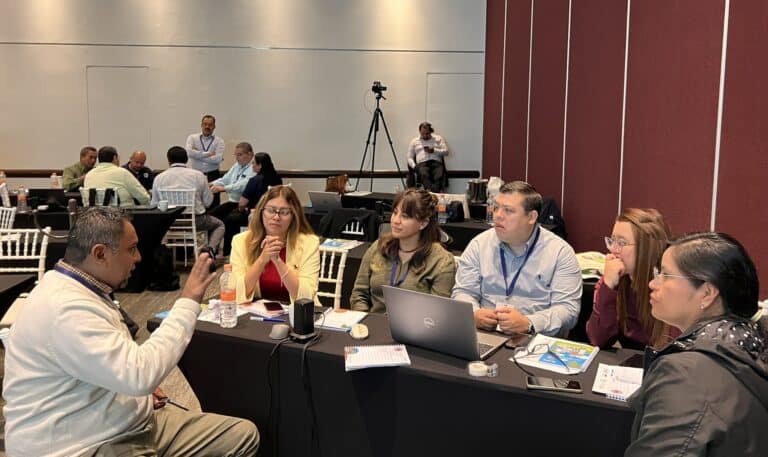
Farmers from Chiapas are joining, over three days of work, representatives from state agencies, agricultural institutions, academia, and international organizations for a dialogue that integrates sustainable productivity, climate resilience, technological innovation, and financing mechanisms, under a vision of hemispheric cooperation.
Strategic partners participating alongside the organizers include the Brazilian Agricultural Research Corporation (EMBRAPA), the Alliance of Bioversity International and CIAT, and the Caribbean Agricultural Research and Development Institute (CARDI).
At the opening were Marco Antonio Barba Arrocha, Chiapas Secretary of Agriculture, representing Governor Eduardo Ramírez Aguilar, and Santiago Ruy Sánchez de Orellana, General Coordinator for International Agricultural Affairs, representing Mexico’s Secretary of Agriculture and Rural Development, Julio Berdegué.
Also speaking were the Director General of IICA, Muhammad Ibrahim; the Director General of CATIE, Luis Pocasangre; former Mexican Senator and IICA Goodwill Ambassador Beatriz Paredes; the Secretary of Agricultural, Rural and Fisheries Development of Veracruz, Rodrigo Calderón Salas; and the Secretary of Agricultural Development of Morelos, Margarita Galeana Torres.
Dialogue and alliances
“We know very well,” said Barba Arrocha, “the needs of farmers in Chiapas. We will collaborate with the federal government on sanitary projects to address fruit fly and New World screwworm. We are working to build a state strategy that will allow producers to access training and free products, in order to continue reducing the incidence of these diseases.”
Barba Arrocha emphasized that, to achieve a more productive agricultural sector, it is essential to promote rural rootedness: “We need new generations to truly see the countryside as a life opportunity. That is essential to unlock the potential of tropical agriculture.”
Ruy Sánchez de Orellana said that calls for dialogue and alliance-building are gaining greater importance “at a time when the rules that once provided predictability are rapidly fading due to geopolitical tensions and multiple crises. The challenging outlook for agriculture is compounded by rising costs of key inputs such as fertilizers.”
The official stated that the best response is food sovereignty, which he defined as the creation of the conditions necessary to guarantee the human right to food for the population.
“Tropical agriculture faces major challenges and major opportunities. Chiapas clearly demonstrates this, with coffee, cocoa, bananas, and mangoes showing the region’s capacity to produce and innovate,” added Ruy Sánchez de Orellana, who described IICA as more than a technical ally for Mexico: “We value its willingness to align cooperation with our national priorities. IICA shows that cooperation is effective when there is trust, social sensitivity, and a results-oriented approach.”
Beatriz Paredes, who highlighted the role of science in transforming the reality of agriculture and rural territories, stressed that the visit of the IICA Director General to Tapachula fosters reflection on the situation of tropical regions in Mexico.
“The conclusions of this meeting will serve all of Mexico; we want the country to catch the passion for the tropics and embrace the importance of designing a public policy strategy. We hope this meeting will be a strong seed that grows into a great forest,” she said.
The Director General of CATIE, a leading academic organization at the continental and global level in tropical agriculture research, headquartered in Costa Rica and closely linked to IICA, highlighted Chiapas for the quality of its soils and its microclimate, which have made it the origin of the Ataúlfo mango, one of the tastiest varieties in the world.
“At CATIE,” said Pocasangre, “we have a coffee breeding program and another for cocoa, a crop largely in the hands of small-scale producers who must be supported. We have the world’s largest collection of coffee varieties and the second largest collection of cocoa. And we are home to the oldest graduate school in tropical agriculture in Latin America and the Caribbean.”
Muhammad Ibrahim said that Chiapas is the heart of Mexico’s biodiversity: “Here, land and culture come together to remind us that the tropics are not only a geographic zone but also the engine of food security in the hemisphere.”
The IICA Director General said there are four priority pillars for building a pathway to prosperity and inclusion in tropical agriculture: resilience, innovation, transformation of value chains, and financial governance.
“We are,” he said, “at a defining moment for agriculture, due to rising fertilizer and energy prices that are driving up production costs and ultimately reaching food consumers. IICA plays a central role in supporting governments across the continent and working with the private sector to bring solutions to multiple crises.”
Ibrahim explained that IICA believes tropical agriculture in the Americas must advance toward greater resilience through applied science, harmonized with ancestral knowledge, an area in which Mexico has extensive expertise.
“We are not seeking only consensus,” he concluded, “but also a portfolio of initiatives that catalyze actions aimed at transforming tropical agriculture and guiding public policies and investment, with farmers at the center.”
More information:
Institutional Communication Division.
comunicacion.institucional@iica.int