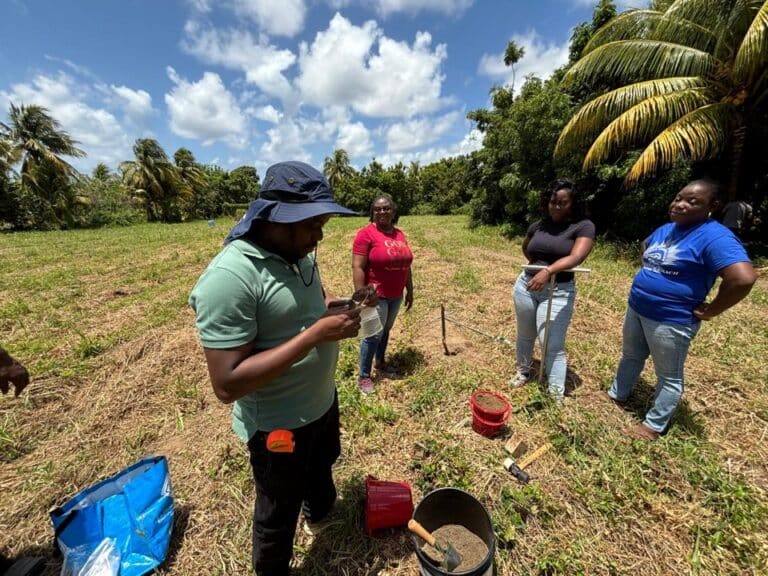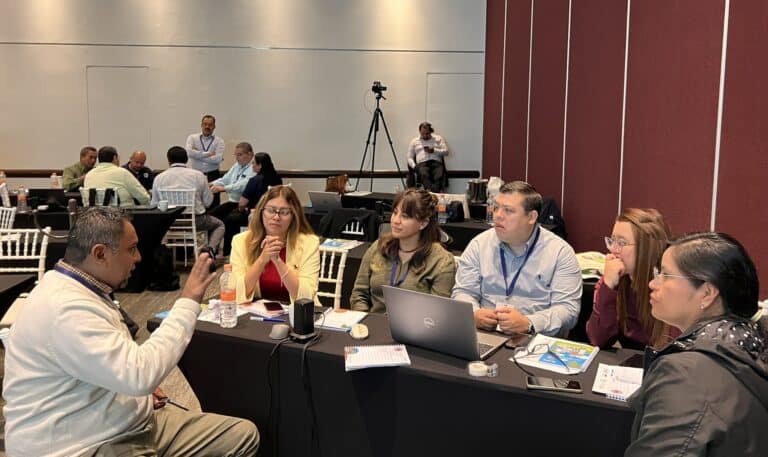

Provinces of Jujuy and Misiones, Argentina, 28 April 2026 (IICA) – A new initiative designed to promote the integration of scientific research, agroecological practices, and local wisdom has been launched in the Argentine provinces of Misiones and Jujuy through a partnership among international organizations.
“Participatory Improvement of Genetic Resources and Seed Systems for Regenerative Agriculture – Raíces” is the name of this trinational project—also implemented in Brazil and Bolivia—funded with supplementary resources from the International Fund for Agricultural Development (IFAD) provided by the European Union. The project is executed by the Inter-American Institute for Cooperation on Agriculture (IICA), in association with the Brazilian Agricultural Research Corporation (EMBRAPA), which serves as trinational technical lead.
The initiative is expected to reach approximately 1,200 producers in Argentina, with a strong emphasis on the participation of women, youth, and Indigenous peoples. It represents a collective response to the urgent need to transform food systems so they become more equitable, sustainable, and resilient.
The project seeks to strengthen smallholder families in Argentina, Brazil, and Bolivia who face barriers to food production, including limited access to suitable seed varieties and bioinputs, insufficient technical support due to low levels of investment, and exclusion from knowledge-generation processes.
Within this framework, the initiative promotes participatory plant breeding (PPB) and evolutionary plant breeding (EPB), the conservation of agrobiodiversity, and the exchange of both traditional and scientific knowledge among South American countries. In Argentina, the National Institute of Agricultural Technology (INTA) is responsible for technical implementation. The initiative is part of the Global Program for Small-scale Farmers and Sustainable Transformation of Food Systems (GP-SAEP).
During the launch, participants highlighted the importance of collaboration between technical experts and producers, which supports the creation and strengthening of community seed banks, the work of seed custodians preserving native and creole varieties, and the use of tools and methodologies adapted to small-scale agriculture.
Doina Popusoi, IFAD technical officer for Raíces and GP-SAEP in Latin America, stated that “the project enables joint planning and decision-making with farmers to identify what works best for each local system. The goal is to develop crop varieties that are resilient to local climate conditions and that contribute to improved access to healthier diets.”
In Jujuy, activities will focus on potato, beans, maize, quinoa, and fava beans. In Misiones, actions will center on maize, sweet potato, beans, watermelon, and squash, prioritizing native seeds suited to the region’s diversified production systems.
According to Luz Lardone, INTA’s National Director of Transfer and Extension, Argentina is “deeply diverse, with a wide range of production systems and scales among producers.” In this regard, she underscored the need for public policies capable of respecting and strengthening local specificities.
Misiones: a territory of agrobiodiversity
The province of Misiones, in northeastern Argentina, is home to one of the country’s richest levels of agrobiodiversity and a significant presence of small-scale farmers who sustain diversified production systems.
One of the project’s key components in Misiones is the strengthening of “seed houses,” which Silvina Fariza, researcher at INTA Misiones and technical lead for the project in the province, describes as “spaces managed by producers within their farms or communities to safeguard seeds, which also serve as platforms for exchange.”

Misiones has a strong tradition of seed conservation and multiplication led by farmers. For decades, seed fairs have promoted the exchange of genetic material and associated wisdom. Native and creole seeds, selected for their adaptation to local conditions, not only sustain production diversity but also constitute a key foundation for farmers’ autonomy.
Beatriz Zemunich, a producer from Wanda with a certified agrobiodiversity farm and an active member of the Misiones Seed Movement for 18 years, noted that “the project helps make visible the work we have been doing and allows us to continue caring for something essential: seeds as the foundation of food sovereignty and the future of our families.”
Jujuy: land of productive diversity
In Jujuy, the Raíces (GP-SAEP) project is being implemented in five strategic territories representing diverse environments and productive systems: Santa Victoria Oeste, Yavi, Humahuaca, Tumbaya Grande, and El Pongo farm in the temperate valleys.
In these areas, the project also strengthens ongoing processes related to seed conservation, the work of seed custodians, and the integration of production and commercialization. “The project allows us to continue and deepen processes that have been underway for years,” said María Florencia Barbarich, INTA Abra Pampa technician and coordinator for the Northwest Argentina (NOA) region of Raíces.
In Casti, for example, the project will support an Andean potato processing plant led by five women—an initiative that combines agrobiodiversity conservation with value addition. The project emerged to recover local varieties that had been displaced by commercial crops and now contributes to enhancing genetic diversity, strengthening local identity, and generating economic opportunities for communities.
“The relationship between women and seeds is historic. We are the ones who select, conserve, and ensure food availability,” said Celeste Carrazana, a member of the initiative, which also seeks to pass on this knowledge to younger generations.
Overall, the initial phase of implementation in Argentina demonstrates the territorial impact of the Raíces project. In Jujuy, activities to date have directly involved more than 150 producers, 95% of whom identify as part of or descendants of Indigenous peoples, primarily from the Gran Nación Colla. In Misiones, actions have included approximately 125 producers, 38% of whom belong to the Mbya Guaraní community.
In addition, as part of this first phase, workshops and training sessions were held for producers and INTA technicians on both seed improvement and conservation methodologies, along with the establishment of agroecological corridors in the province of Misiones.

More information:
Institutional Communication Division.
comunicacion.institucional@iica.int