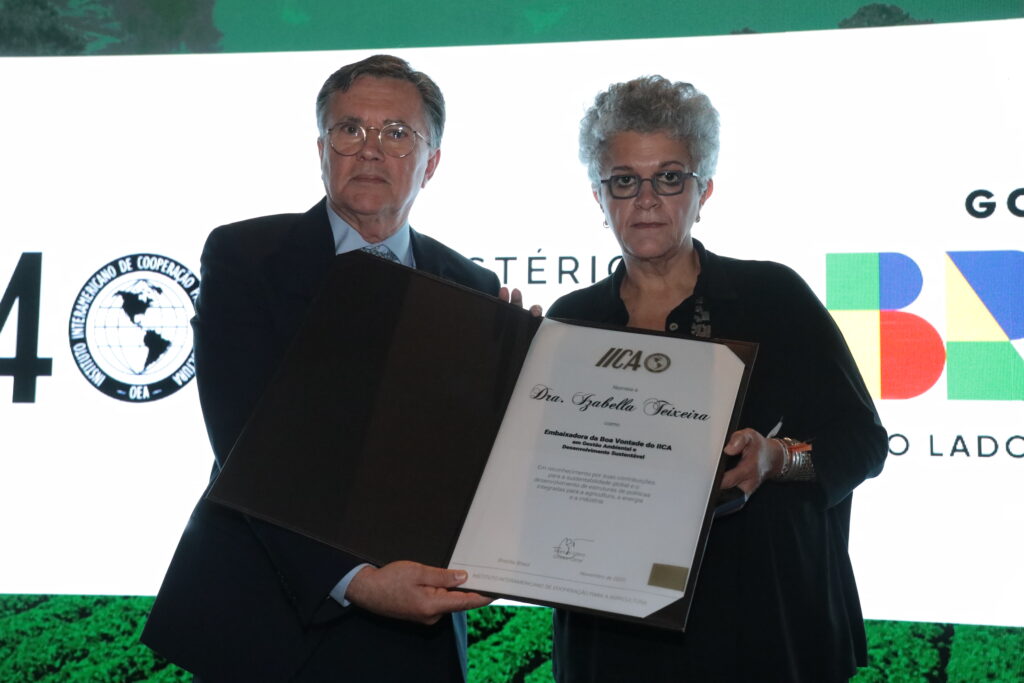
IICA Director General Manuel Otero and Izabella Teixeira, biologist and former Minister of the Environment of Brazil.
Belém do Pará, Brazil, 11 November 2025 (IICA) – Renowned biologist Izabella Teixeira, former Minister of the Environment of Brazil, who has had a distinguished career in international negotiations related to the relationship between production activities, natural resource management and climate, was recognized as a Goodwill Ambassador of the Inter-American Institute for Cooperation on Agriculture (IICA).
Teixeira, who led Brazil’s delegation of negotiators to COP21 in 2015, when almost 200 countries adopted the Paris Agreement, received the award from IICA Director General Manuel Otero.
IICA’s Goodwill Ambassadors accept the challenge of contributing to efforts to raise public awareness about the importance of food and nutrition security, and work on behalf of development through projects related to caring for biodiversity and natural resources, the bioeconomy, animal and plant health, and responsible production—all key issues on IICA’s agenda.
“I am deeply moved and honored by IICA’s tribute. I wish to highlight the work that the Institute carries out under the leadership of Manuel Otero. He has had the courage to open up political forums for dialogue and establish consensus-building platforms in the Americas, within the context of a changing world in which food security is vulnerable to geopolitical changes and the climate crisis”, said Teixeira upon receiving the certificate.
“The world”, she added, “is undergoing an accelerated fragmentation of interests, agendas and partnerships; a new international order and a new system of international cooperation are taking shape. We are literally experiencing a global transition. Within this context, our region must understand and embrace the future as a great ally. I believe that IICA has opened up a critical space for the convergence of interests, based on the conviction that discussions related to agriculture and food security should not be political or ideological disputes”.
Environment and inequality
Teixeira’s leadership and knowledge were key in drafting Brazil’s new Forest Code, which achieved a historic reduction in deforestation rates in the Amazon, and in creating a national policy on climate issues that involves the agriculture sector and other crucial economic sectors, such as energy and industry.
The renowned biologist graduated from the University of Brasilia, was named Champion of the Earth by the United Nations in 2013 and led the Brazilian Ministry of the Environment from 2016 to 2020. She pointed out that Latin America must guarantee its own food supply and address inequalities, which are not only of a social nature, but also include technological, environmental and economic aspects.
“Our region’s greatest asset is its abundance of natural resources, and the peace it enjoys. It is extremely important to understand the value of peace and of having enormous resources of common interest for development. I don’t believe in any solution that is based on fear or improvisation”, said Teixeira.
In that regard, she called for agriculture to be seen as a transformative economic sector in the face of today’s new realities: “The future must be our ally; the past must cease to be a determining factor. I am certain that agriculture plays a fundamental role in shaping a new mindset among leaders and in developing the climate agenda, the technological agenda, industry, and the fight against social inequality”.
Manuel Otero, upon presenting Teixeira with the award of recognition, highlighted her commitment to agriculture as part of the solution to the most important challenges currently facing humanity, whose future will depend on its capacity to produce food, fiber and energy while caring for the planet.
He also praised the work of the Brazilian expert alongside IICA at COP30 in Belém do Pará, particularly in showcasing the progress the region has achieved in developing and expanding an increasingly sustainable and resilient agriculture sector in which farmers play a leading role.
More information:
Institutional Communication Division.
comunicacion.institucional@iica.int