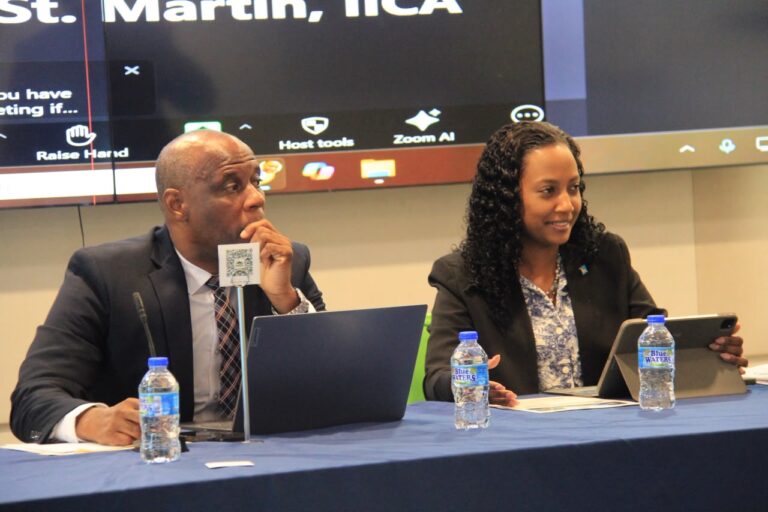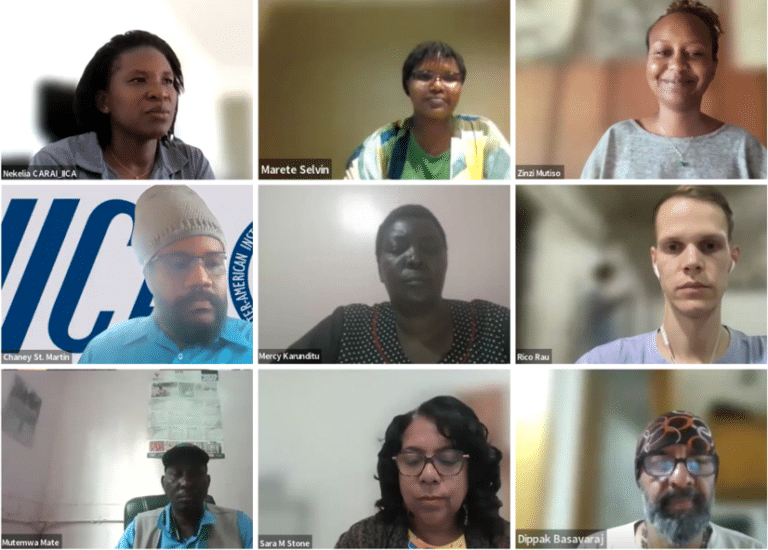

CCRAF’s 2026 Edition Beginner-to-Business Series, equipped more than 1000 participants with practical knowledge on resilient farming and sustainable livelihoods.
Roseau, Dominica, May 5, 2026 (IICA). – Across the Caribbean, a wave of entrepreneurial energy and innovation was sparked as the Caribbean Climate-Resilient Agriculture Forum (CCRAF) successfully concluded its 2026 Edition, 3-Part Beginner-to-Business (B2B) Webinar Series. The webinars, which brought together farmers, entrepreneurs, youth, and development practitioners from across the Caribbean, Latin America, Asia, and Africa, equipped hundreds of participants with practical knowledge to launch and sustainably grow agricultural enterprises. Participation remained strong throughout the series, with more than 430 participants, representing over 30 countries in each webinar.
The CCRAF is a network promoted by the Inter-American Institute for Cooperation on Agriculture (IICA) in the Caribbean region to share knowledge of resilient agricultural practices, build a community of engaged actors at the regional level, enhance collaboration among stakeholders and translate knowledge to action on the ground, among other objectives.
“The CCRAF Yearly 3-Part Webinar Series is about more than training—it’s about empowering people to take action. Our goal is to continue connecting knowledge with real opportunities and immediate actions that can transform livelihoods and strengthen food systems across the region,” said Nekelia Gregoire Carai, Coordinator of CCRAF.
The webinar featured Leading Caribbean practitioners who shared real-world experiences and practical business models tailored to regional conditions:
Starting a Small Hydroponics Enterprise
Sherrie-Ann Brazier, Founder of SHAADE Hydroponics in Antigua and Barbuda, delivered an inspiring session on building a successful hydroponic enterprise from the ground up. “You don’t need to know everything to start—just begin, learn as you go, and stay committed. Agriculture can truly transform not just your income, but your family and your purpose,” she shared.
Key takeaways included:
- Producing up to 2,500 heads of lettuce weekly on less than an eighth of an acre.
- Using significantly less water and land than traditional farming.
- Growing a family-run business through continuous learning and innovation.

SHAADE Hydroponics (Antigua and Barbuda) shared its experience on building a successful hydroponic business from scratch, based on continuous learning, innovation, and family commitment.
Starting a Small Vermicomposting Enterprise
Micah Martin, Co-Founder and Manager of Compost-Inn in Trinidad and Tobago, demonstrated how organic waste can be transformed into high-value vermicompost. “What many people see as waste is actually a resource. With the right approach, you can convert it into a product that improves soil, supports food production, and creates income,” he noted.
Key insights included:
- Converting organic waste into nutrient-rich “black gold”.
- Selecting worm species suited to tropical Caribbean conditions.
- Managing key environmental factors for successful production.
- Creating multiple income streams through value-added products.
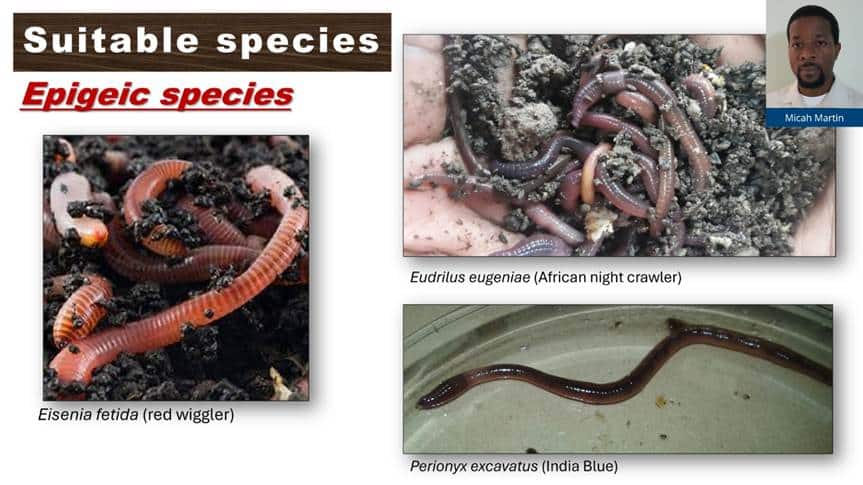
Turning waste into “black gold” is possible. Micah Martin, co-founder of Compost-Inn (Trinidad and Tobago), demonstrated this by presenting a vermicomposting model adapted to the tropical conditions of the Caribbean.
Starting a Small Mushroom Enterprise
Pauline Smith, CEO and Co-Founder of Jamaica Exotic Mushrooms, showcased how mushroom cultivation is emerging as a high-income, climate-resilient enterprise. “Mushroom farming is one of the fastest ways to generate income in agriculture. In just a few weeks, you can go from production to profit—while building a business that is resilient and sustainable,” she emphasized.
Key highlights included:
- Producing oyster mushrooms in approximately 4 weeks.
- Using local materials such as bamboo and lemongrass as substrate.
- Meeting strong demand from the hospitality sector.
- Creating inclusive opportunities for women, youth, and small entrepreneurs.
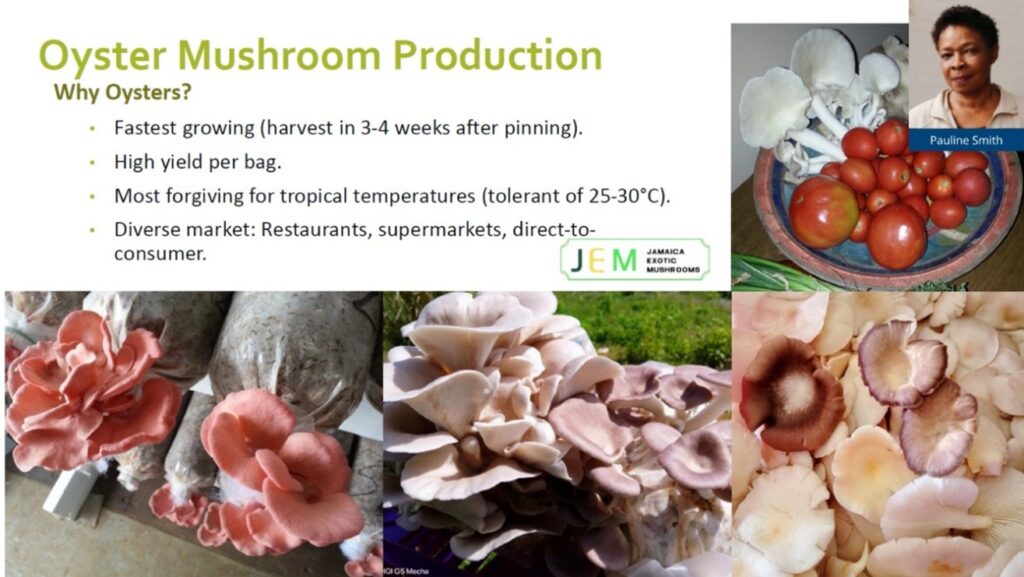
Mushroom cultivation is becoming established as a profitable business activity, resilient to climate change, and with high potential for small producers.
Across all sessions, the message was consistent: start small, use available resources, and build towards sustainable income opportunities. For many participants, the series represents the first step toward a new and innovative agricultural future.
Looking Ahead: A Regional Platform for Knowledge-to-Action
The CCRAF continues to serve as a hub for exchange, collaboration, and innovation to bridge the gap between knowledge and practice in agriculture across the Caribbean. Building on the success of the series, the CCRAF will continue expanding its programming through Special Edition Webinars and in-person training under its “CCRAF On the Road” Knowledge-to-Action Initiative.
Learn More About the CCRAF
Webinar recordings and resources are available online:
🌐 Website: https://ccraf.iica.int
▶️ YouTube: https://www.youtube.com/@ccrafcaribbean
📧 Email: ccraf@iica.int
🔗 All links: https://linktr.ee/ccrafcaribbean
More Information
Institutional Communications Division
comunicacion.institucional@iica.int