Valparaíso, Chile, 12 May 2026 (IICA) – In Cuncumén, a coastal dryland area where every rainfall matters and every summer puts production to a test, a 17-hectare farm has become more than just a field: it is a place where restoring soil, retaining water, and diversifying production are no longer just ideas, but concrete practices.
Cuncumén is a rural locality located in San Antonio Province, Valparaíso Region, in central Chile, approximately 100 kilometers southwest of Santiago, the country’s capital. It is a coastal dryland area, meaning a territorial strip that depends almost exclusively on rainfall for agriculture, without access to permanent irrigation, and which has faced a prolonged drought over recent decades.
In Latin America’s dryland areas, mud washes downhill with every rainfall, reservoirs run empty by summer, and soil loses depth year after year. For peasant families who depend on that land, this is not a future problem. It is today’s problem.
Starting from this reality, the Inter-American Institute for Cooperation on Agriculture (IICA) is working together with the Cuncumén Peasant Agricultural Cooperative on a 17.3-hectare farm, with funding from the Foundation for Agricultural Innovation (FIA), in a project called “Silvoagricultural Diversification as a Productive Methodology and Strategy and Optimization of On-Farm Irrigation in the Dryland Conversion Area of Cuncumén, San Antonio Province”.
For more than two years, the project has been implementing a silvoagricultural diversification demonstration unit that combines soil conservation, water management, and sustainable production. During that time, a concrete experience has been built, with visible results and a growing network of actors joining along the way.
“In Cuncumén, we are seeing that it is possible to recover degraded soils, manage rainwater, and diversify production in dryland areas when there is collective commitment and technical support,” said Hernán Chiriboga, IICA Representative in Chile. “It is not a magic formula. It is sustained work, alliances built patiently, and confidence that family farming has a future in these territories.”

Building a network
The project began as an alliance between IICA, the cooperative and FIA. Over time, other actors found in this space a place where their own work also made sense. In this process, IICA acts as a technical coordinator and facilitator of capacities in the territory.
Currently, CONAF (National Forestry Corporation of Chile) and INIA (Agricultural Research Institute) are also participating by providing native plants for forest restoration. The Forestry Institute (INFOR) is contributing through the design and implementation of the silvopastoral unit, while the Municipality of San Antonio and PRODESAL are supporting links with local farmers and access to fairs, and INDAP (Agricultural Development Institute) is participating through its regional Rural Board.
Other participating organizations include the GEF-FAO Landscape Restoration Program, which used the farm as a training space for rural women producers from the Valparaíso Region, and the Federico Santa María and Concepción universities, with pilot initiatives on dehydration technology and soil improvement using biochar. INAPI, meanwhile, is working with the cooperative on certification of the Cuncumén Clean Valley, and PROCHILE has launched a process to support walnut exports by cooperative members.
Each of these institutions started this process for different reasons. What keeps them engaged is that the farm offers something concrete to see, learn from, and replicate.
Retaining water and soil before they are lost
The technical core of the project consists of Water and Soil Conservation Works, known as OCAS. The logic is simple: in dryland areas, rainwater tends to run off downhill carrying the soil with it. OCAS seek to intercept that process.
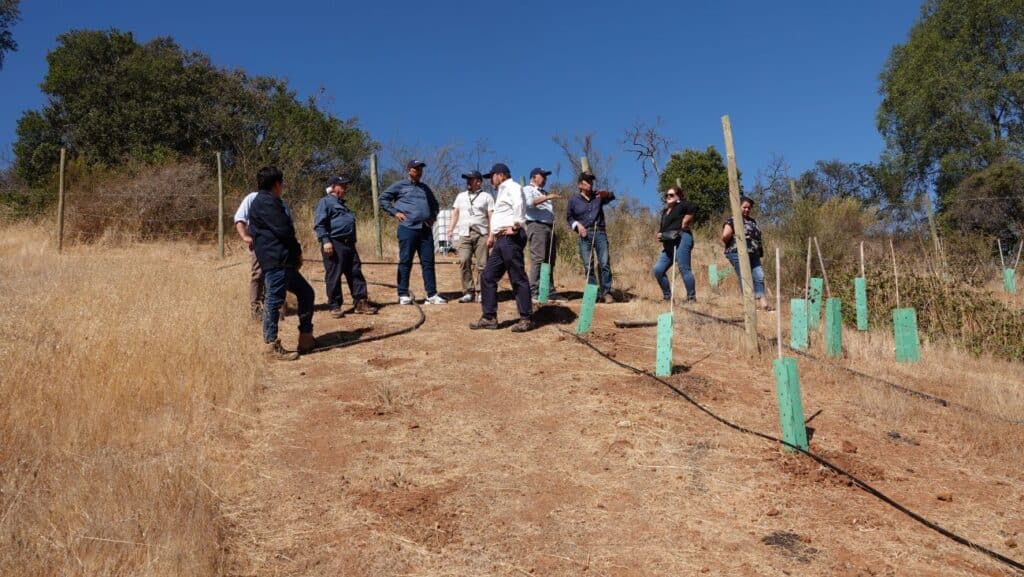
On the Cuncumén farm, check dams were built using local materials—treated posts, soil bags and plastic membranes—combined with chagual (Puya chilensis, a bromeliad native to central Chile) plantations to stabilize slopes. Brush barriers were installed to slow down laminar erosion. Diversion channels following contour lines were traced—using an A-frame level built on the farm itself—to distribute water along the hillside instead of allowing it to concentrate. Semicircular bunds were built to retain water around each forest plant, and a rainwater harvesting system was implemented to channel runoff from the upper hillside to an on-farm storage reservoir.
Following the winter rains of 2025, the dams successfully accumulated soil. The infiltration trenches retain more than six cubic meters of water per rainfall event. The semicircular bunds allow plants to survive the summer without mechanized irrigation.
Most of these works were built using local materials and labor, under the technical guidance of the IICA team and institutions such as CONAF, INFOR, and INIA.

One farm, multiple uses
On these recovering soils, the project gradually established a multiple-use land management proposal. Today, the farm integrates walnut and almond trees, citrus with artisanal limoncete production, open-field and greenhouse vegetables, cut flowers such as lilies, limonium, gladiolus and chrysanthemums, a windbreak barrier of quillay and chagual, a silvopastoral module with sheep and goats, compost, humus and biofertilizer production, and reforestation with native species from Chile’s sclerophyllous forest.
One of the findings during the period was the use of espino (Vachellia caven), a native tree of Chilean drylands historically regarded as a weed or invasive pasture plant. The project documented that its fruits—known as quirincas—can be processed to obtain a highly palatable feed supplement for goats and sheep, with yields of up to 707 kilograms per hectare of crushed whole fruit. This type of finding is directly relevant for arid and semi-arid areas in other countries of the continent where underutilized native species with similar forage potential exist.
The cooperative has already begun offering concrete services to local farmers: on-farm irrigation assistance, branch chipping, sales of humus and biochar, and marketing of flowers and vegetables.
An open space for learning and visiting
The farm has an explicit vocation to serve as a place where people can see and understand. During 2025, it hosted women producers from the Valparaíso Rural Women’s Board, students from DUOC-UC and the Cuncumén Agricultural High School, and members of the local community during the Traditional Fair. During each visit, participants toured the productive modules, the OCAS, the irrigation and water harvesting system, and the bioinput unit in the field.

In addition, the project produced technical brochures on each module, available for farmers in the area to review and assess whether any of the practices may be useful on their own farms.
What makes this experience interesting is not that it is a finished model. It is that it demonstrates that in dryland territories with degraded soils and high water fragility, it is possible to recover productive conditions, diversify income, and do so with low technological costs and in partnership with local actors. It is a concrete response to questions that many rural communities across the continent are asking today.
IICA supports processes such as the one in Cuncumén so that the knowledge generated in one territory can reach others. This experience shows that when there is sustained technical support, alliances built patiently with confidence in family farming, concrete results are possible: soils that recover, water that is retained, families that remain in their territories and continue producing.
For the Foundation for Agricultural Innovation, supporting the creation and structuring of this demonstration center responds directly to its mission: to promote, through territorial innovation, concrete solutions to the problems of declining soil productive capacity, recovery of abandoned productive land, and maintenance of associated biodiversity. These factors have a direct impact on agricultural productivity, farmers’ permanence in their territories, and the local economy and food security.
Andrés Gálmez Commentz, from FIA, emphasized what these types of projects mean for those who live and work in these territories: farmers finding profitable solutions to concrete problems, communities recovering their productive capacity, and families able to remain in rural areas. He also underscored that having irrigation in historically dry areas—subjected to prolonged drought—has created a real opportunity for those who previously depended exclusively on rainfall, generating a center of institutional interest that strengthens productive biodiversity and the sustainability of the system as a whole.
“The work carried out by IICA has been fundamental, since through this project local responses have been developed for local problems, incorporating many farmers with profitable solutions that are also fully transferable to other areas of the country,” Gálmez Commentz stressed.

More information:
Institutional Communication Division.
comunicacion.institucional@iica.int