IICA, the Latin American Network of Rural Extension Services (RELASER), and the Global Forum for Rural Advisory Services (GFRAS) are implementing this initiative in Costa Rica, Ecuador, Madagascar, and Uganda.
San Jose, 9 June 2026 (IICA) – In a bid to transform production systems through the adoption of agroecology—an integrated approach in agrifood systems that takes into account environmental, social, and economic dimensions—the Rural Advisory and Agroecology Project (AERAS) has empowered small farmers from Latin America and Africa, by ensuring them improved access to knowledge, support services, and technology. More than 10,000 farmers have benefited during the two years of the project’s implementation.
The initiative, which is being implemented by the Latin American Network of Rural Extension Services (RELASER), the Global Forum for Rural Advisory Services (GFRAS), the Young Professionals for Agricultural Development (YPARD) network, and Access Agriculture with the support of IICA, is part of the Global Programme for Small-Scale Agroecology Producers and Sustainable Food Systems Transformation (GP-SAEP), funded by the International Fund for Agricultural Development (IFAD), the European Commission, and Belgian Development Cooperation.
The project has provided training and technical support in areas such as livestock farming, and the production of cocoa, coffee, Musaceae, vegetables, and tropical roots. It brings together local stakeholders, academia, the public sector, and producers, to improve their capacity to withstand the effects of environmental and socioeconomic challenges.
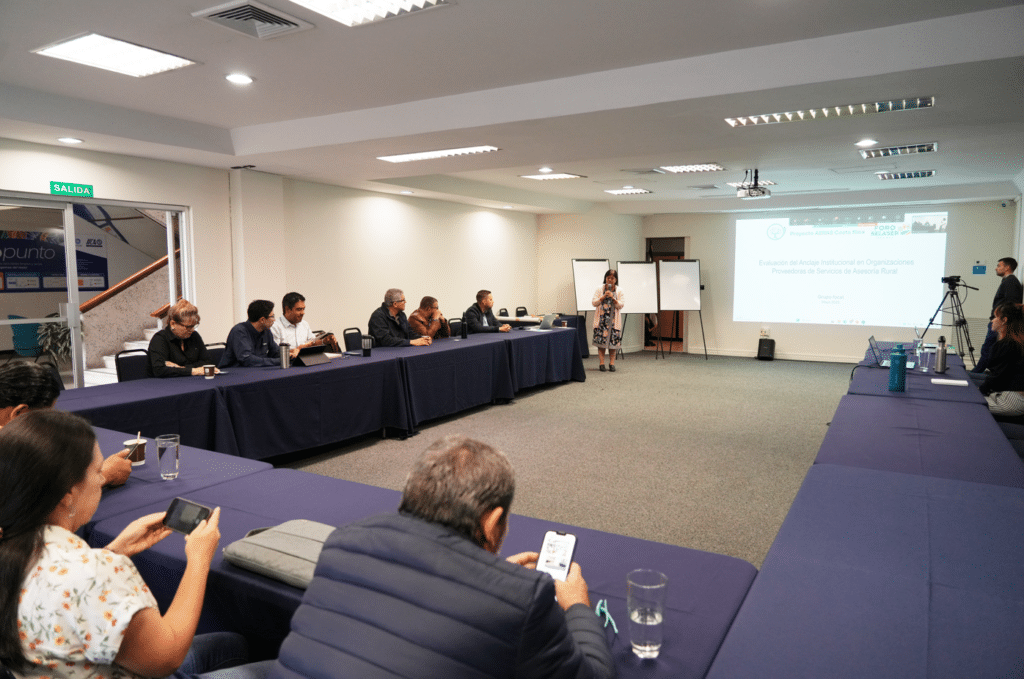
As part of follow-up activities and future strategies, a meeting was held in Costa Rica with extension officers, institutional partners, and public-private stakeholders linked to the project, to analyze progress made, identify lessons learned, and to build a roadmap for ongoing collaboration that will ensure that the efforts spearheaded by the initiative will endure.
Coordinator of the project and of Foro Relaser Costa Rica, Laura Ramírez Cartín, stressed that, “AERAS has enabled farmers to acquire knowledge in areas such as the reduction of external inputs, soil health,biodiversity, synergies, economic diversification, joint knowledge creation, food security, impartiality, connectivity, land governance, and resources.”
Kenneth Solano, an IICA Project Management and Agribusiness Specialist in Costa Rica, emphasized the relevance and importance of the program in the current context, noting that, “These environmental, social, and economic sustainability projects are fundamental in tackling the challenges of an increasingly competitive agriculture sector; and they require proper support to generate a long-lasting impact.”
Solano emphasized the importance of creating opportunities for collective reflection to ensure continuity. “These reflective and evaluation exercises are vital in laying the foundation for our work and defining the next steps of the project, to ensure that this effort will endure and continue to create positive results in the region.”
Oswaldo Páez Aponte, a consultant to the project, emphasized that, “The most valuable changes stemming from AERAS are those that will extend beyond the duration of the project. The most significant thing is to ensure that these agroecological practices do not remain on paper but gain traction in the organizations that are providing extension and consultancy services in rural areas.”
The project’s next steps include strengthening the network for collaboration between public and private institutions that will facilitate the pooling of resources, knowledge, and commitments among various stakeholders, to continue to promote the implementation of an agroecological approach.
More information:
Institutional Communication Division.
comunicacion.institucional@iica.int