Participants in the event included Juan Gabriel Ramírez Guillén, Minister of Agriculture and Livestock of Costa Rica; Marco Zapata, IICA Representative in Costa Rica; and Muhammad Ibrahim, Director General of IICA.
San José, 11 June 2026 (IICA) — The Inter-American Institute for Cooperation on Agriculture (IICA) and the Costa Rican Foreign Trade Promotion Agency (PROCOMER) brought together representatives from academia, startups, agribusiness companies, investment funds, multilateral organizations, research centers, and government authorities at the Innovation Hub: AgriFoodTech, a platform designed to connect technology, investment, and industry and promote innovative agricultural solutions with scaling potential across the region.
With the objective of connecting capabilities and accelerating the transformation of agriculture, the working session was attended by Costa Rica’s Minister of Agriculture and Livestock, Juan Gabriel Ramírez Guillén; PROCOMER General Manager Laura López Salazar; IICA Director General Muhammad Ibrahim; and approximately 170 representatives of the AgriFoodTech ecosystem from Chile, Mexico, the United States, Guatemala, Ecuador, Costa Rica, and other countries.
The event, held at IICA Headquarters in San José, featured the presentation of the AgriFoodTech Hub strategy and the launch of its business acceleration program. Participants also examined financing mechanisms for innovation and explored emerging technologies with the greatest potential to transform the agri-food sector and strengthen its competitiveness.
The gathering fostered strategic connections among participants as a means of sharing lessons learned and strengthening the conditions required for the development, incubation, and acceleration of high value-added agri-food businesses in Costa Rica and the region.
It also served as a space to reaffirm the commitment to strengthening an agri-food innovation ecosystem built on collaboration among the public sector, the private sector, and international cooperation.
In that regard, Minister Ramírez noted that strengthening the AgriFoodTech ecosystem requires improving connectivity among stakeholders and leveraging existing capabilities.
“There is capacity to move forward, but one of the main constraints has been coordination among institutions and sectors. This space makes it possible to integrate startups, academia, investment, and development efforts to advance the agriculture we need today,” he said.
Ramírez underscored the willingness of Costa Rica’s public sector to support this process and facilitate linkages between entrepreneurial ventures, research centers, and national technical capabilities.
PROCOMER General Manager Laura López Salazar explained that the drive behind the hub is the result of a sustained process of institutional coordination aimed at generating tangible outcomes for the agribusiness sector.
“The public sector does not only work for the private sector; it works with the private sector. That is the only way we can achieve the goals we have set as a country. Coordination cannot remain an intention; it must translate into concrete actions with a long-term vision,” she stated.
She also highlighted that the development of this initiative reflects the evolution of programs aimed at modernizing Costa Rican agriculture through the incorporation of innovation, technology, and value addition.
IICA Director General Muhammad Ibrahim stressed that innovation and dynamic businesses are essential to transforming agriculture in the Americas.
“Latin America and the Caribbean have natural resources and capital, but greater coordination is needed so that dynamic businesses can scale and generate impact. IICA’s role is to facilitate those connections and make its cooperation network available,” he said.
Ibrahim emphasized that the challenge lies in promoting innovation and translating it into practical solutions that reach rural territories. “We must ensure that innovative ideas, technologies, and business models become real opportunities for producers, especially small-scale producers. To achieve this, a common agenda that brings together the public sector, the private sector, and international cooperation is essential,” he added.
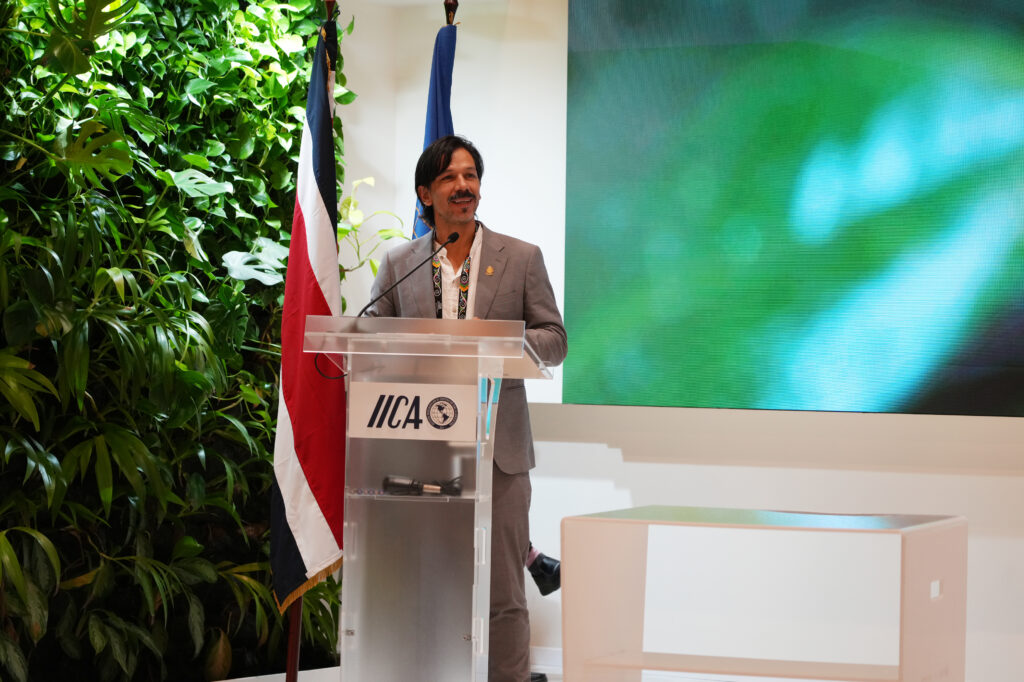
Juan Gabriel Ramírez Guillén, Minister of Agriculture and Livestock of Costa Rica.
A strategy with a clear focus
As part of the event, PROCOMER Agribusiness Director Esteban Schroeder presented the AgriFoodTech Hub Strategy, aimed at positioning Costa Rica as the leading agri-food innovation hub in the Americas through the consolidation of a collaborative ecosystem that connects universities, companies, startups, and public institutions.
The initiative provides a platform for developing, validating, and scaling sustainable, resilient, and high value-added technologies while fostering investment attraction, the creation of quality jobs, and the transformation of the agri-food system.
In addition to presenting the strategy, PROCOMER Special Projects Manager Diana Castillo announced the launch of the second edition of the AgriFoodTech Acceleration Program for Costa Rica, designed to support early-stage ventures in advancing their technological maturity, scalability, and internationalization.
Both editions have received technical support from IICA, which has facilitated the program’s connection with international cooperation networks, strategic stakeholders, and innovation ecosystems across the region as a means of promoting the exchange of experiences, knowledge transfer, and the creation of opportunities that contribute to the scaling and internationalization of participating ventures.
The Acceleration Program will be implemented through a structured process that combines technical support, specialized training in business models, access to financing, and the strengthening of entrepreneurial capabilities, thereby contributing to the dynamism and competitiveness of Costa Rica’s agri-food ecosystem.
Financing mechanisms for dynamic agribusinesses
Celestina Brenes, an IICA specialist, highlighted the importance of strengthening business management capabilities among agri-food ventures to facilitate access to financing. She noted that, in addition to technological potential, initiatives must advance in structuring internal processes that enable them to meet the requirements of the investment ecosystem.
During the event, participants explained that although the region has ventures supported by innovative technologies and solutions, gaps remain in business management and investment readiness. Among the main challenges identified were the preparation of complete and well-structured data rooms, the definition of strategies for the efficient use of capital, and the strengthening of business models and the economic viability of projects.
Participants agreed that opportunities exist to close these gaps through specialized support mechanisms. In this regard, initiatives such as the Venture Builder model promoted by Ocean Oasis and programs such as TechStartups, developed by Tecnológico de Monterrey, were presented as mechanisms to accelerate the commercial maturity of dynamic businesses, including those linked to the agricultural sector.
International organizations also expressed their interest in contributing to the strengthening of the ecosystem. CAF – Development Bank of Latin America and the Caribbean highlighted the regional coordination potential of the AgriFoodTech Hub Costa Rica, launched during the event.
The panel also provided an opportunity to review international experiences in the development of innovation ecosystems. Examples included CORFO Chile, which has promoted governance schemes involving public institutions, academia, and the private sector, as well as initiatives led by the United States Department of Agriculture to identify priority technological areas and direct innovation efforts toward challenges facing the agricultural sector.
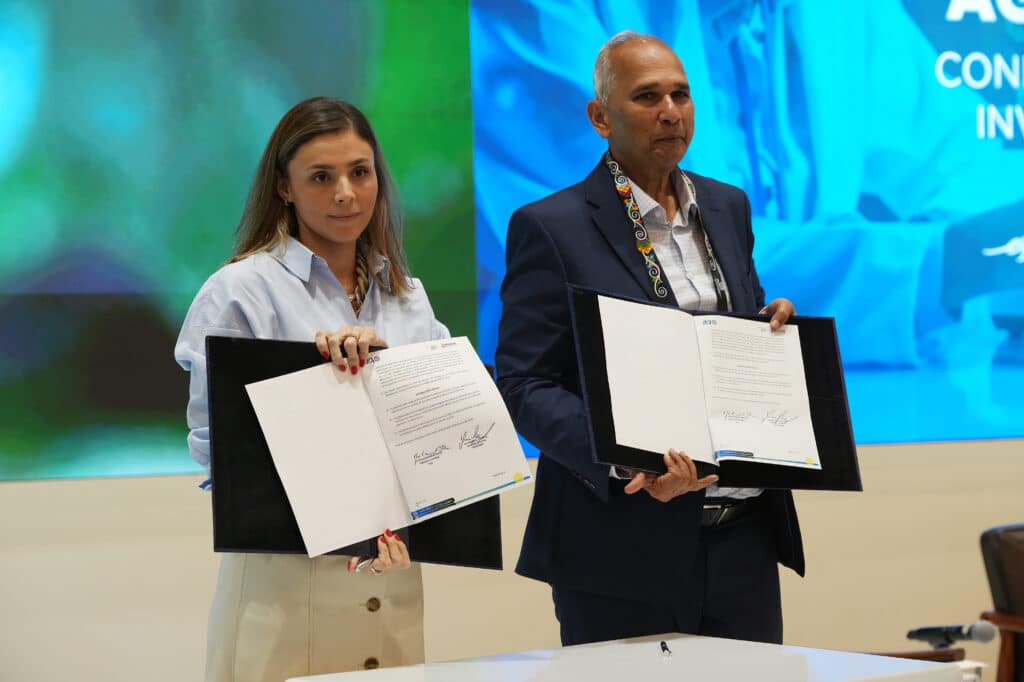
Laura López Salazar, General Manager of PROCOMER, and Muhammad Ibrahim, Director General of IICA.
As part of the event, IICA and PROCOMER signed a Memorandum of Understanding establishing the basis for strengthening cooperation in the development of the AgriFoodTech ecosystem.
The agreement includes lines of action aimed at strengthening the innovation ecosystem, including the development of acceleration and scaling programs for entrepreneurial ventures, the creation of research platforms, and the promotion of enabling conditions for investment in agri-food technologies.
More information:
Institutional Communication Division.
comunicacion.institucional@iica.int