
Montreal, 15 June 2026 (IICA). At a meeting in Montreal, Canada, involving senior government officials, international organizations, representatives of the aeronautical industry, technical experts, and stakeholders in the global energy sector, IICA and the Pan American Liquid Biofuels Coalition (CPBIO) called for greater international harmonization of the sustainability standards used to measure the carbon footprint of biofuels and sustainable aviation fuels, and the adoption of clear economic incentives that promote new investments in the sector.
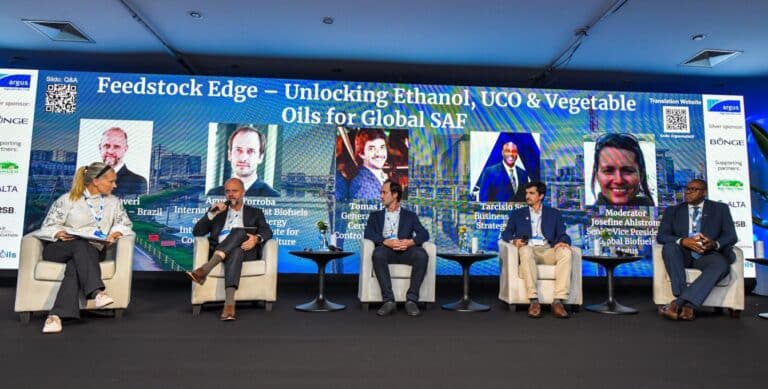
Agustín Torroba, a specialist in biofuels and renewable energies at the Inter-American Institute for Cooperation on Agriculture (IICA) and Executive Secretary of the CPBIO, took part in Climate Week 2026, organized by the International Civil Aviation Organization (ICAO), where participants discussed the main obstacles that continue to limit the global expansion of the sustainable aviation fuel (SAF) industry.
SAFs are viewed as a key alternative way of reducing aviation’s carbon footprint without immediately replacing the existing aeronautical infrastructure. This is a process in which agriculture assumes strategic importance: crops, waste, vegetable oils, fats and other kinds of sustainable biomass can be transformed into raw materials for the production of renewable fuels, generating new opportunities for value added, employment and investment in rural territories.
For the Americas, a region with high agricultural productivity and extensive expertise in liquid biofuels, SAFs represent a concrete opportunity to link energy security, agricultural development, and the decarbonization of international aviation.
“A number of methodologies exist today for assessing the sustainability and carbon emissions of renewable fuels. The lack of mutual recognition between these standards leads to additional costs, duplication of certifications, and unnecessary barriers to trade and investment. We need to move towards frameworks that make it possible to use equivalent, comparable and compatible criteria to measure the elements involved,” Torroba explained.
He also stressed the importance of strengthening the economic signals needed to encourage new investment in the sector.
“The Carbon Offsetting and Reduction Scheme for International Aviation (CORSIA) is a key instrument for the decarbonization of international aviation. However, current pricing trends for carbon offsets are still significantly lower than the abatement costs associated with SAFs. As long as that gap persists, the signals for mobilizing investment will continue to be insufficient,” he said.
The discussions also highlighted the role that agriculture in the Americas can play in the energy transition of air transportation.
According to data presented during the event, the region produces approximately 87% of the various types of alcohol used for biofuels worldwide, and accounts for a significant slice of global sustainable vegetable oil production, two of the main technological platforms currently used to produce SAFs.
“The decarbonization of aviation will not depend solely on new technologies. It will also require coherent regulatory frameworks, adequate economic signals, and greater recognition of the strategic role that sustainable agriculture in the Americas can play in the global energy transition,” Torroba concluded.
IICA and the CPBIO’s participation in the ICAO’s Climate Week is part of the efforts to strengthen the presence of the countries of the Americas in the main international discussion forums that focus on sustainable fuels, the decarbonization of transportation, and the energy transition.
More information:
Institutional Communication Division.
comunicacion.institucional@iica.int