
The young Bolivian woman will be honored with the “Soul of Rurality” award, which recognizes rural leaders essential to sustainability and food security in the Americas.
El Alto, Bolivia, August 28, 2025 (IICA) – At just 26 years of age, Abigail Mamani Mamani already has an impressive track record as an advocate for rediscovering one’s roots, community work and respect for the land. From the city of El Alto, Bolivia, Abigal is in constant dialogue with the rural community of Ancoraimes, Macamaca, the birthplace of her parents, while also overseeing a lifelong mission that fuses spirituality, traditional agriculture and new approaches to development.
Given her commitment to this work, the Inter-American Institute for Cooperation on Agriculture (IICA) has recognized Abby—as she is known to everyone—as a Leader of Rurality of the Americas. The young Bolivian will be awarded the “Soul of Rurality” award, which is part of an IICA project to turn the spotlight on men and women who are leaving their mark and making a difference in rural areas, representing key figures for food and nutritional security and sustainability in the hemisphere.
Abby was born in El Alto but raised between two worlds: urban life, with her studies and responsibilities, and the rural world, where she returned at every opportunity to sow potatoes, herd llamas and to keep her inherited customs alive. This existence between two realities shaped her identity and her vision of the future.
Abigail, a daughter of potato farmers, demonstrated notable leadership potential from an early age. In high school, she was president of her class for seven consecutive years and she founded a student association for her school’s student center. In the labor association—Central Obrera Regional (COR-EL Alto)—she served as the first Secretary of Education and Culture for more than seven years, most notably promoting the Decade of Family Farming in Bolivia in 2019.
She also played an active leadership role in her region for six years, working closely with the community to spur projects such as the construction of solar-powered tents.
“No matter how long I live in the city, my Aymara roots are still alive in me”, she states. “There is something that is transmitted that transcends the visible realm: the connection to the land, to Pachamama, and to the knowledge of our ancestors”.
For this sociologist, the connection to the countryside and the land is not just a practical one: it is also spiritual and cultural. “I have Aymara ancestry—she emphasizes—and although I live in the city, my roots remain intact. Thanking the Earth, requesting permission before planting, understanding that energy also resides in our foods: all of that is part of our cosmic world view, our existence in the world”.
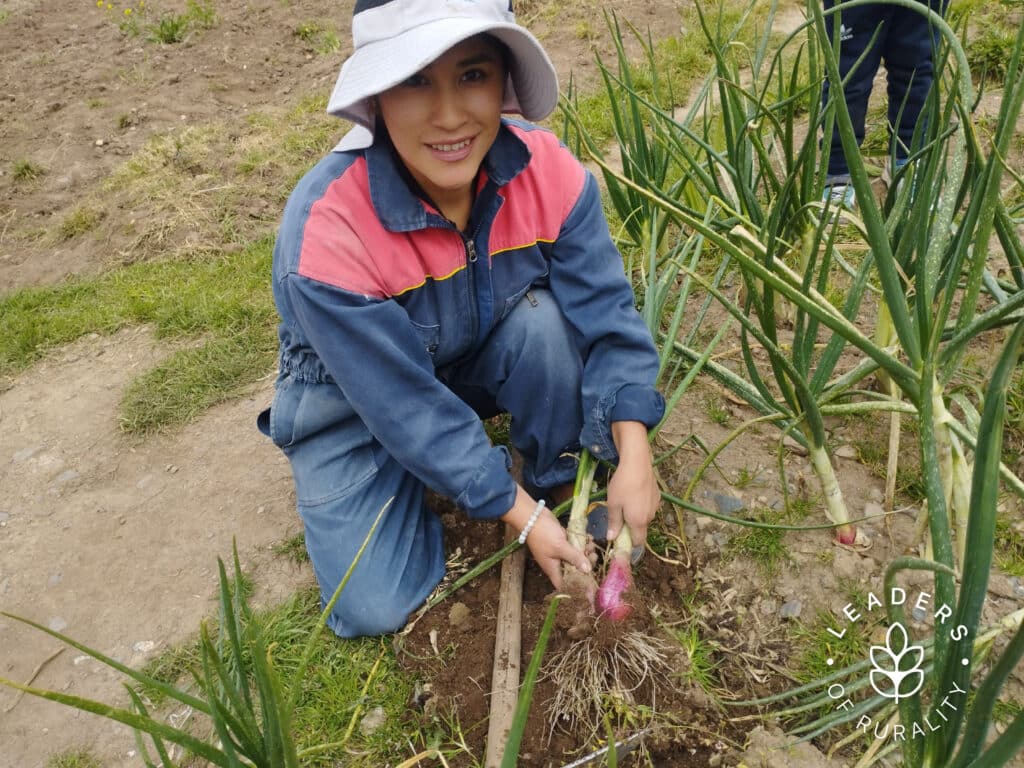
The young Bolivian woman will be honored with the “Soul of Rurality” award, which recognizes rural leaders essential to sustainability and food security in the Americas.
Nature as a system that connects all living things
Abby recalls that in university she attended a philosophy workshop that deepened her view of the earth, modernity and indigenous spirituality. It made her realize that “our relationship to Pachamama is not simply a custom, but a complete knowledge system that connects us to all living things”.
City life has not prevented her from maintaining her rural practices, particularly on her sojourns back home, where she plants vegetables with her parents, using traditional methods without agrochemicals and reclaiming ancestral ways of planting. “We do it for personal consumption, but at times we also share our crops with friends”.
These activities are complemented with a broader vision of taking the countryside to the city. “Here in El Alto, there are urban gardening initiatives in public squares. I want to replicate it in my community. Modern life should not distance us from our roots but should help us to reconnect to them”, says Abby.
In her hometown, this reconnection faces some challenges, in particular, given the increased extraction of minerals. Mamani Mamani complains that, “Before, we had trees, sheep and water. Today, we have furnaces, dust and barren land. Artisanal mining requires firewood, and this caused progressive deforestation”.
She also explains that “young people have no desire to farm anymore. They prefer quick money, even if it means abandoning our customs”.
In view of this reality, Abby feels the urgent need to combine both worlds: ancestral knowledge and today’s technical tools. “We cannot reject technology—she acknowledges—instead we must adapt it”. For example, she points out that she “was able to observe the use of drones to plant or monitor crops or electric cars built by young people in El Alto. There is no lack of creativity, only of support”.
She also considers that education and knowledge sharing are key to structural change. “Some knowledge cannot be found in books”, stresses Abby. “Every time that I go out to the community, I hear something new from the elders” and “my job is to take this knowledge to other forums: universities, associations, to the neighbourhood”.
Mamani Mamani stresses that this knowledge “could help us to tackle the environmental crisis that we are experiencing”.
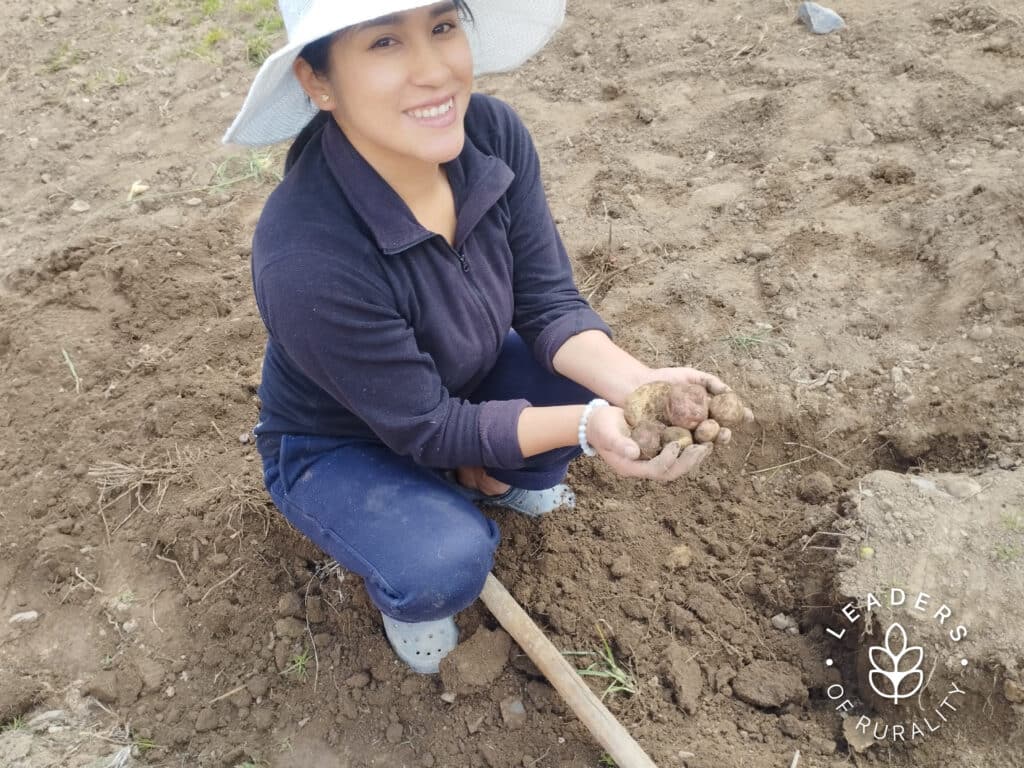
Abby, a young Bolivian woman awarded by IICA, reflects on indigenous spirituality and connection to the land: “Our relationship with Pachamama is not just a custom; it is a complete system of knowledge that connects us to all living things.”
A “great lesson” to share
Recalling other challenges, Abby says that the abandonment of rural areas is not irreversible. “When the pandemic hit, many people returned to the countryside and discovered that they could produce there, live better and breathe”. In general, other than the change in thinking brought on by the Coronavirus, “we have an underlying need to return to the land, and this could become an opportunity if we combine it with public policies and collective awareness”.
Gender equality is another of her spheres of action. In her university thesis, she explored the impact of this issue in rural areas and noted that the reproduction of traditional roles can cause rural women to be overlooked. “At times, even the women themselves feel that they are incapable of leading”, stressed Abby, “and that is why it is so important to empower them when they are young, from when they are in school”.
For this young Bolivian professional, the countryside is not just a place for production, but also a worthwhile space, that connects us to what is essential. “Money is not everything. Working on the land with love, thanking it and understanding it will restore our health, meaning and balance”.
“That is the major lesson that I wish to share”, she tells us.
Looking to the future, she hopes to multiply these experiences, forging networks between urban and rural communities and developing sustainable alternatives that are environmentally friendly. “I want to continue fighting to ensure that youth do not lose their connection to Pachamama, because if we forget her, we may also lose our very selves”, Abby says in closing.
More information:
Institutional Communication Division.
comunicacion.institucional@iica.int