
Brasilia, November 6, 2025 (IICA) – A group of thirty ministers, deputy ministers, and high-ranking officials of agriculture across the Americas came together to deliver a joint message: the continent’s agriculture must build a new narrative that reflects its ability to feed the world sustainably and its role as an essential part of the solution to the challenges facing humanity.
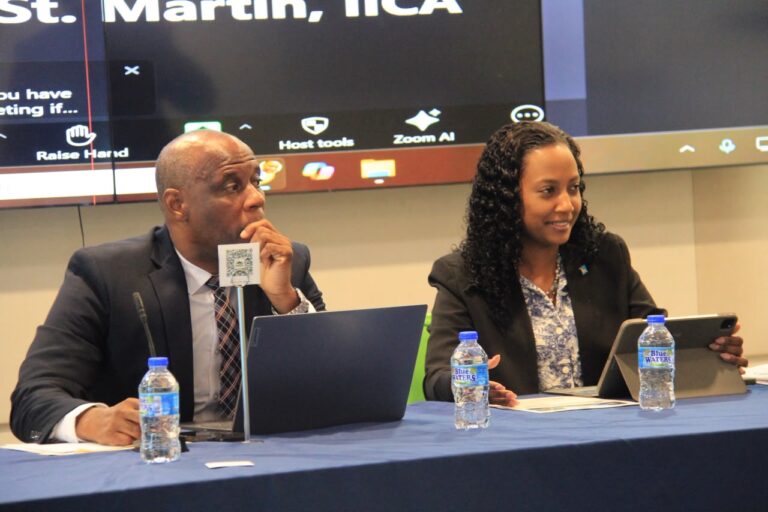
Under the slogan “A new narrative for agriculture and food systems in the Americas”, delegations from countries across the continent gathered in Brasilia for the 2025 Meeting of the Ministers of Agriculture of the Americas.
The event, which takes place every two years, was organized by the Brazilian government in collaboration with the Inter-American Institute for Cooperation on Agriculture (IICA), and included numerous technical sessions focusing on the role of science, technology and innovation in food security and productive transformations.
Ministers and officials exchanged experiences and engaged in discussions with experts and producers with the mission of building a shared vision of productivity and resilience in agricultural production and the status of rural communities.
The technical forums covered key themes in IICA’s strategic technical cooperation agenda, including bioeconomy, agricultural digitalization, livestock health and the need for a new generation of public policies for the sector, developed with private sector participation.
The new narrative, as explained by IICA Director General Manuel Otero, stands in contrast to the view of agriculture as an extractive industry with negative environmental impacts. It aims, instead, to showcase the true face of agriculture, which, in the case of countries in the Americas, is an integral part of their development strategies.
Different agricultural systems
Today, 80% of the continent’s population lives in cities, and most people are susceptible to alarmist messages that associate agriculture with pollution, greenhouse gas emissions and environmental degradation, explained Walter Boethgen, agronomist and professor at Columbia University.
“The reality”, he added, “is that there are good and bad agricultural systems. We need to differentiate them and find ways to promote the good ones and eliminate the bad ones. There isn’t just one system of production. There are many, very different ones, and many are very good”.
Roberto Rodrigues, Special Envoy for the Agricultural Sector at COP 30, which will take place this month in Belém do Pará, spoke about “the four modern horsemen of the apocalypse”, referring to the main challenges facing humanity today: food security, the energy transition, climate change and social inequality.
“These challenges must be confronted”, he said, “and one of the main solutions lies in agriculture. Without food, peace is lost, and democracy erodes. A country with hunger cannot have stability”, Rodrigues emphasized, also stressing the importance of education. “Sadly”, he said, “many people think chickens are born in the supermarket”.
Chile’s Minister of Agriculture, Ignacia Fernández, also addressed the issue of the lack of proper information about the true nature of agriculture and the recent advances made in the region regarding environmental protection.
“The predominant view ignores the quiet transformation happening in all rural areas”, she said.
Sergio Iraeta, Argentina’s Secretary of Agriculture, Livestock and Fisheries, explained the importance of recognizing something that may seem obvious but is often forgotten: with no agriculture nor farmers, there is no food.
In this regard, Guatemala’s Minister of Agriculture, Livestock and Food, María Fernanda Rivera Dávila, urged moving “from narrative to action, and the way to do this is with coherent and evidence-based policies. We must also combine ancestral and local knowledge with state-of-the-art technology to increase resilience”.
Other technical forums highlighted the need for joint efforts to face productivity challenges.
Pedro Martel, Director of Agriculture at the Inter-American Development Bank (IDB), revealed that over the past 60 years, Latin American production has grown at an average annual rate of 2.9%, and the region has multiplied its production six times. A large part of this growth comes from improvements in productivity. “But when we break down the data by period, we see that growth has slowed down since 2010. A huge opportunity to change this reality is to promote technical efficiency through new technologies”, he said.
Another key point in the technical forums was a presentation by Silvia Massruhá, President of the Brazilian Agricultural Research Corporation (EMBRAPA).
Massruhá shared details on how Brazil, which was a food importer in the 1970s, became a food powerhouse in just a few decades.
“We invested in research and science; we expanded our productivity and, to a lesser extent, the area planted. Brazil is now one of the countries that most uses biological-based products, no-till farming and integrated production systems. We work on sustainable production with science, technology, training and entrepreneurship. But the key factor is public policy. This experience is what we are ready to share with other countries,” she announced.
More information:
Institutional Communication Division.
comunicacion.institucional@iica.int