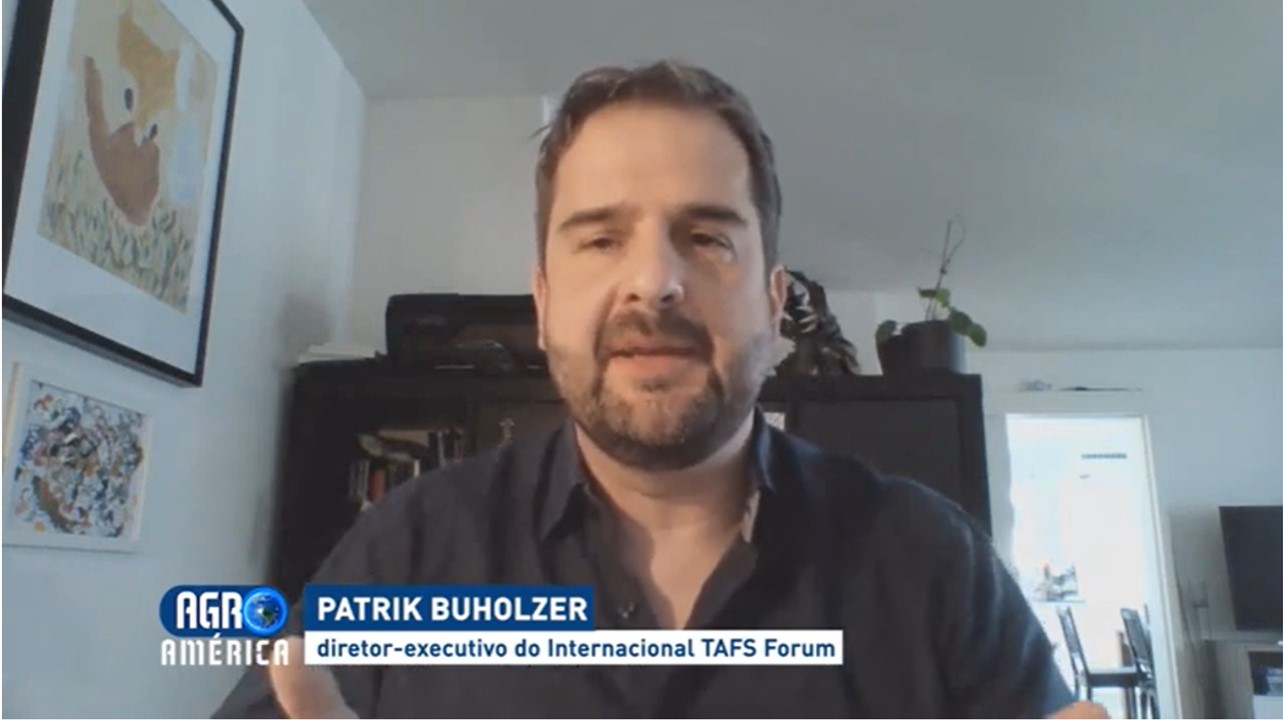
During an interview on the Agro America program, aired on Brazil’s TV Agro channel, Patrick Buholzer, Executive Director of the TAFS Forum, discussed the need for a new approach to the viral disease. He also called for a shared global understanding of the problem.
Brasilia, 11 July 2023 (IICA) – According equal status to countries whose livestock industry is free of foot and mouth disease, whether with or without vaccination, is urgently needed to bolster food security, provide greater stability to agricultural producers and to enhance animal welfare. Thus, the entire society stands to benefit.
This was the view expressed by Patrick Buholzer, Executive Director of the TAFS Forum, an international organization headquartered in Switzerland, which is involved in the research of transmissible animal diseases and their relationship to food security.
“Distinguishing between countries that are foot and mouth disease-free with or without vaccination made sense in the past. It is now time to recognize that the two statuses are equivalent, given the high quality of vaccines today, which, in combination with the very sophisticated and precise diagnostic methods developed in recent years, provide an excellent tool to contain the disease”, said Buholzer during an interview on the AgroAmerica program, aired on Brazil’s TV Agro Mais channel. He expounded on the need to adopt a new approach to the viral disease and called for a greater shared global understanding of the problem.
He stated that from the point of view of security and access to international meat markets, countries must prove that they are free of foot and mouth disease and that they have implemented a consistent surveillance system. However, whether this is with or without vaccination should be a secondary consideration.
The expert stressed that many South American countries have an excellent track record of quality and security in their livestock production, having achieved foot and mouth disease-free status with vaccination. “A case in point is Uruguay, whose products are exported to multiple international markets and are far from being considered risky but are recognized for their safety”.
Buholzer pointed out that recognizing the equivalence of both scenarios is advisable from a scientific and commercial point of view. “Although trade today places no restrictions on countries that vaccinate, it would ensure greater security if they were considered equal. It would also provide greater stability and predictability for livestock producers”, he stressed.
Buholzer emphasized that given the differences established today, incorrect incentives are applied, encouraging many countries to push for foot and mouth disease-free status without vaccination, often too hurriedly, which has potential risks. “The decision to end vaccination should be based on risk assessment, considering the local and regional epidemiological situation. It is risky to eliminate vaccination without a careful analysis, seeking to increase opportunities by accessing new markets”.
He also emphasized that this step would mean that there would be less culling of healthy animals, as there would be fewer foot and mouth disease outbreaks. “Slaughtering healthy animals is no longer acceptable for societies and we have proven this on various occasions”, he said.
Seminars in Asia
During the interview Buholzer spoke about a historic international seminar that was held recently in Seoul, South Korea, where important stakeholders were discussing the topic. The event captured the interest of various Asian countries, where consumption of animal protein is on the rise. Asia is the main purchaser of South American meat and sales are estimated to continue growing in the coming years.
“We had an excellent discussion in Seoul and the participants demonstrated tremendous commitment. Representatives from international organizations, the industrial sector and from vaccine and other animal health-related companies attended. It was a very open discussion”, he said, while indicating that TAFS plans to host two addition seminars in Thailand and Taiwan in the coming weeks.
Buholzer reported that the Asian countries outlined their position in terms of foot and mouth disease, which is quite different from in the Americas. “In Asia, the disease is still present in many countries. South Korea itself had an outbreak just a short time ago, which happily it was able to contain quickly. In contrast, most countries in South America have been foot and mouth disease-free with vaccination for many years. There have been no outbreaks in most South American countries for several years”.
He closed by saying that, “Vaccination is like an insurance policy and placing with or without vaccination status on the same footing would be beneficial to all. We keep repeating this and we are seeing the positive results. People understand that this is necessary from a scientific point of view and also to guarantee food security, at a time when the climate crisis is creating severe challenges for agrifood production”.
AgroAmérica is a program broadcast by the Brazilian TV channel AgroMais, owned by the Bandeirantes Communication Group and produced in partnership with the Inter-American Institute for Cooperation on Agriculture (IICA).
The show covers current affairs in the agriculture and rural sector to promote the sharing of experiences and a discussion on challenges and opportunities in Latin America and the Caribbean.
More information:
Institutional Communication Division.
comunicacion.institucional@iica.int