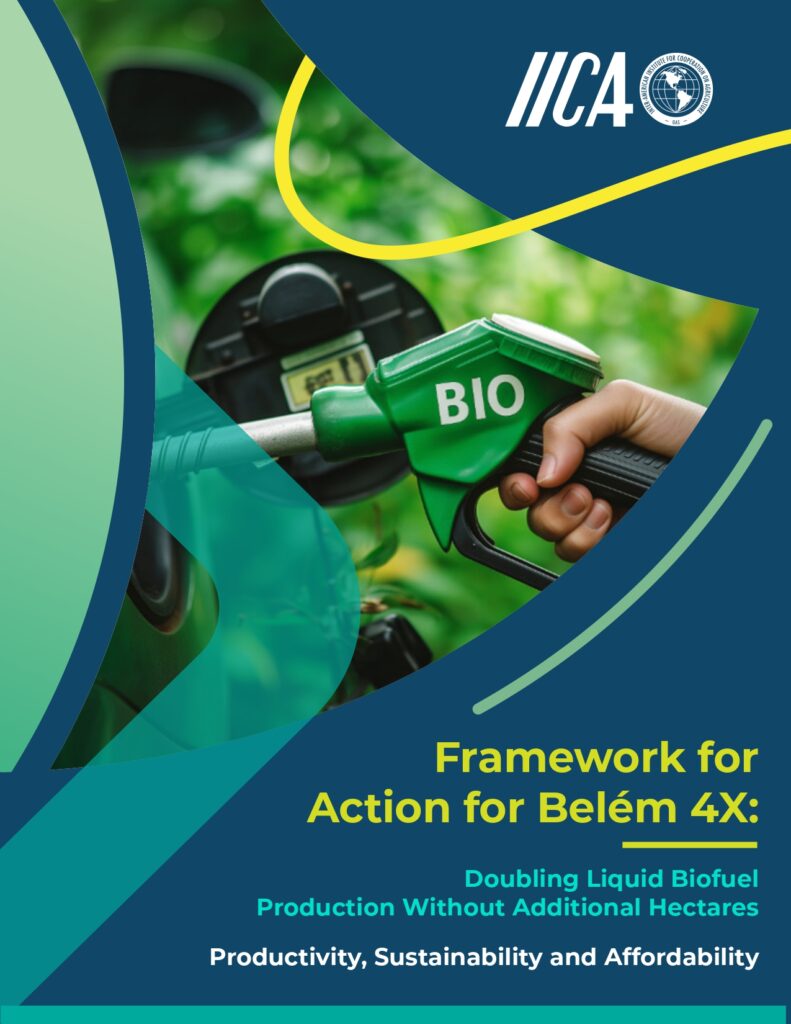
Belém do Pará, Brazil, 18 November 2025 (IICA). At COP30 in Belém do Pará, the Inter-American Institute for Cooperation on Agriculture (IICA) and the Pan-American Liquid Biofuels Coalition (CPBIO) proposed a framework for action to meet the global objective of at least quadrupling the production and use of sustainable fuels by 2035.
The goal announced by the President of COP30¾which includes doubling liquid biofuel consumptionby 2035¾is set out in the “Belém Commitment for Sustainable Fuels”, or “Belém 4x”.
The framework for action designed to achieve Belém 4x was summarized in a policy brief prepared by IICA and the CPBIO based on the International Energy Agency (IEA) report entitled “Delivering Sustainable Fuels – Pathways to 2035” and the IICA report “Closing gaps in agricultural yields: a key sustainable alternative in the supply of liquid biofuels. Agriculture as an environmental resource”.
The Pan-American Liquid Biofuels Coalition (CPBIO) is comprised of the leading business and industrial associations in the Americas engaged in the production and processing of sugar, alcohol, maize, sorghum, soybeans, vegetable oil and grains,among other agricultural products. Created in 2023, IICA is in charge of its Technical Secretariat.
According to the IICA-CPBIO study, liquid biofuel production could be doubled without expanding the agricultural frontier by closing the gap in productivity of the six main crops currently used in liquid biofuel production (maize, sugarcane, wheat, soybeans, rapeseed and palm oil). This would make it possible not only to produce the amount of liquid biofuels proposed in the Belém 4x Declaration, but actually produce 72% more.
Sustainable fuels—including liquid biofuels, biogases, low-emission hydrogen and hydrogen-based fuels—offer multiple benefits for the energy sector, complement electrification,and boost efficiency in energy transitions.
Furthermore, sustainable fuels are particularly important for sectors that continue to rely on fuel-based solutions, such as aviation, shipping and some segments of land transport and industry.
Sustainable fuels can also improve energy security, stimulate economic development and strengthen environmental sustainability. Liquid biofuels are the most important for achieving this goal.
Closing gaps in productivity
The findings of the IICA-CPBIO report on how to close the gaps in agricultural yields in the case of the six crops mentioned will make it possible to achieve a significant increase in biofuel production, without the need to expand the agricultural frontier.
This data is especially relevant in light of the history of the expansion of liquid biofuel production, which has increased steadily and effectively through the use of abundant, low-cost agricultural crops, whose production processes are carried out using mature commercial technologies.
It is recommended that public policies and international regulatory frameworks prioritize strategies focused on productivity, sustainability, and the harmonization of standards. Closing agricultural gaps is not only more feasible and cost-effective, but also a concrete way to achieve climate goals by strengthening food production without putting pressure on ecosystems.
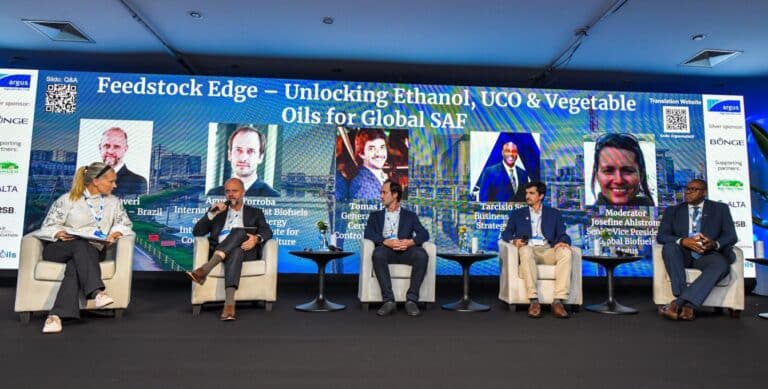
“Biofuels are the fastest way we have of decarbonizing transportation; they are an immediate solution. According to preliminary data from IICA, biofuel production in the Americas is reducing emissions by 185 million tons of CO2 equivalent per year. This is in addition to energy diversification and the production of byproducts. In short, biofuels in the region are a source of food, environmental and energy security. To double production by 2035, as explained in Belém 4x, we must be very practical: closing the gaps in productivity of the main agricultural value chainswill give us all the raw materials we need to produce more sustainable biofuels, abundantly and cost-effectively”, said Agustín Torroba, IICA international biofuels specialist and Technical Secretary of the CPBIO.
To respond to the global call to quadruple the production of sustainable fuels and double that of liquid biofuels, it is not necessary to open new agricultural frontiers;countries simply need to close the gaps in yields in abundant, low-cost, sustainable crops such as maize, wheat, sugarcane, soybeans, rapeseed and palm oil. This is the fastest, most scalable and most cost-effective way to achieve both goals.
The policy brief is available in Spanish from the IICA repository via the following link: https://repositorio.iica.int/items/7e19a8a5-7347-4a52-aa97-f70218d8555e
More information:
Institutional Communication Division.
comunicacion.institucional@iica.int