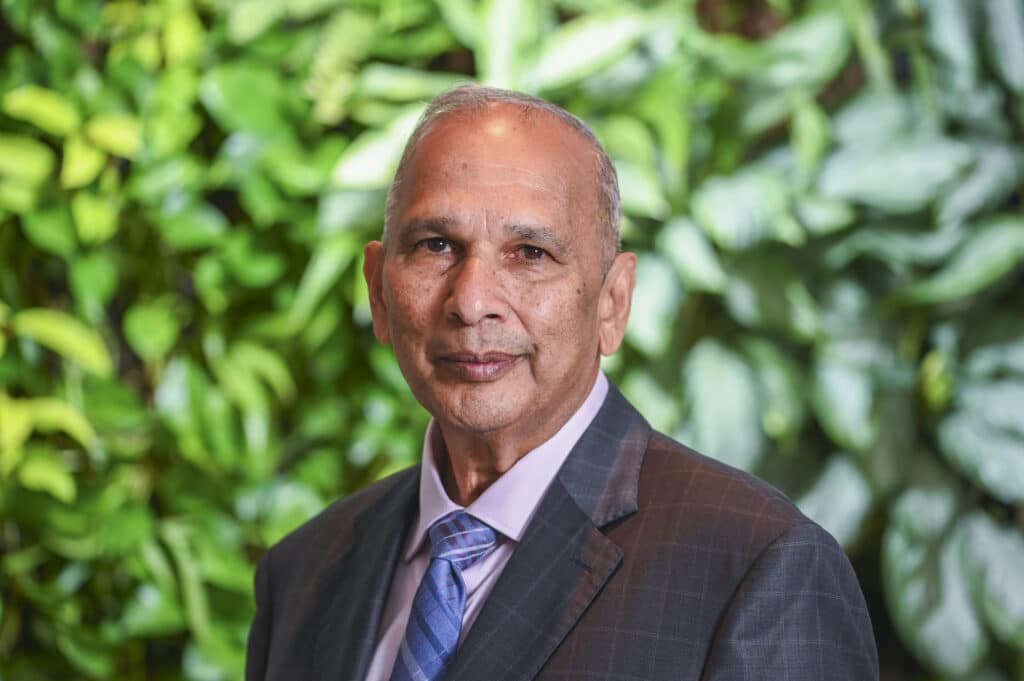

San José, 31 July 2025 (IICA). The Tropical Agricultural Research and Higher Education Center (CATIE), a preeminent academic center specializing in agricultural productivity and sustainability, is to have a chair named after Manuel Otero, the Director General of the Inter-American Institute for Cooperation on Agriculture (IICA), in recognition of his work in support of global food security.
The creation of the Manuel Otero Inter-American Chair on Tropical Agriculture was announced by CATIE’s Director General, Luis Pocasangre, during the opening ceremony of the International Conference on Tropical Agriculture, held in San José, Costa Rica, with the participation of renowned specialists on the subject from around the world.
Otero, a citizen of Argentina and a veterinarian by profession, earned a master’s degree in animal production at CATIE, where he first came into contact with tropical agriculture, before embarking on a career with IICA. “During his administration, he has provided tremendous leadership, contributed to innovation and research in tropical agriculture, and supported the technological modernization of the sector,” Pocasangre noted.
The head of CATIE also pointed out that the academic institution has a long-standing connection with IICA, and expressed appreciation for Otero’s support for its educational work. “On behalf of our staff, we wish to dedicate this chair to Manuel Otero for his extraordinary professional achievements and his contribution to the strengthening of tropical agriculture.”
Much work still to be done
“I arrived at CATIE in 1976. As an Argentine, I was a typical representative of temperate agriculture. A few hours later, I had to take an organic chemistry level test. Feeling tired and nervous, I saw a toucan through the window. I realized that I was in the tropics, and that I was going to have a great experience, although I never thought I would live and achieve so many things,” Otero recalled.
The IICA Director General thanked CATIE for the acknowledgement, commended the support that the hemispheric organization’s staff provides, and spoke of the importance of his family. “I gratefully accept the responsibility, mindful of the fact that many tasks still lie ahead. I will do my best to honor this recognition, which will stay with me the rest of my life,” he said.
Following the announcement, Otero gave a presentation entitled “A New Tropical Agriculture Narrative for Food and Nutrition Security and the Health of the Planet” to the scientists, researchers, representatives of international organizations, ministry of agriculture officials, and representatives of the private sector taking part in the conference.
Otero emphasized that tropical agriculture was indispensable; it accounts for 40% of global agricultural trade, hosts the planet’s greatest agricultural biodiversity, and provides livelihoods for billions of people.
In Latin America and the Caribbean, it accounts for 6% of total production in the tropical countries, 14% of employment, and 14% of exports. “More than half of the continent’s farmers live in tropical areas,” he observed.
However, he also noted that its potential in terms of productivity, biodiversity conservation, biomass contribution, and poverty eradication has not yet been realized, except in the case of Brazil, which in recent decades has undergone a revolution that has transformed it into a global agricultural power.
“The knowhow needed to unleash the potential of tropical agriculture must be produced in the tropics. Adapting models from temperate agriculture is useful, but insufficient. We must strengthen national research centers of excellence, aligned at the regional and global levels, as a matter of urgency. Investment in research and development in tropical areas is still low,” Otero pointed out. He then spoke about ways of transforming tropical commodities into products with identity and value added.
In this regard, he drew attention to the need to create new leadership structures to ensure that the subsector has its own spokespersons, and to empower scientists, rural youth, women, and community leaders, and promote the emergence of a specific kind of diplomacy to represent tropical agriculture with a powerful voice in major international forums.
“We possess natural wealth that has not been transformed into productivity and need rural areas to be more dynamic. We are convinced that the future of global food security depends on the tropics, but to build a new reality, we need a new narrative. We need a communications strategy targeted at our citizens and consumers. And must bear in mind that there can be no transformation without science relevant to the tropics. We must also be clear that while innovation is disruptive by nature, it also has to be inclusive, and that it is important to produce more, but also to conserve.”
More information:
Institutional Communication Division.
comunicacion.institucional@iica.int