Efforts are being made to strengthen the capacity of CARIFORUM countries to respond rapidly to food safety events through an action that aims to improve the traceability of food and the recall of food and food products.
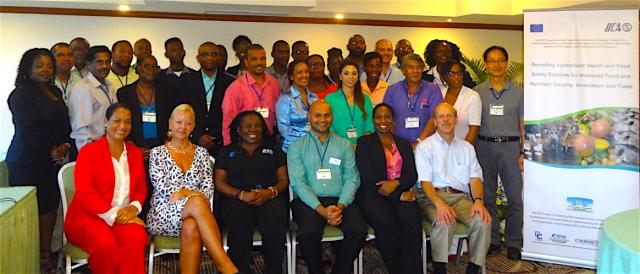
(Bridgetown, Barbados, 27 July, 2016) – A Traceability and Food Recall Project for the CARIFORUM Region is being funded by the European Union’s 10th EDF Sanitary and Phytosanitary Measures (SPS) Project for CARIFORUM States, which is being executed by the Inter-American Institute for Cooperation on Agriculture (IICA).
Under the 10th EDF SPS Project, the Institute of Food Technologists – Global Food Traceability Center (IFT-GFT) has been contracted to train public and private sector professionals from around the Region, on the principles and practice of traceability. At the end of the action, it is expected that countries would have improved their capacity develop traceability systems that allow operations to respond rapidly to food safety events. Twenty five public and private sector professionals from twelve countries from the CARIFORUM Region were trained at a Workshop held at Accra Beach Hotel and Spa, 26-27 July in Barbados. Over the next four months, additional national trainings will be conducted in eight countries for private sector stakeholders.
Mrs Ena Harvey, Head of the Barbados Delegation of IICA, remarked that “in addition to facilitating intra-regional and international trade and inspiring consumer confidence from within the Region and to international buyers, well-designed traceability systems ensure effective preparedness, prevention and response time in situations concerning food safety emergencies”.
Ms Katja Svensson, Programme Manager for the Regional Trade Integration Unit of the EU Delegation to Eastern Caribbean States, stressed that “comprehensive traceability systems, which enable buyers and consumers to efficiently track the origin of and ingredients contained in food and food products along the entire supply chain, are integral for the Region as it seeks to enhance trade opportunities both in the region and abroad”. She also reiterated the EU’s commitment to ensuring that food and food products from the Region comply satisfactorily with international SPS requirements, which are compulsory in order to engage in international trade.
At the Workshop, the results of a traceability and recall pilot study, which was a collaborative effort between the Food and Agriculture Organization (FAO) of the United Nations and IICA, were presented by Mr Juan Pablo Vial, the consultant on the study. Mr Vial discussed the achievements, constraints and lessons learnt from the pilot studies on traceability systems for products within fresh produce, poultry, fisheries, condiments and spices value chains in Dominica, Antigua and Barbuda, Barbados and Grenada. The results of these studies, as well as the Guidance Document developed from this action will now serve as an important model for other countries within the Region to implement traceability systems.
Mr Benjamin Choo, Owner of Choo’s Enterprises located in Barbados, also presented a case study of his experience in implementing a traceability system for spices manufactured by his operation. Mr Choo indicated that based on his experiences working on the pilot study, his operation has made significant changes to food product record keeping and retrieval methods. Mr Choo also highlighted the importance of implementing and integrating an appropriate accounting system and information technology software and tools to automate tracking and record keeping processes.
Permanent Secretary of the Ministry of Agriculture, Food, Fisheries and Water Resource Management, Mr Esworth Reid, thanked the EU, IICA and the FAO for their work in enhancing the participants’ awareness of the principles of food borne diseases and the importance of traceability systems, saying that “a strong food safety system, which should include a modern Foodborne Illness, Surveillance, Response, and Data System, is integral to safeguarding the food security of the Region”.
Through this and other workshops, the SPS Project aims to build a cadre of professionals that are skilled in addressing critical food safety matters impacting human health, trade and the environment.
For additional information, please contact Dr Janet Lawrence, SPS Project Manager at janet.lawrence@iica.int