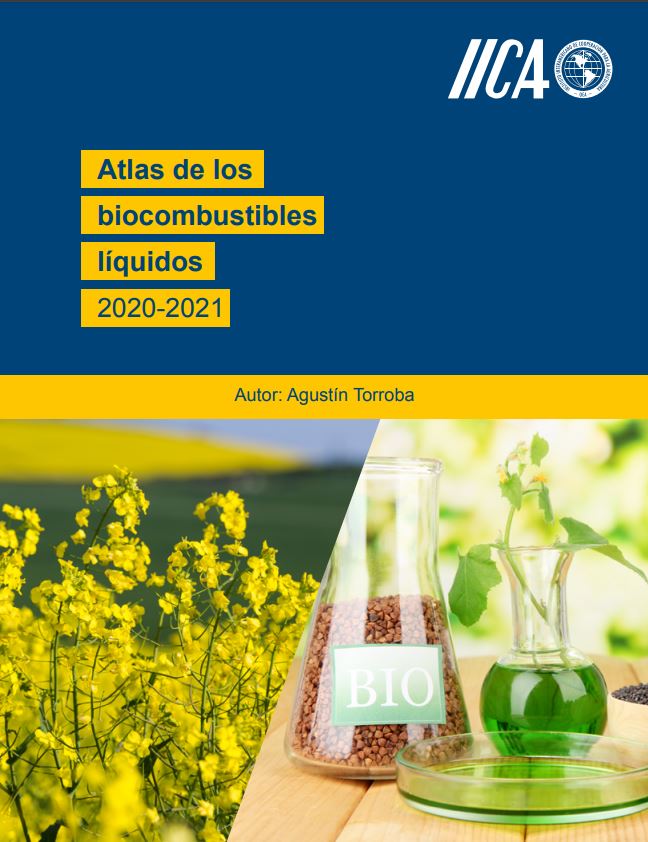
IICA has published the “Atlas de los biocombustibles líquidos 2020-2021,” an accurate, reliable and detailed information tool on the main biofuel variables.
San Jose, 16 September 2021 (IICA). Liquid biofuels have become an important tool for the decarbonization of land transport, and it is the agricultural sector that provides the basic raw materials for the processing and production of these more environmentally friendly biological fuels.
The production and consumption of liquid biofuels—acknowledged as an option for transitioning toward clean energy—fell significantly in 2020, due to mobility restrictions and the contraction of economic activity.
However, data for the first half of 2021 points to a sharp recovery, bearing in mind that the production and consumption of liquid biofuels increased elevenfold between 2000 and 2019.
According to the Atlas de los biocombustibles líquidos 2020-2021, published recently by the Inter-American Institute for Cooperation on Agriculture (IICA), the raw materials most used to produce biodiesel in 2020 were vegetable oils, with palm (32%), soybean (26%) and rapeseed (15%) oils leading the way.
The remaining 27% was produced utilizing other raw materials, such as used vegetable oils, animal fats and other virgin vegetable oils, including sunflower oil. Maize and sugarcane were the principal raw materials used to produce bioethanol, accounting for 63% and 30% of the total, respectively.
Thus, biodiesel is produced from biological raw materials to replace petroleum diesel, and bioethanol to replace petroleum gasoline.
This year, the easing of the vehicle mobility restrictions introduced in 2020 has stimulated the aggregate consumption of liquid biofuels, with positive effects observed in the European Union, the U.S., Indonesia, India and Argentina.
As a result, various scenarios suggest there will be a five to eight percent increase in global consumption in 2021 compared to 2020.
Increased consumption of biofuels has been driven by the framing of public policies authorizing—and, in many cases, promoting—their use.
One of the most commonly used instruments are compulsory quotas, known as “biofuel use mandates”.
In 2020, 65 countries established mandates with varying degrees of stringency and levels of compliance. Instruments of this kind are also applied in some countries at the state level, depending on the latter’s degree of decentralization.
The Americas play a prominent role in both production and consumption, and in the establishment of biofuel use mandates, especially in the southern and northern regions of the continent.
According to IICA’s international biofuel specialist, Agustín Torroba, the Atlas de los biocombustibles líquidos 2020-2021 is an important tool that provides government specialists and policymakers with accurate, reliable and detailed information on the main biofuel variables. This allows them to stay abreast of the latest global trends, and provides the complete information required to establish regulatory frameworks and design public policies.
Biofuels have also begun to be used in other sectors besides land transport, with aviation a case in point. For example, while biojet fuel (a biofuel that replaces fossil jet fuel) was first used commercially in 2007, its utilization increased significantly in 2020 as a result of new installed capacity. A number of countries even began discussing and implementing biofuel use mandates in this sector.
The governments of Norway and Sweden enacted legislation in support of sustainable aviation biofuels, and France is considering implementing a mandate in the short term. Other European Union (EU) member states, including Germany, the Netherlands and Spain, have also been discussing the issue, while several initiatives of the same kind are underway in the United States, and Brazil has already approved quality specifications.
Today, liquid biofuels continue to gain ground as part of the transition towards cleaner fuels, within the framework of a paradigm of mobility based on internal combustion engines.
New mobility paradigms (electromobility, hydrogen propulsion, etc.) are beginning to be developed whose wide-scale rollout will take time, while biofuels are a more environmentally sustainable alternative to fossil fuels that do not c all for major technical changes. They also make it possible to add value and diversify agricultural production, generating employment and positive economic impacts for rural producers.
The IICA publication Atlas de los biocombustibles líquidos 2020-2021 is available at
https://repositorio.iica.int/bitstream/handle/11324/18661/BVE21097939e.pdf?sequence=1&isAllowed=y
More information:
Agustín Torroba, IICA international biofuel specialist.
agustin.torroba@iica.int