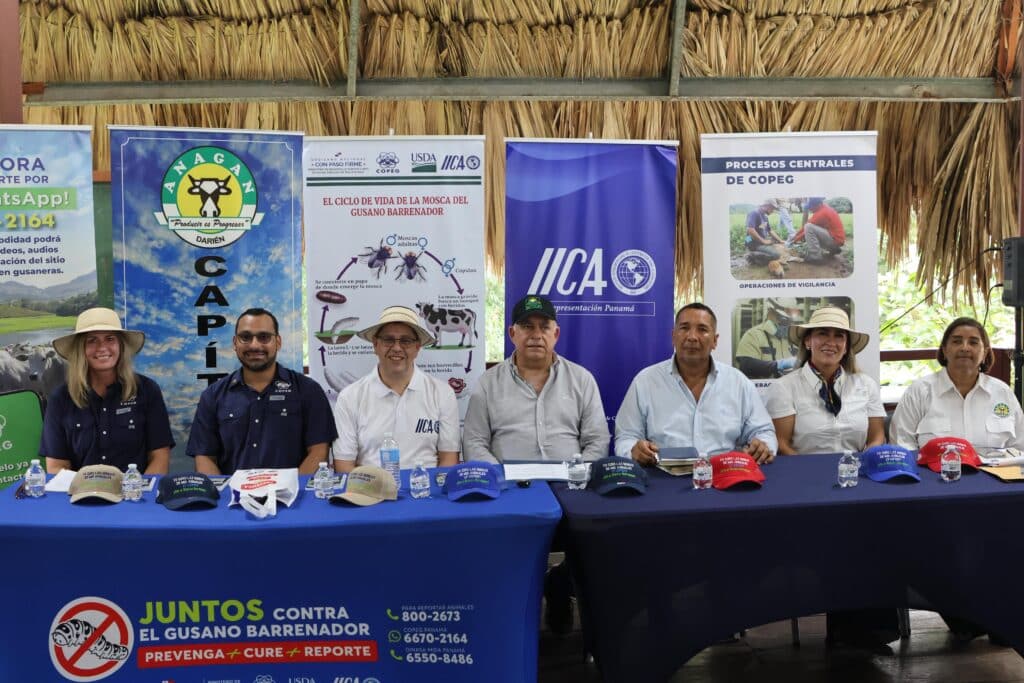
Christina Lohs, Director General of COPEG in the United States; Carlos Moreno, Director General of COPEG in Panama; Miguel Arvelo, IICA Representative in Panama; Roberto Linares, Minister of Agricultural Development; Arnulfo Díaz De León, Governor of the province of Darién; Yamileth Cruz, Mayor of Santa Fé de Darién; and Olga Frías, President of the Darién Chapter of the National Association of Livestock Farmers (ANAGAN).
Santa Fé, Darién, Panama, 4 September 2025 (IICA). As part of the efforts to curb the spread of the New World screwworm (NWS), a current health threat in Central America and Mexico, the Ministry of Agricultural Development (MIDA) of Panama, the Inter-American Institute for Cooperation on Agriculture (IICA) and the Panama-United States Commission for the Eradication and Prevention of Screwworm (COPEG) organized a meeting with livestock farmers in the city of Santa Fé de Darién to strengthen health surveillance and better protect local livestock production.
More than twenty years after it was eradicated, the New World screwworm (NWS), Cochliomyia hominivorax, reappeared in 2023. This transboundary parasitic disease poses significant health risks for animals, humans and ecosystems, with direct repercussions on food safety, the rural economy and community well-being.
In light of this context, Panamanian health authorities, with support from the U.S. government, via its Animal and Plant Health Inspection Service of the Department of Agriculture (APHIS/USDA), and in close collaboration with specialized international agencies such as IICA, have undertaken efforts to prevent the spread of the disease. Informed and active participation by livestock producers will largely determine the success of these actions.
During the session in Santa Fé de Darién, IICA-funded health control and sampling kits were distributed to strengthen local capacities for early pest detection and control. Technical presentations and practical demonstrations described treatments and methods for preventing and controlling NWS, as well as measures for preventing bat bites and veterinary practices for calf disbudding and navel care.
In attendance at the event were national and regional authorities, including Roberto Linares, Minister of Agricultural Development; Arnulfo Díaz De León, Governor of the province of Darién; Miguel Ángel Arvelo, IICA Representative in Panama; Christina Lohs and Carlos Moreno, Directors General of COPEG in the U.S. and Panama, respectively; Yamileth Cruz, Mayor of Santa Fé de Darién; and Olga Frías, President of the Darién Chapter of the National Association of Livestock Farmers (ANAGAN).
Minister Roberto Linares underscored the fact that animal health is a fundamental pillar for the competitiveness and sustainability of the national agriculture sector.
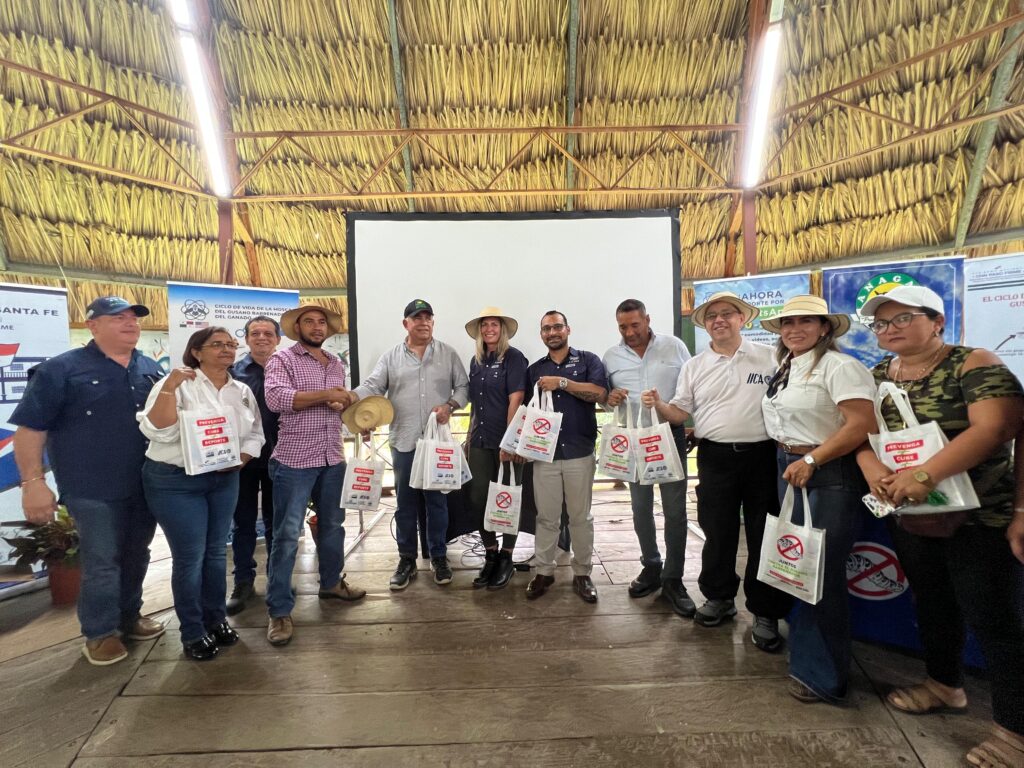
During the session in Santa Fé de Darién, IICA-funded health monitoring and sampling kits were distributed to strengthen local capacities for early pest detection and management.
“We are committed to joining forces with producers in the fight against the New World screwworm, because not only is animal health at stake, but food security and the future of our rural communities as well. MIDA will continue to support producers in Darién, providing them with technical assistance, resources and programs that can strengthen their prevention and response capacities”, he stated.
The head of MIDA also highlighted the fact that Panama plays a key role in containing the disease at the regional level, given its strategic location in the Americas. He also noted that coordinated work between governments, international agencies and producers’ associations is the only way to prevent the spread of the disease to other regions.
Miguel Ángel Arvelo reaffirmed IICA’s commitment to this regional effort. “The Institute maintains an unwavering commitment to working hand-in-hand with MIDA, COPEG and livestock producers to overcome this health threat. Technical cooperation, knowledge sharing and local capacity building are key pillars, because we will only succeed in containing and eradicating the New World screwworm through joint efforts”, he noted.
Through this effort, MIDA, IICA and COPEG are underscoring the importance of active collaboration between institutions and producers, as a key means for guaranteeing animal health, protecting ecosystems and guaranteeing the livelihood of livestock farming families in the face of this transboundary health threat.
More information:
Institutional Communication Division.
comunicacion.institucional@iica.int