During an interview with the program Agro América, broadcast by Brazilian TV channel AgroMais, the Minister of Agriculture, Livestock and Fisheries of Argentina underscored the need to discuss how to provide economic support for the conservation of ecosystems such as the Amazon or the Gran Chaco Americano.
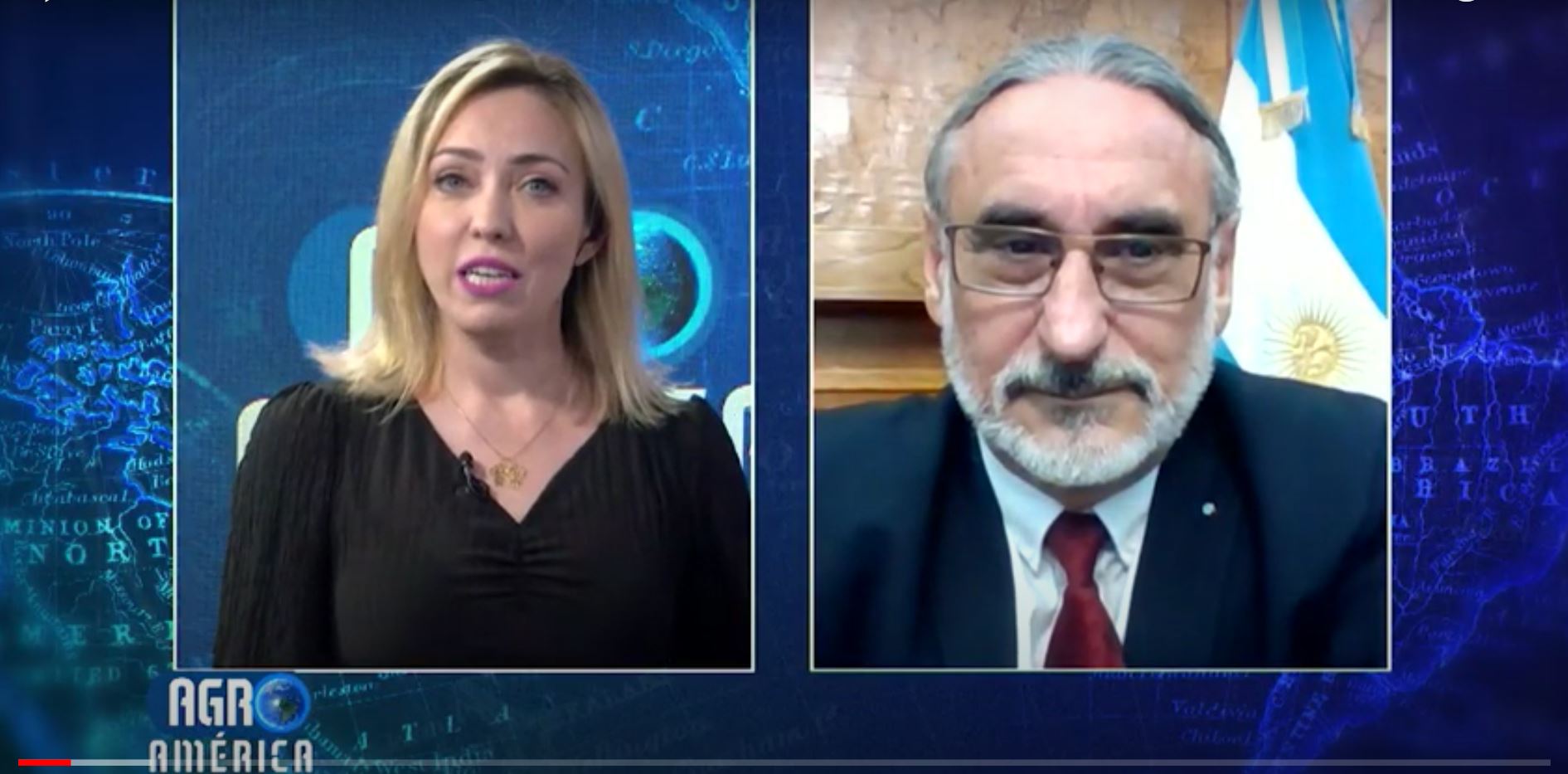
Brasilia, 24 February 2021 (IICA). During an interview with the program Agro América, broadcast by Brazilian TV channel AgroMais, the Minister of Agriculture, Livestock and Fisheries of Argentina, Luis Basterra, stated that “now is the time to determine who is responsible for the economic component of environmental services that benefit the entire planet and whose preservation must not hamper the development of countries that need them the most”.
“To advance towards an equitable world, we must engage in serious, in-depth discussions regarding how to financially support the preservation of ecosystems such as the Amazon or the Gran Chaco Americano”, stated the head of Argentina’s Ministry of Agriculture. He also warned that “if this discussion is left out of the global agenda, we will pay a steep price for the comfort of industrialized countries, in the form of trade barriers to development”.
In this regard, he explained that “producing while taking care of our natural capital is non-negotiable. In this regard, one key aspect that must be addressed involves determining the value and corresponding payment for ecosystem services that benefit humanity as a whole”.
Basterra criticized certain policies of industrialized countries that purchase raw materials from Latin America, stating that “they cannot block our entry into markets on the grounds of environmental aspects, especially considering that their liabilities in this area are massive compared to ours. This way of acting will not lead to an equitable world, but rather a world of restrictions that limit the capacity for development of countries in the region, which end up paying the highest price”.
Basterra also highlighted the importance of working in a coordinated manner. “If we go about things separately, our region’s relative influence will be low”, he explained, urging countries in the hemisphere to work together, adopting a clear and unified stance in international forums in which these issues are discussed.
In this regard, he praised IICA’s role in coordinating joint positions ahead of forums related to environmental sustainability and food security for humanity as a whole.
“Certain responsibilities rest solely on countries that, for two and a half centuries since the Industrial Revolution, have depended on our nations as suppliers of raw materials, have accumulated wealth and continue to be the main emitters of gases that contribute to global warming. Let us not forget that seven of the main gas emitting nations are all in the Northern Hemisphere, and that they are asking us to comply with environmental standards that they themselves have not met for 250 years”, noted Argentina’s Minister of Agriculture.
On the other hand, Basterra highlighted the joint work carried out by the AG-5 Group of the G20 together with the Minister of Agriculture, Livestock and Supply of Brazil, Tereza Cristina, to prevent the imposition of para-tariff barriers with no scientific basis in international trade. He also highlighted the progress achieved by Argentina and Brazil with respect to the wheat supply, joint projects between the National Institute of Agricultural Technology (INTA) of Argentina and the Brazilian Agricultural Research Corporation (EMBRAPA), the support provided by those agencies to family farming, and scientific exchange programs.
Agro América is a program broadcast by Brazilian TV channel Agro Mais of Grupo Bandeirantes de Comunicación. It is produced in partnership with the Inter-American Institute for Cooperation on Agriculture (IICA).
The program presents the current situation of the agriculture and rural sector in IICA member countries, with the aim of fostering the sharing of experiences and a discussion of the challenges and opportunities facing Latin America and the Caribbean in the field of agricultural and rural development.
More information:
Institutional Communication Division of IICA.
comunicacion.institucional@iica.int