IICA presented to IFAD the lessons learned from a technical assistance program that it is carrying out in Haiti, which emerged as a response to the earthquake two years ago.
Rome, February 22, 2012 (IICA). At the invitation of the Director for Latin America and the Caribbean of IFAD, the Inter-American Institute for Cooperation on Agriculture (IICA) presented in Rome the successful experiences of the Support Program for Food Security and Job Creation (PASAC) that was implemented in Haiti, and which focuses on rural areas affected by the earthquake which struck the country in January 2010.
The project, valued at some 3.2 million dollars provided by the International Fund for Agricultural Development (IFAD), is being carried out by IICA jointly with the Haitian Centre for the Promotion of Agriculture and the Protection of the Environment (CEHPAPE), the Haitian Foundation for Integrated Development in Latin America and the Caribbean (FONHDILAC), and 14 irrigation associations within the country, under the supervision of the Ministry of Agriculture.
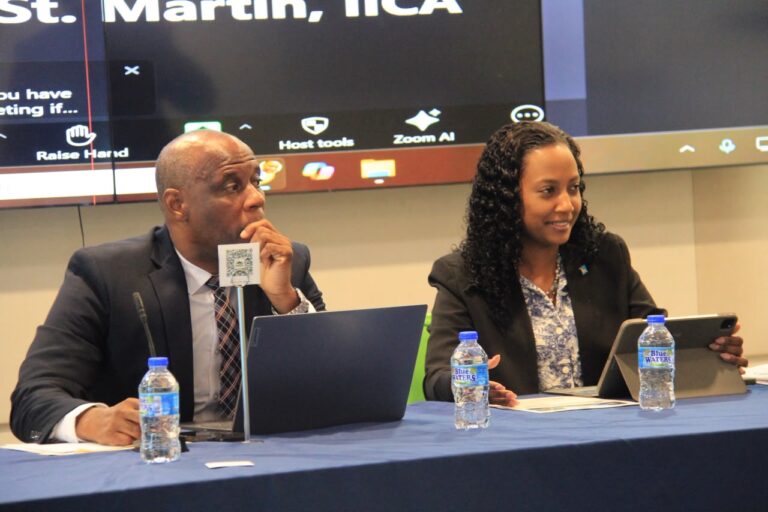
The report was presented before the Governing Council of IFAD, in the presence of Hebert Docteur, Minister of Agriculture of Haiti, Josefina Stubbs, IFAD Director for Latin America and the Caribbean, Marco Camagni, Programme Officer of the Fund with responsibility for Haiti, as well as ambassadors from the member countries of that organization.

IICA Representative in Haiti, Alfredo Mena, and Alan Thermil, project specialist at the Institute, outlined the main aspects of PASAC, including its historical context, its institutional framework, evaluation of results as well as response capacity. The presentation included a video documentary on the implementation of the project.
According to an IFAD press release, Minister Docteur assured the audience that “the results of the project are very stimulating. It is an interesting model because small farmers are involved in decision-making”.
PASAC was implemented with the objective of providing permanent and sustainable benefits to the Haitian people. The impact of the program, which will be finalized on March 31, 2012, can be viewed from two levels: assistance with respect to the emergency caused by the earthquake and subsequently, the thrust for agriculture.
With respect to emergency assistance, the program contributed US$1 million to cleaning and rehabilitation of irrigation infrastructure, repair of broken material and repair of water meters and cultivated lands. The benefits have been quite positive, as this assistance enabled resumption of the school year in 2010, as well as the reactivation of agricultural activities.
In the area of development, the program carried out by IICA has assisted the communities with respect to water management, as well as with the technical and financial administration of their productive activities that are linked to this resource, such as irrigation.
According to Josefina Stubbs, “It is wonderful that a small amount of money has been of assistance to thousands of families in rehabilitating agricultural infrastructure that was destroyed by the earthquake”.
Additionally, sustainable job creation has been strengthened through the repair of roads and irrigation infrastructure, the construction of storage facilities and support for micro-enterprises. These benefits have resulted in an increase in production and improvement in food security for Haitian households.
IFAD is the second major donor to the agricultural sector in Haiti and, since 1978, has invested US$160 million in that country.
For more information, contact:
Mena, Alfredo, alfredo.mena@iica.int
Benchwick, Gregory Paul, g.benchwick@ifad.org
Special: IICA whit Haití